King's Corner: Crossing the Line
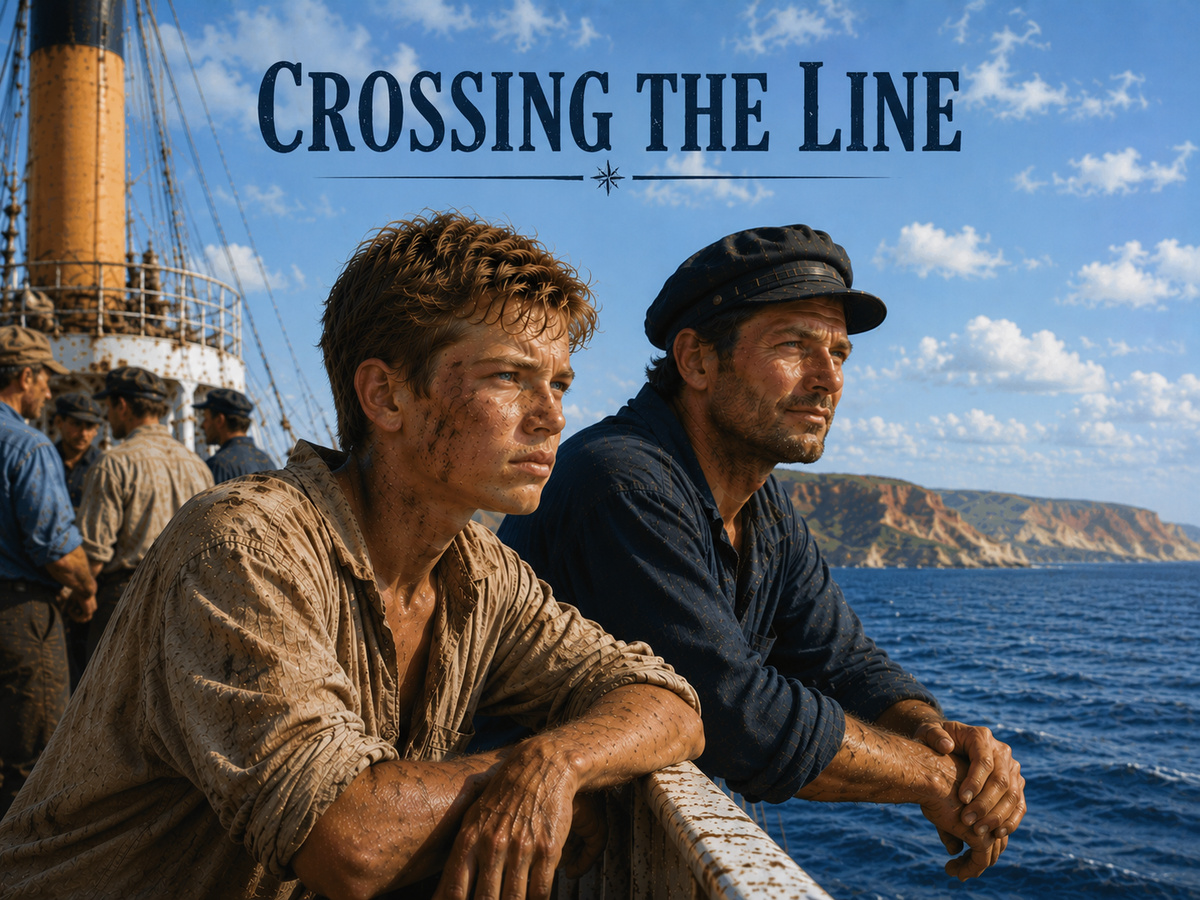
If you've ever found yourself completely out of your depth, you'll understand something of what my father, 13-year-old Robert Mark King, was about to experience. Most of us eventually find ourselves in places we never expected—a diagnosis, a loss, or simply a season where yesterday's confidence no longer seems enough. Looking back, those unfamiliar seasons often become the moments when we discover God has been quietly at work all along.
As Seattle faded into the autumn mist, Mark stood at the stern watching America disappear behind him. Only weeks earlier he had watched the last bend of Wyoming's Wapiti Valley slip from sight through the window of a train, wondering if he had just left behind the place he had spent his young life searching for. Now another horizon stretched before him. Below deck, two prize bulls and twenty head of cattle had been entrusted to his care for the three- to four-week voyage across the Pacific. He had left one season behind and, without realizing it, was sailing toward another.
For a 13-year-old, it felt like the adventure of a lifetime.
The first days were everything he had imagined. The Pacific seemed endless. The mostly Australian crew traded stories from earlier voyages while the Australian captain quietly pressed on without putting into port. Mark had never traveled beyond North America. The world suddenly seemed much bigger than the Wapiti Valley.
The routine below deck soon became the real voyage. Before daylight each morning he climbed down among the cattle. Water. Hay. Then 18 or 20 heavy buckets of manure hauled onto the deck before climbing down to begin again. By evening the routine repeated itself. As the ship steamed south, the holds grew hotter and more humid. His shoulders became stronger. The buckets never seemed any lighter.
After nearly two weeks, Mark became convinced there had to be a better way.
One bucket had become coated with dried manure. Mark tied a rope to the handle and lowered it into the ship's wake, certain the ocean could clean it better than he could.
For a moment, it seemed like an excellent idea.
Then the bucket caught the full force of the water.
The rope snapped tight and instantly began dragging him toward the stern. Crewmen came running. One grabbed Mark before he lost his footing while others seized the rope. Together they hauled the bucket back aboard before it disappeared beneath the ship toward the propeller.
Later, the captain heard.
He looked at the bucket. Then the rope. Then the young American standing before him.
"If that rope had fouled the propeller," he said quietly, "we'd have been dead in the water."
That was all.
Years later Mark understood what the captain had already known. War had made the Pacific a far more dangerous place than a 13-year-old could imagine.
A few days later curiosity got him into trouble again.
One of the ship's lifeboats hung ready for emergencies. Wondering what was inside, Mark climbed aboard. Without realizing what he had done, he released the forward tackle. Instantly the lifeboat swung almost vertical, hanging only by its rear rope while its contents tumbled into the sea.
Mark clung desperately to the boat.
He had never learned to swim.
Once again the crew came running. They slowly cranked the lifeboat upright until Mark climbed safely onto the deck. The captain arrived moments later, surveyed the empty spaces where the emergency stores had been, then looked at Mark.
"If there were somewhere I could put you ashore," he said quietly, "I'd do it."
There wasn't.
He glanced across the empty Pacific.
"Do that again..."
He paused.
"...and I'll throw you overboard myself."
No one laughed.
The crew quietly made sure there wasn't another time. They never mentioned it again. They simply kept an eye on him.
Looking back, this was one of the first times Mark discovered that one of God's quiet ways of caring for us is through other people.
After nearly a month at sea they finally sighted the coast of Western Australia. For several more days the steamer followed the seemingly endless shoreline south before Perth finally appeared, rising above the ocean on the hillside ahead. Hidden behind the ridge lay the Swan River. Further offshore one of the crew pointed toward another vessel.
"The Pinguin," he said quietly.
Mark looked across the water.
"German raider."
He watched her for a moment.
"Easy enough getting into Fremantle."
He shrugged.
"Getting out again..."
He let the sentence drift away.
As Australia drew nearer, one of the crew leaned on the rail beside Mark.
"Not many people think about it," he said, nodding toward the coastline. "But that's the far west of Western Australia."
Mark looked again toward the coast.
The older hand smiled.
"That's it."
After a moment he added,
"From here on, mate..."
"...it's east all the way home."
Mark stood quietly watching Australia grow larger. He wondered what God had waiting for him in this strange new country. The coastline held his attention another moment before he found himself looking back along the deck at the sailors beside him.
Before long he would discover that Australia wasn't only the land rising before him.
It was the people already standing beside him.
Jeff Headley is pastor of the Dayton Valley Community Church, and a storyteller who blends humor, honesty, and hope. His weekly column reflects on resilience, grace, and the surprising ways faith shows up in ordinary life.