From the Centennial to the Semiquincentennial: The Miners Union Hall Celebrates America's 250th Anniversary
There are towns that celebrate the Fourth of July because the calendar politely reminds them to do so. Virginia City has never belonged to that class of communities. The old Comstock has observed Independence Day since the days when miners descended into the earth each morning with more hope than certainty, and after all these years it still greets the occasion with the same enthusiasm that once greeted the discovery of a promising vein of silver.
This year's celebration, however, carried a distinction unlike any other.
The nation marked the 250th anniversary of the Declaration of Independence. The Virginia Miners' Union quietly celebrated another birthday of its own, having been organized on July 4, 1867. Standing between those anniversaries was the historic Miners Union Hall, completed during America's Centennial in 1876. There are few places where the story of a nation, a labor union, and a historic building come together so naturally beneath one roof.
It would have been a shame to leave its doors closed.
From nine o'clock in the morning until the evening fireworks, visitors climbed the familiar staircase on B Street and stepped into a building that has witnessed labor meetings, civic gatherings, celebrations, and nearly a century and a half of Virginia City's history.
Some arrived with cameras around their necks. Others came carrying questions. More than a few admitted, with genuine surprise, that although they had visited Virginia City many times—or even lived nearby—they had never before stepped inside the Hall.
There is something curious about human nature. We are forever willing to travel great distances in search of history while quietly passing it every day on our own streets.
Those who crossed the threshold found themselves surrounded by the story of the Comstock.
Historic photographs looked down from another century with the solemn expressions photographers once demanded. Original documents rested beneath glass, preserving the signatures of men who helped shape the affairs of Virginia City. Throughout the Hall, artifacts quietly reminded visitors that history is rarely made by famous people alone, but by ordinary citizens whose lives happened to intersect with extraordinary events.
Among the exhibits, none drew more attention than the Virginia Miners' Union ceremonial silk banner.
Painted by hand during the 19th century, it remains one of the finest surviving examples of its kind. Though time has left its mark upon the silk, the miner at its center still stands proudly, serving as a fitting reminder of the Union founded on that very day in 1867 and the men whose labor helped build both Virginia City and the State of Nevada.
Nearby, visitors admired an extraordinary collection of Fraternal Order of Eagles regalia and artifacts preserved by Comstock Aerie No. 523. Ornately embroidered collars, jeweled badges, historic photographs, ceremonial regalia, and one-of-a-kind artifacts offered a glimpse into more than a century of the Aerie's history. These were not borrowed museum pieces nor reproductions prepared for display. They were the original objects, carefully preserved by generations of Eagles who understood that today's keepsakes become tomorrow's history.
While visitors explored the Hall on B Street, another Fourth of July tradition continued throughout the day on nearby C Street.
In front of the Bucket of Blood Saloon, members of Comstock Aerie No. 523 operated their annual hot dog stand from morning until evening. Volunteers served hot dogs with every proper fixing and cold bottled water to residents and visitors alike. Following the parade, the line stretched steadily along the boardwalk as hungry spectators gathered for lunch, old friends renewed acquaintances, and newcomers quickly discovered that hospitality remains one of Virginia City's finest traditions. The annual fundraiser once again supported the charitable work of the Aerie and its continued preservation of the historic Miners Union Hall.
As the afternoon gave way to evening, visitors returned to the Hall for what became the day's most memorable gathering.
By four o'clock, every chair had been claimed.
The Hall became standing-room-only. Visitors lined the walls, gathered at the rear of the room, and quietly filled every remaining space rather than miss the occasion.
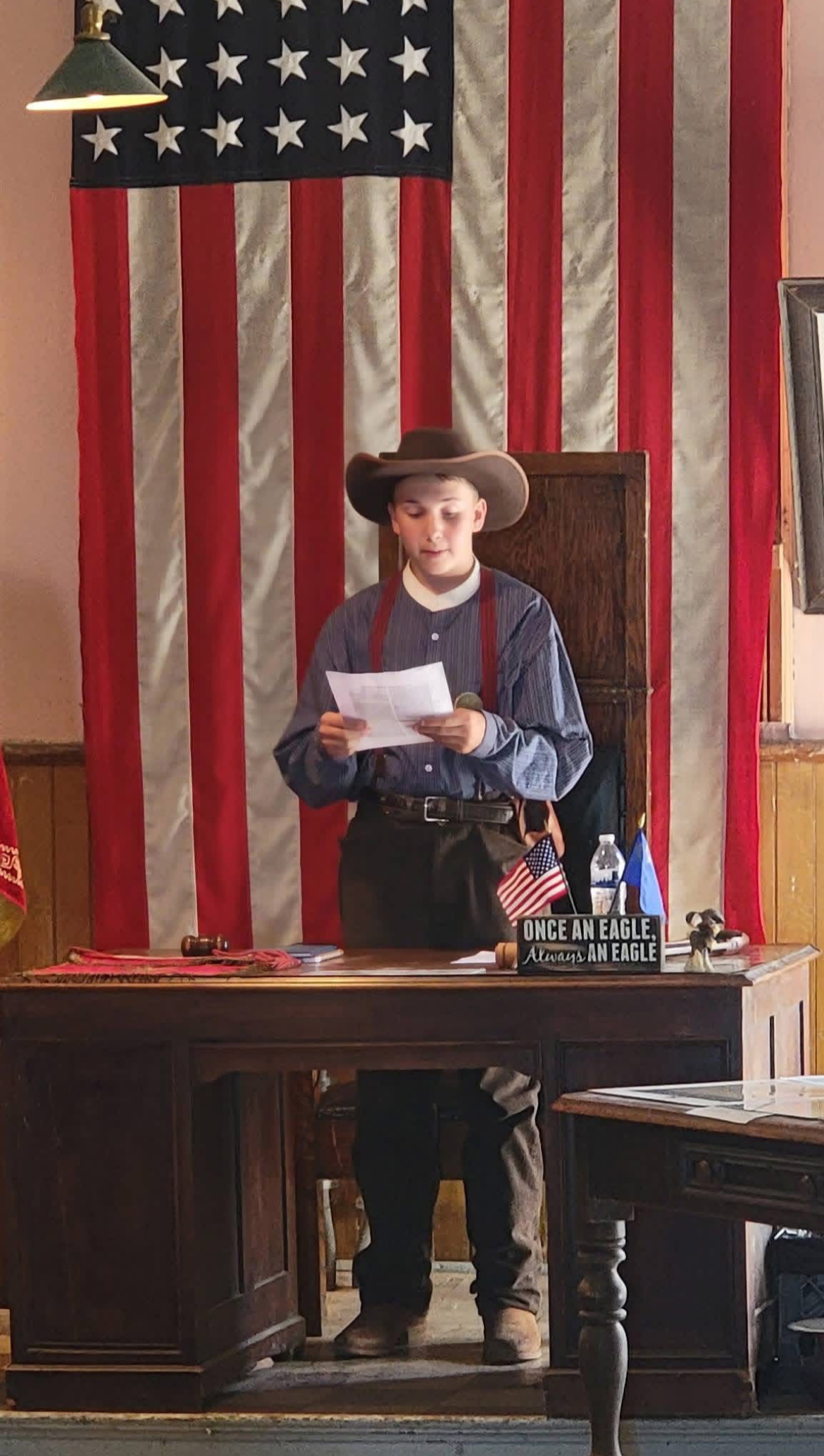
Ethan Robinson rose and began reading the Declaration of Independence.
Standing beneath the great American flag that filled the wall behind him, he read the familiar words that have inspired generations of Americans. As his voice echoed beneath the Hall's high ceiling, the room fell silent.
For a few moments, time itself seemed to fold together. The Declaration belonged to 1776. The Virginia Miners' Union to 1867. The Hall to 1876. The audience to 2026. Yet beneath that historic roof, those years no longer seemed separated by time, but connected through a shared history.
When the final words of the Declaration were spoken, the silence lingered for a brief moment, as though no one wished to be the first to disturb it. Then the Hall answered with warm, sustained applause—not simply for the reading, but for the enduring words that had once again found a home within its walls.
As conversations resumed and daylight gradually yielded to dusk, visitors remained inside the Hall, many gathering at its tall historic windows for one final celebration.
Night settled gently over the Comstock, and fireworks blossomed above Virginia City in brilliant bursts of crimson and gold, their reflections dancing across the Hall's old windowpanes while cheers drifted upward from the streets below. Framed by the historic windows, the display offered a view few experience and made it easy to imagine others standing in that very place through generations past, celebrating beneath the same Nevada sky.
As the evening drew to a close, the old Hall quietly resumed its watch over Virginia City.
Its rooms had welcomed first-time visitors and lifelong residents alike. They had celebrated the nation's 250th anniversary, honored the founding of the Virginia Miners' Union, and reminded hundreds of visitors that history is not something hidden away in distant museums. More often than not, it is waiting patiently just beyond a familiar doorway.
Historic buildings do not preserve themselves, nor do the stories they hold. For more than a century, the members of Comstock Aerie No. 523, Fraternal Order of Eagles, have quietly carried that responsibility, preserving the Miners Union Hall and the remarkable collection of artifacts, regalia, photographs, and traditions entrusted to their care. Because of that stewardship, visitors today can experience the history of the Comstock where it happened.
As the last echoes of the fireworks faded across the hills, the Hall stood much as it has since 1876—quiet, steadfast, and ready to welcome the next generation through its doors. On this Fourth of July, it did more than commemorate America's 250th anniversary. It reminded everyone who entered that the story of our nation is not preserved by monuments alone, but by communities willing to care for the places where history still lives.