The Hospital That Charged a Dollar and Outlived Common Sense

Virginia City sprang up the way most mining towns do: overnight, without a plan, and with all the dignity of a poker player who has just mistaken luck for intelligence.
One day, there was sagebrush and loneliness; the next, there were miners, merchants, saloons, gamblers, and enough optimism to bankrupt a continent. Silver had been discovered on the Comstock, and everybody hurried to Virginia City to become rich, or at least become a cautionary tale.
Now, a booming town can survive for a surprising length of time without sidewalks, manners, or good judgment, but eventually it discovers the need for schools, orphanages, and hospitals. The realization generally occurs after enough citizens have either broken themselves, orphaned themselves, or educated themselves into trouble. Father Minogue of St. Mary's of the Mountain Church recognized this inconvenient truth and invited the Daughters of Charity to establish those necessities.
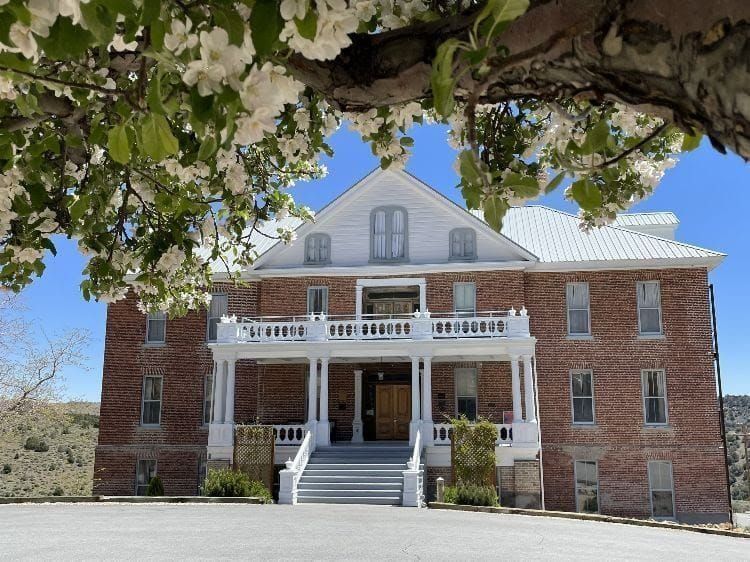
The Daughters arrived and, in 1876, opened a hospital so modern it created envy in cities three times the size of Virginia City. It featured gas lighting, indoor plumbing, steam heat, and, according to the newspapers, a wash basin with both hot and cold running water beside every bed. In 1876, it was not a hospital, but sorcery with bookkeeping.
I confess that when I first heard of hot and cold running water beside every bed, I felt a little resentful. I have stayed in motels during my travels where obtaining either hot water or cold water was considered an exciting surprise rather than a guarantee. Here, the miners were receiving luxury accommodations, while I have spent portions of my life negotiating with stubborn faucets that regarded running water as optional service.
The hospital's location made perfect sense. It sat near the mines, which was convenient because the mines spent much of their time manufacturing patients.
A miner could begin his morning hopeful and healthy and finish the afternoon requiring a physician, a bandage, and perhaps a discussion with his next of kin. The Comstock was generous with silver but charged a steep fee in the way of bruises.
The Daughters of Charity also devised a payment plan that revealed a rare flash of practical wisdom. For one dollar a month, miners could receive treatment, medications, and meals.
Today, if a fellow receives a paper cut and visits certain medical facilities, he may require a second mortgage and a team of accountants before being allowed to leave. Yet here was a complete healthcare plan for a dollar.
A dollar! Modern insurance companies would study such a proposal the way a vampire studies a sunrise.
Somewhere, there is an executive having chest pains merely from hearing the story. The miners paid their dollar, received care when they needed it, and nobody appears to have spent six months arguing over forms printed in microscopic type.
The hospital served Virginia City faithfully until 1942. Then, like many old institutions, it retired and sat vacant for more than 20 years. Buildings are much like people in that regard. After decades of usefulness, they are often abandoned by those who have forgotten what usefulness looks like.
Fortunately, the old hospital received a second life. In 1964, it reopened as the St. Mary's Art Center.
The patients were replaced by artists, which may not be as dramatic a change as it sounds. Each group spends considerable time staring into space, making strange noises, and requiring the intervention of concerned friends.
Visitors today can still see traces of the hospital's former life. There is a narrow nurses' staircase, worn by generations of hurried footsteps. There is a stove so central to the building's design that the structure was practically built around it. Such details remind us that some places are not merely constructed; they are accumulated, layer upon layer, by the people who pass through them.
The building now contains an upstairs theater, as well, proving that a place can reinvent itself without forgetting who it was. That is a rare achievement. Most of us cannot remember why we entered a room, let alone preserve a century and a half of history.
And so the old hospital remains, standing over Virginia City after 150 years of triumphs, disasters, booms, busts, and civic schemes. It has watched miners come and go, silver fortunes appear then disappear, and generations of citizens confidently predict the future before being proven wrong by it.
I suspect the building has learned a lesson that the rest of us never quite grasp. Human beings are temporary creatures forever rushing about in search of progress. Meanwhile, sturdy old buildings sit quietly in one place and wait for us to discover that history was worth keeping all along.
The hospital became an art center, the miners became legends, and the dollar-a-month healthcare plan became the most unbelievable part of the entire story.