King's Corner: The Last Harvest
One of the hardest things about life is that we rarely recognize an important season while we're living it. We assume the turning points are the dramatic moments—the bus ticket, the big move, the new opportunity. Looking back, I suspect God often works differently. He prepares us for the future through ordinary days, teaching lessons we understand only years later.
When my dad, Mark King, arrived in Fargo at 13 years old, he was simply looking for work. Three boys he met in a movie theater helped him find it. The next morning he joined a harvest crew shocking wheat on a North Dakota farm and moved into the bunkhouse where the boys lived.
What followed was six weeks of hard work and good company.
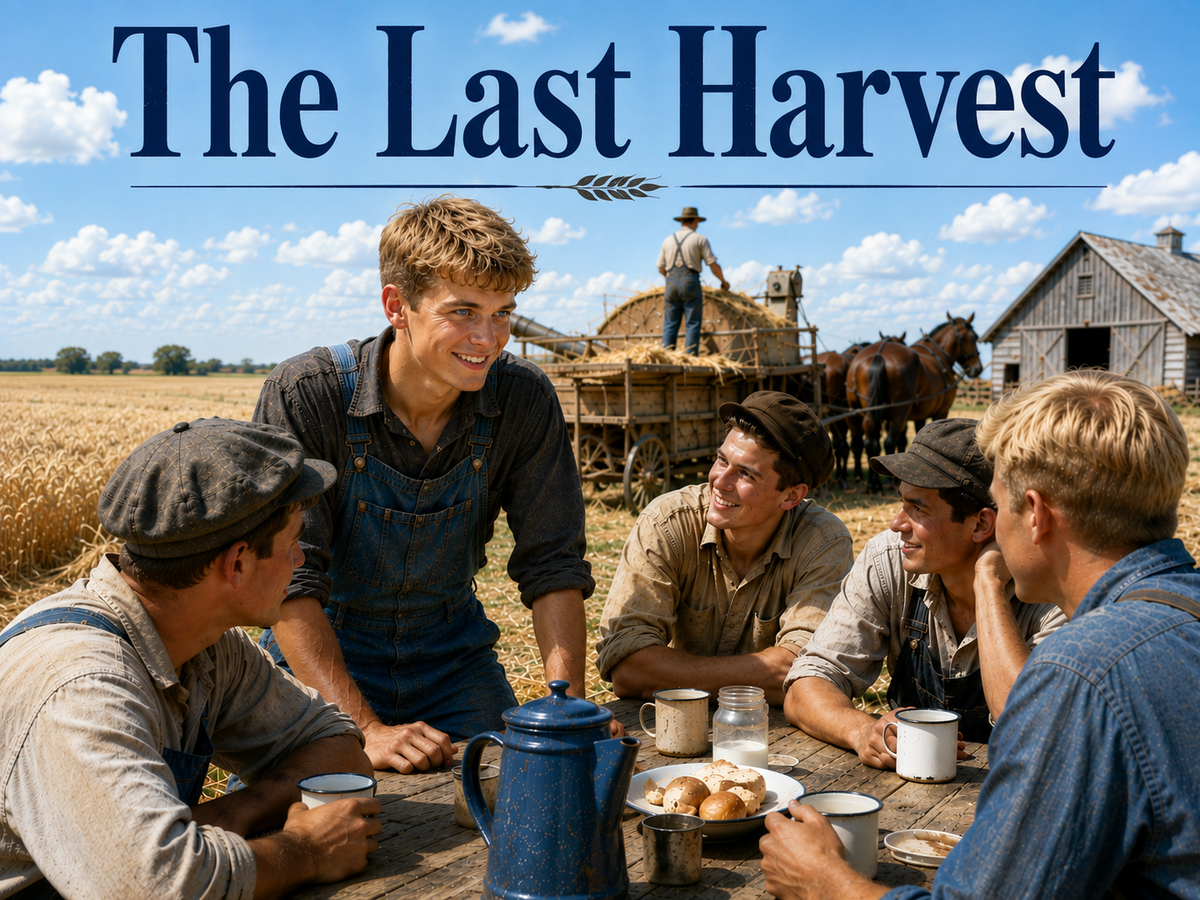
The harvest crew spent long days gathering sheaves of wheat into stooks so the grain could continue drying before storage. It was repetitive work. Hot work. Dusty work. Yet Mark loved it. After the crowded streets of New Jersey and the uncertainty of the weeks that had followed, there was something satisfying about waking each morning knowing exactly what needed to be done.
The boys worked together all day and spent their evenings together. Around the supper table and in the bunkhouse after dark, stories flowed as easily as the coffee. The Fargo boys wanted to hear about New Jersey and Wisconsin. Mark wanted to hear about farms, ranches, horses, and places farther west.
Everyone was fascinated by somebody else's horizon.
The boys thought Mark's stories sounded exciting. Mark thought they were already living the kind of life he had dreamed about for years. Night after night, dreams were traded as freely as stories. Sometimes we need someone else's perspective to remind us of what we already have.
The landowner often talked about the combine harvester that was coming. It hadn't arrived in time for the wheat harvest, so the work still had to be done by hand, just as it had been for generations. But everyone knew things were changing. The machine would arrive soon enough. Once it did, crews like this would never be needed in quite the same way again.
The harvest my dad joined would be one of the last.
Nobody seemed sentimental about it. Shocking wheat was hard work. The combine represented progress. Yet there was something significant about standing at the end of one era while another waited ahead.
We spend so much time looking toward the next chapter that we miss the value of the one we're in. Yet the season we're eager to leave is often preparing us for the season we're eager to reach.
The combine finally arrived in a cloud of dust and noise, carrying the future with it.
To a 13-year-old, the machine was impressive. It represented a world changing before his eyes.
The men who arrived with it were even more interesting.
One of them was a young rodeo hand named Ken.
Most of the harvest crew had spent their lives close to home. Ken seemed different. He talked comfortably about horses, rodeos, ranches, and places beyond North Dakota. Mark had loved horses since his time in Wisconsin, though his confidence around them exceeded his actual experience. Ken belonged to a larger world, and Mark found himself listening carefully whenever he talked.
The combine crew took over the threshing and baling, and Mark helped wherever he could. By then he knew the crop, understood the work, and had earned the respect of the men around him. When the harvest season ended, the combine owner offered him a place on the crew.
It would be easy to call that luck.
I don't think it was.
The opportunity arrived because Mark had spent six weeks doing the work in front of him. Long before he could see Calgary, Yellowstone, Australia, or any of the adventures that still lay ahead, he was learning a lesson that would shape much of his life. Faithfulness in today's work often opens tomorrow's door.
The crew headed north toward Calgary. Mark's friendship with Ken grew. Then came another opportunity. There was work available at a cattle and dude ranch west of Cody, Wyo., near Yellowstone National Park. Ken was heading there and thought Mark should come too.
Six weeks earlier, my dad had arrived in Fargo with no plan at all. Now he was heading toward mountains, horses, and a future he could barely imagine. He didn't know that Yellowstone would become one of the most important places in his young life. He didn't know that horses would shape much of his future. He didn't know that Ken would remain part of his story for years to come.
He only knew there was another door opening.
We often assume the important parts of life are the dramatic moments—the leap, the decision, the opportunity. Looking back, I suspect God does some of His best work in the seasons between. Mark thought he was spending six weeks harvesting wheat. In reality, he was being prepared for Yellowstone, horses, friendship, and opportunities he could not yet imagine.
It was the last harvest of his life, though he had no way of knowing it at the time.
God rarely wastes a season.
The road west wasn't finished with him yet.
Jeff Headley is pastor of the Dayton Valley Community Church, and a storyteller who blends humor, honesty, and hope. His weekly column reflects on resilience, grace, and the surprising ways faith shows up in ordinary life.