How the Eagles Came by a Hall on B Street (and Kept It)
If a person were to spend any length of time in Virginia City, he would soon discover that the town is not in any particular hurry to forget anything. The hills remain where they were first placed, the buildings stand as though they have made up their minds about it, and the stories, true or otherwise, persist with admirable determination.
One such story belongs to the Miners Union Hall on B Street.
The building has been there since 1876, which is long enough to have outlasted most arguments and a fair number of the people who made them. It came into being after the Great Fire of 1875, when Virginia City learned, at some expense, that wood and open flame are poor companions. The town rebuilt in brick, and the Miners Union Hall was among those structures designed with the firm intention of not repeating the lesson.
In its earlier days, the hall belonged to the miners, men who spent their days beneath the earth and their evenings discussing the consequences of it above ground. These discussions were conducted with conviction, volume, and a willingness to continue until either the matter was settled or everyone grew too tired to continue, which often amounted to the same thing.
But the hall was never reserved for argument alone. It proved itself useful in other ways, hosting gatherings, entertainments, and the sort of events that reminded a man there was life beyond the mine. If a building could earn its keep, this one managed it with consistency.
In September of 1903, the Fraternal Order of Eagles established Comstock Aerie No. 523 and held its early meetings in the Knights of Pythias Hall, just two doors down from the Miners Union. The Eagles, for those not yet acquainted with them, are a fraternal organization devoted to community, charity, and the practice of people helping people, a principle simple enough to understand and difficult enough to carry out consistently. They are the sort who gather not merely for conversation, but to be of use, which is a rarer habit than it ought to be.
There, within easy walking distance of what would later become their home, they conducted their business, initiated members, and went about the steady work of becoming established.
And for some years, that arrangement held.
Then, in October of 1925, the matter changed entirely.
The Eagles, having come to the reasonable conclusion that permanence is preferable to uncertainty, and perhaps finding that two doors was a greater distance than necessary, entered into negotiations with the Miners Union for the purchase of the hall. The terms were set at $1,425, to be paid over time, with interest included to ensure that no one forgot the seriousness of the arrangement. A motion was made, discussed, and, perhaps unsurprisingly, carried unanimously.
At that point, the building ceased to be someone else’s and became, in every practical sense, theirs.
And with that, the Eagles did what any sensible organization would do upon acquiring a hall: they began to use it.
There was no need for ceremony to mark their arrival. The building had already seen enough of that sort of thing. Instead, it received them in the same way it had received others before, with space enough for meetings, gatherings, and the occasional disagreement conducted with proper enthusiasm.
The hall, which had once echoed with the voices of miners debating the conditions of their labor, now took on a new set of voices, no less determined, and no less inclined to speak at length when the situation required it.
And so the purpose of the building remained unchanged, even as its occupants did. It was still a place where people gathered, spoke their minds, and attempted, sometimes successfully, to come to an understanding.
Today, the Miners Union Hall remains on B Street, holding its place with the same quiet confidence it has maintained for generations. It has seen miners, it has seen Eagles, and it has seen enough of human nature to avoid being surprised by it.
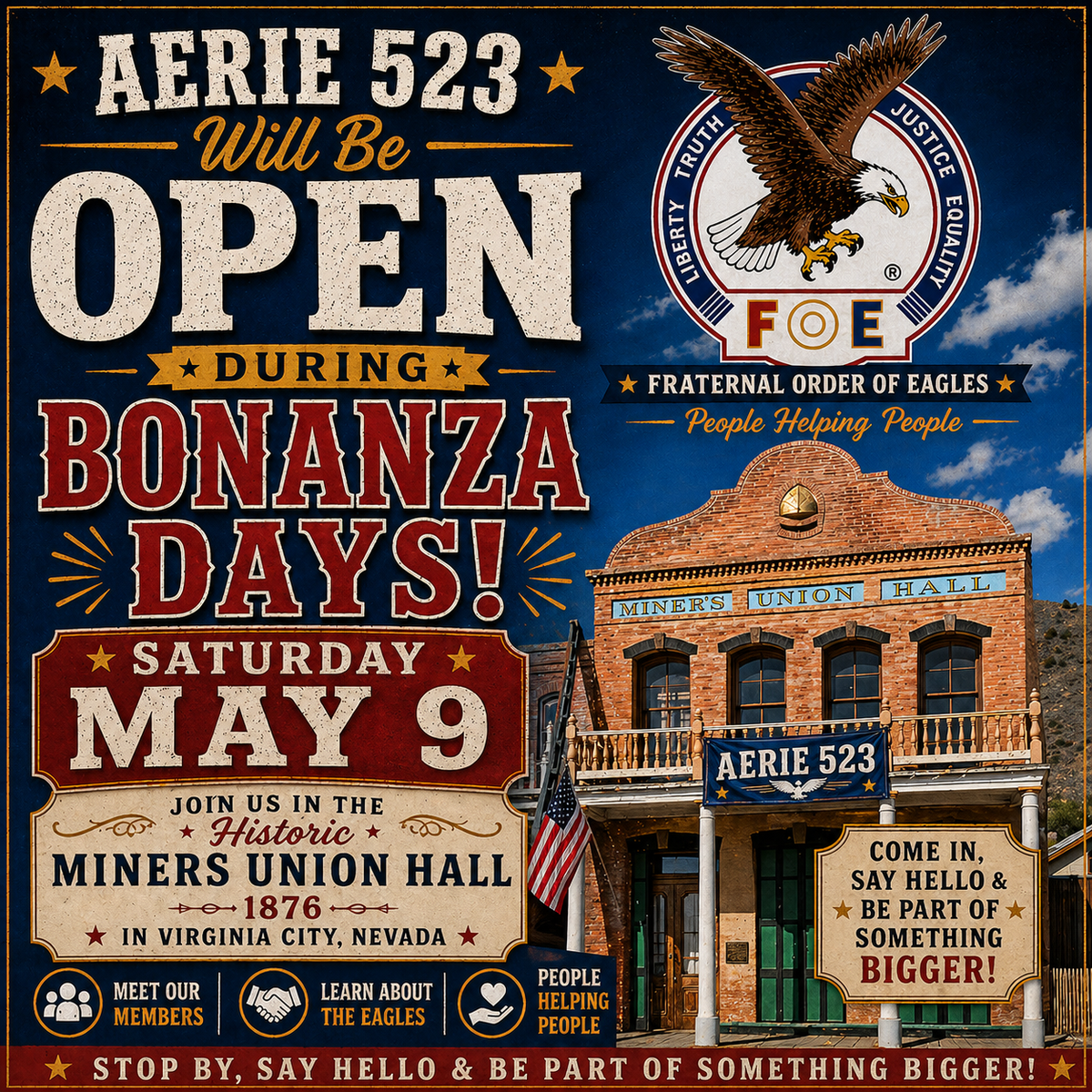
During Bonanza Days, on Saturday, May 9, its doors will be open to those who care to step inside. Visitors will find more than an old structure of brick and timber. They will find a place that has been worked for, paid for, and cared for, a place that has earned its standing in the story of Virginia City.
And should a visitor find the place agreeable, and the company even more so, it may occur to them that the Eagles are still there, and still about the same business. They are not difficult to find, nor particularly inclined to turn away good company.