Virginia City High School Students Step Into Real-World Business Pitch Experience
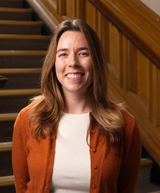
Editor’s note: Julia Moreno-Fritz served as one of the community members who reviewed student presentations for this project.
Virginia City High School students recently stepped into the role of young entrepreneurs, presenting original business ideas to a panel of community members in a classroom experience designed to mirror real-world expectations.
The project was developed by Bob Hastings, Community Resource Coordinator for Storey County Health and Community Services, in collaboration with Stacy York, Director of Health and Community Services. Hastings said the Career Launch class was designed to bridge career exploration with real-world skill building for students.
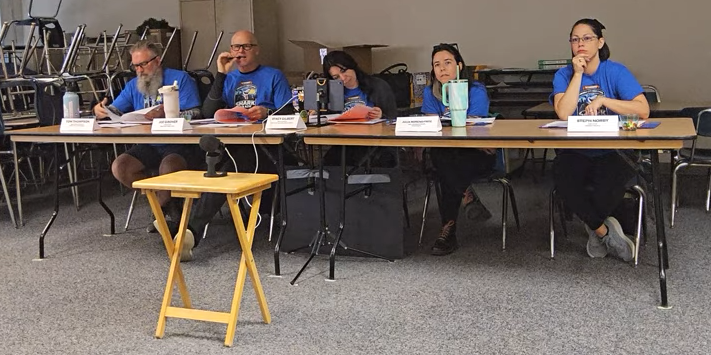
The project brought together five student groups who developed and pitched business concepts in a “Shark Tank”-style format. Community members from Storey County, the Storey County School District, and the editor of the Comstock Chronicle served as outside reviewers, asking questions and evaluating student presentations.
A key part of the project was bringing in outside community members to serve as evaluators, something Hastings said was intentional to push students beyond their comfort zones.
“By using ‘Sharks’ that come from outside the high school, the student is forced to face some of their fears,” he said. “These are real-world skills. Speaking in public or presenting ideas to bosses and investors.”
Game Ready: Turning Everyday Problems Into Products
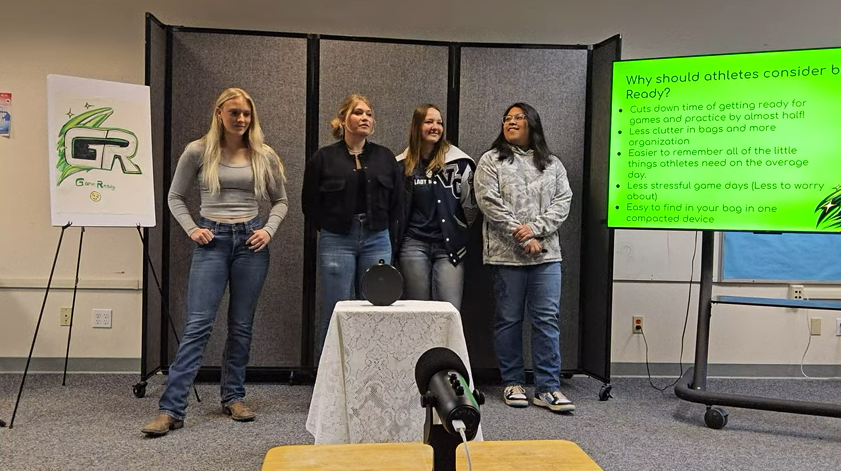
Nevaeh Ruelas, a junior at Virginia City High School, worked alongside Kaiya Krum, Tesla Turley, and Danika Baker on a project called Game Ready, a concept designed to simplify game-day essentials for athletes.
Krum, a junior at Virginia City High School, said the idea started from personal experience and observing what athletes often forget or have to carry separately.
“I was just thinking about what would make life easier as a softball player and for other outdoor athletes, too,” Krum said. “We made something that has everything we need, like sunscreen, deodorant, ChapStick, Icy Hot, and eye black, all in one thing instead of a lot of things scattered around your bag. It’s encompassed in one thing.”
What began as a simple concept quickly grew once the team realized there wasn’t anything like it on the market.
“When we started talking about this idea, I was like, this is genius,” Ruelas said. “Then we were like, wait a minute, this sounds too good. So we started looking, and nothing like this existed, which is so silly to me because it’s such a simple concept.”
From there, the group refined the idea, narrowing down essential items and building it into a more realistic product design.
“We started brainstorming,” she said. “We chose five base things that we would need in general for a normal game day, and then the design started happening.”
The Game Ready team also moved beyond concept work, creating a 3D-printed prototype and researching manufacturing options to make the idea financially realistic.
“We did extensive research,” Ruelas said. “We went through seven different producers to see where we could get this much product and bring the cost down. If we used big-name brands, it would easily be up to $30 just in products alone.”
Krum said the project helped her build skills that extend far beyond the classroom, particularly in communication and networking.
“I feel like I’ve just learned so much in general from this class,” Krum said. “We’ve learned how to present ourselves to other people, how to connect with people, and networking. I think that’s really big.”
She said the class also helped build confidence in professional skills she expects to use long after high school.
“This class is a really good class if you don’t really know what you’re doing,” she said. “For example, resumes, cover letters, all of that stuff I learned in here, and that is something I will be using for the rest of my life.”
Court Pulse: Technology and Athlete Performance
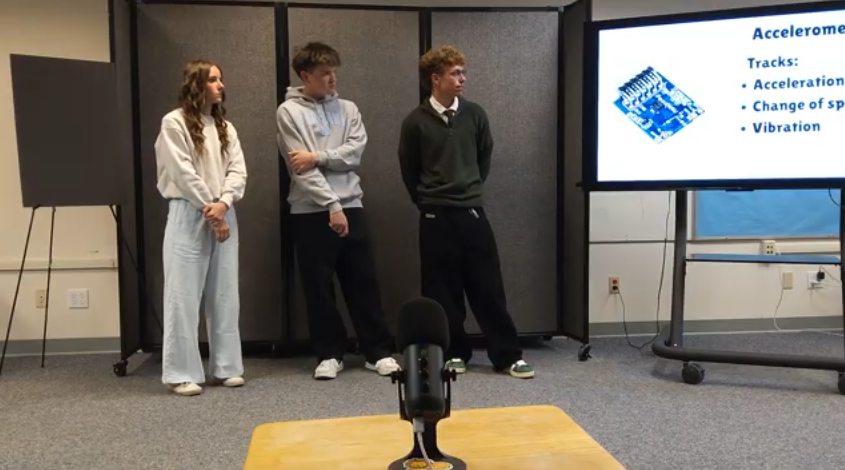
Another student project, Court Pulse, focused on athletic performance and recovery.
The project, developed by Luke Branson, Derek McCoy, and Haylee Walters, centered on a wearable watch band paired with an app designed to monitor fatigue in athletes.
Branson said one of the most challenging parts of building the project was figuring out how the technology would function.
“The most challenging part was probably researching and figuring out the actual electronic pieces that go into it and how they all connect,” Branson said. “We never knew how that worked before, so figuring all that out and how it works in real life was hard.”
McCoy said the experience gave him a clearer understanding of how businesses operate and how ideas are built through experience and mentorship.
“I think something that I’ll take is all the stuff I’ve learned about how businesses work,” McCoy said. “Mr. Hastings tells us all the time how he dealt with business and going through the ranks, so I’ll definitely take that moving forward.”
Branson said exposure to guest speakers throughout the class also helped shape his thinking about future career interests.
“When he brings a lot of guest speakers in,” Branson said, “that gave me a great connection and outlet to find a new passion for journalism. Now that wasn’t my original idea before, but since having this class and that experience. That’s changed what I want my future to be.”
For Branson, the value of the class extends beyond individual projects and into how students experience real-world expectations in a school setting.
“I would just say hopefully this class continues in the next years,” he said. “I would recommend every student to try to take this class because a lot of students complain that we don’t learn real-world skills in school, but I think Mr. Hastings and everyone does a really good job of giving us opportunities and skills that we don’t get to learn in other classes. I think everyone should take advantage of the opportunity and take this class if you can.”
Building Skills for Every Career Path
For Hastings, the goal is simple: expose students to skills and expectations they will encounter well beyond the classroom.
“I’ve always liked working with high school kids,” Hastings said. “The purpose is to show all students that there are good-paying, successful careers for everyone, whether college-bound, pursuing certificate programs, or entering the trades.”
Hastings said the class focuses heavily on helping students identify opportunities they may not have previously considered while building professional skills along the way.
“Many high schoolers are unaware of the vast number of opportunities that exist,” he said. “We are helping them find and explore those opportunities.”
Unlike a traditional classroom setting, Hastings said much of the work is centered on process, reflection, and real-world application.
“There is a lot of focus on the process,” he said. “Much of what we do is self-evaluation, determining where and how a student can be successful.”
The presentation model itself was inspired by a “Shark Tank”-style format, allowing students to practice teamwork, critical thinking, project management, and public speaking in a high-pressure environment.
“By doing this, the students are taking many of the skills they have learned and packaging them together,” he said. “This better prepares them to use these skills in the workplace.”
Looking Ahead
Hastings said that reaction is exactly what the project is designed to create.
Strangely, he said, some of the most impactful moments came not from the presentations themselves, but from the questions students were asked.
“Our Sharks are not letting the students off easy,” Hastings said. “They are giving very tough questions, and the students are giving good, concise answers. They have not backed down once.”
He said he was especially proud to see students respond confidently under pressure.
“It makes me proud to watch,” he said.
The involvement of outside partners was also intentional, Hastings said, noting support from Storey County and the school district in helping connect students with broader community experiences.
Hastings said that collaboration strengthens the impact of the program for both students and the community, helping connect career readiness efforts with long-term community development.
Looking ahead, Hastings hopes the program continues to grow and evolve, including an increased focus on emerging skills like artificial intelligence.
“Regarding evolution, that is something I look at closely,” he said. “We will have to increase the AI focus in the future.”
For Hastings, the long-term goal is broader than any single project.
“I want students to know that regardless of your path, everyone can be successful and have a rewarding career,” he said.