The Jackalope

The other day I was working at the Odeon when I overheard a lady ask her husband if the mount on the wall was a jackalope. Now, this is an old European mount, just the skull and antlers of a deer. Naturally, my ears perked up and I started listening in. Without missing a beat, her husband said, “Yep, they’re indigenous to the area. You can find them in Nevada, Arizona, and certain parts of Utah.”
She frowned a little and said, “Hmm, I thought they were made up, but I guess they’re real.”
Her husband replied, “Nope, they’re real. They’re just really fast, so you’ve got to pay close attention.”
I couldn’t help myself, so I found an excuse to walk past them into the back room. The lady stopped me and asked, “Excuse me, sir, what is that on the wall?”
“That’s a jackalope,” I said. “My grandpa shot it when he was a kid. There used to be more of them around here, but they’re nearly extinct now.”
I caught the twinkle in her husband’s eye. They stayed a while, had a couple of drinks, and we swapped stories.
You see, being at the bar is more than serving drinks and throwing a big party. It’s about the connections we make and the stories we share. That’s how real community gets built. It’s how you welcome new people into your home, make them feel at ease, and give them the chance to become part of your town.
I was born in a tiny little place between Waldport and Alsea, Oregon. My family bounced around all over the countryside. Yes, we have connections back to the Comstock days, but we’ve only been here since the early ’90s. I hear a lot of people complain about the new influx of Californians, but I say welcome them with open arms and help them become part of the community.
If you don’t want our home to change, then take the time to explain why this place is so special, how we came to be, and, if they like it the way it is, how they can help us keep it that way. If we’re not part of the solution, we’re part of the trouble.
Now, back to jackalopes.
Did you know where they really came from? The truth is this: in the 1930s, Douglas Herrick and his brother, hunters with taxidermy skills, popularized the American jackalope by grafting deer antlers onto a jackrabbit carcass and selling it to a local hotel in Douglas, Wyoming.
But I prefer my way.
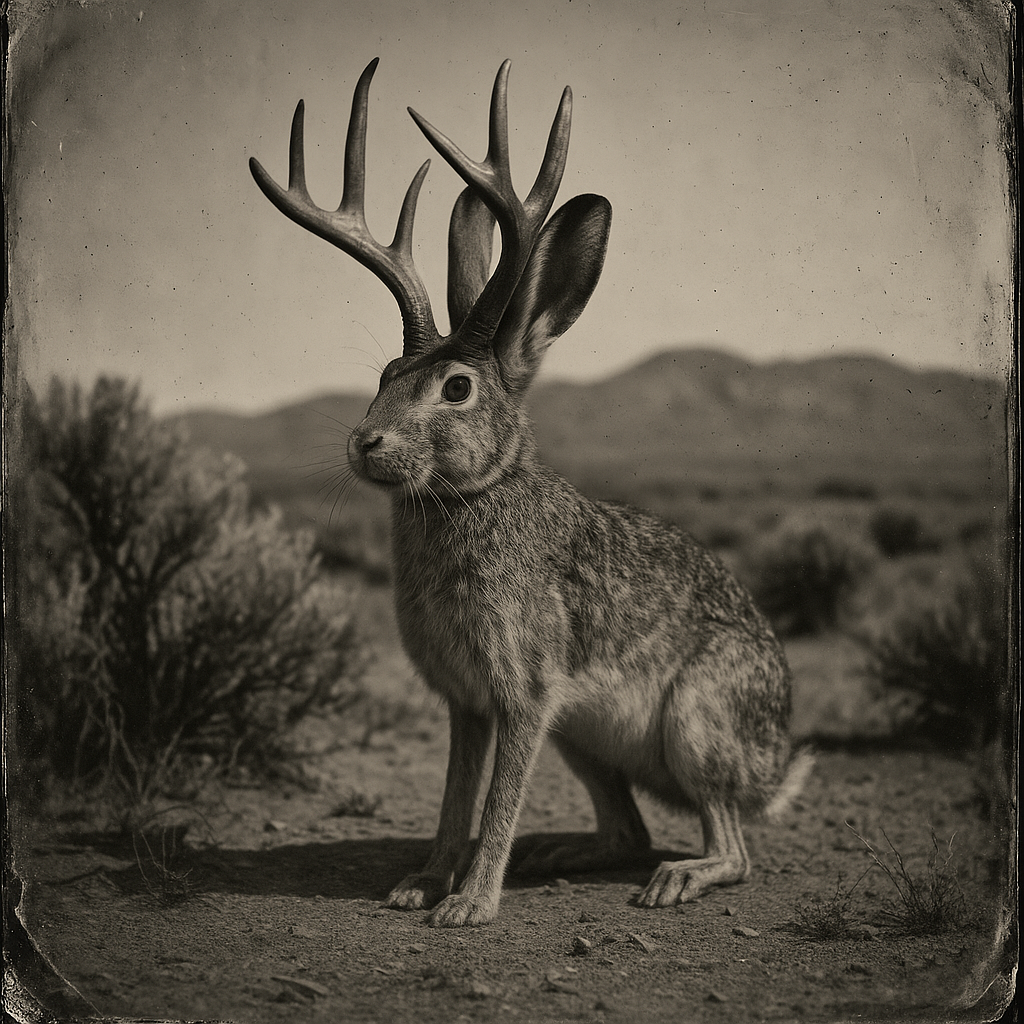
Long, long, long ago there lived a species of small deer, not unlike their fanged cousins of the Himalayas, called the Nevada musk deer. They weren’t much bigger than a jackrabbit, but unlike their Himalayan cousins, the Nevada musk deer had both fangs and antlers.
Jackrabbits themselves can get quite large. In fact, there was once a species called Nuralagus rex, a “giant” rabbit that weighed an average of 26 lb. and lived on Menorca. We had our own version here, but instead of being fat and slow, ours was fast, super fast. All the energy its European cousin put into becoming big and round, this one put into its legs. I like to call it the Velocissimo Nuralagus rex.
Nevada, as you may know, wasn’t always as dry as it is now. There were large lakes, and ancient Lake Lahontan was practically an inland sea. But not all things last forever. As the inland sea dried up, the animals that depended on it, like the Nevada musk deer and the Velocissimo Nuralagus rex, began to die out. Food grew scarce, and their populations dwindled.
Nature, being what it is, always finds a way. As Dr. Ian Malcolm said"if there's one thing the history of evolution has taught us is that life will not be contained, life breaks free, it expands to new territories, and it crashes through barriers painfully, maybe even dangerously. But uh... life finds a way"
In the end, there was only one Nevada musk deer left and one Velocissimo Nuralagus rex. Some say what happened next was a last-ditch effort by nature to keep something of them alive. Others say it was sheer boredom, and maybe a little fermented fruit. Either way, the union of those two creatures created something new.
Something fast.
Something clever.
Something with antlers.
And a lot of them! Since, well you know..... rabbit.
So fast that only the keenest hunters might ever glimpse one from the corner of their eye. Even with our advanced technology, we still can’t track them. Their numbers are unfortunately decreasing.
All the jackalopes on earth, the story goes, are descended from those two ancestors. Because jackalopes have incredibly long, unnatural lifespans, humans have hunted them as a sort of fountain of youth. Legend says that if you kill one and eat its heart, you gain its ability never to die of natural causes. But they’ve been so over-hunted, and they can’t reproduce on their own, like mules, they’re stuck with an odd number of chromosomes, so their population has crashed.
If you ever happen to get lucky enough to see a jackalope in the wild, keep it to yourself. You never know who might be listening, who might want to hunt it.
And who knows… the one you saw might be the last one left.