The Great Reno Thinking Machine Panic

There was a time when a town worried about ordinary things. Folks lost sleep over cattle rustlers, highwaymen, and whether Cousin Elmo should be left alone near a poker table.
Those were simpler days. Now we have progressed.
We worry about giant warehouses full of blinking lights that spend their days thinking about cat videos, online shopping carts, and whether a fellow in Ohio really meant what he wrote on social media.
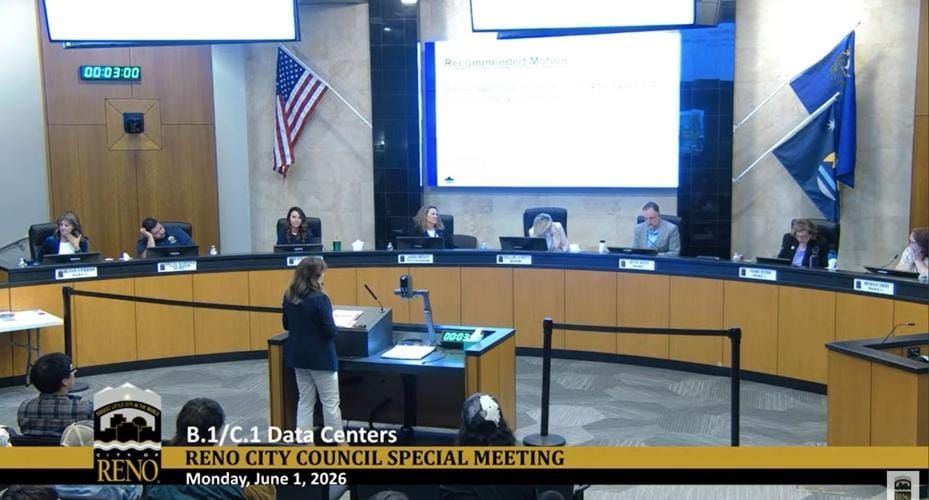
The Reno City Council recently decided that enough was enough and slammed the gate on new data centers, at least for the time being. By a vote of six to one, they adopted a moratorium stretching to Aug. 31, 2027.
The city declared that no new thinking-machine palaces shall get built without written rules, regulations, and a few hundred studies, and everyone feels reasonably certain civilization will survive the experience; however, existing projects are safe.
The data center already rising on Keystone Avenue may continue its climb toward the heavens. It has achieved that most sacred of modern statuses: it was approved before anyone became truly alarmed.
The discussion lasted for hours. Citizens lined up to testify about the enormous appetite these electronic beasts have for water and electricity.
One would think the machines had developed a taste for bourbon and prime rib. Speaker after speaker warned that data centers consume resources on a scale usually associated with invading armies or teenage boys during summer vacation.
The city listened carefully and agreed that it might be wise to establish some rules before every vacant lot became a giant warehouse dedicated to teaching artificial intelligence how to draw pictures of raccoons dressed as Civil War generals. Now, city staff will begin writing regulations.
There will be discussions of water use, energy consumption, sustainability, building safety, noise, air quality, community benefits, and suitable locations. In government, whenever a problem appears, the first instinct is to create a committee.
The second instinct is to create a document. By the time the Council finishes, everyone involved will have either retired or forgotten the original question.
Not everyone was pleased. Representatives of several trade unions objected strongly.
They pointed out that data centers bring construction jobs, economic activity, and opportunities for working people. They argued that shutting the door on new projects could mean shutting the door on future prosperity.
Here is where Nevada's oldest tradition enters the story: everybody likes economic development right up until it arrives next door. Environmental advocates see enormous power consumption, unions see paychecks, politicians see votes, developers see profits, and the public sees trouble.
Remarkably, all of them may be correct at the same time.
As I watched this debate unfold, my thoughts drifted toward Storey County and the sprawling Tahoe Reno Industrial Center, where data centers have been multiplying faster than rabbits with a tax exemption. Storey County officials more than likely remember the events of 2024, when the Nevada Legislature cast a long and interested glance toward the tax revenues generated in the industrial center.
Nothing attracts attention quite like success. A gold mine may lie hidden underground for years, but the moment it starts producing wealth, people appear from every direction carrying maps, regulations, and calculators.
It is one of the oldest laws of the American West. First comes opportunity, then comes prosperity, followed by a crowd of people determined to save you from both.
Whether data centers prove to be Nevada's next great economic engine or merely enormous electric space heaters remains to be seen. For now, Reno has decided to stop, think, study, regulate, evaluate, analyze, assess, review, and contemplate.
In other words, the city has chosen to fight the rise of the thinking machines by thinking about them very hard. Mark Twain would likely admire the irony.