King's Corner: The Horse in the Rotunda
When my dad was a boy, he brought a horse to school.
That sounds like the beginning of a joke—but to him, it was just another Tuesday.
He was eight or nine when his mother decided he belonged in Catholic school. My grandmother Julia was a force of nature; Bobbie was not easily contained. He was curious, fearless, and not especially concerned with consequences. Sister Bernadino, his teacher, had already taken a particular interest in him—this being the same boy who had once brought a snake to class and nearly introduced it to her hand.
Then came the horse.
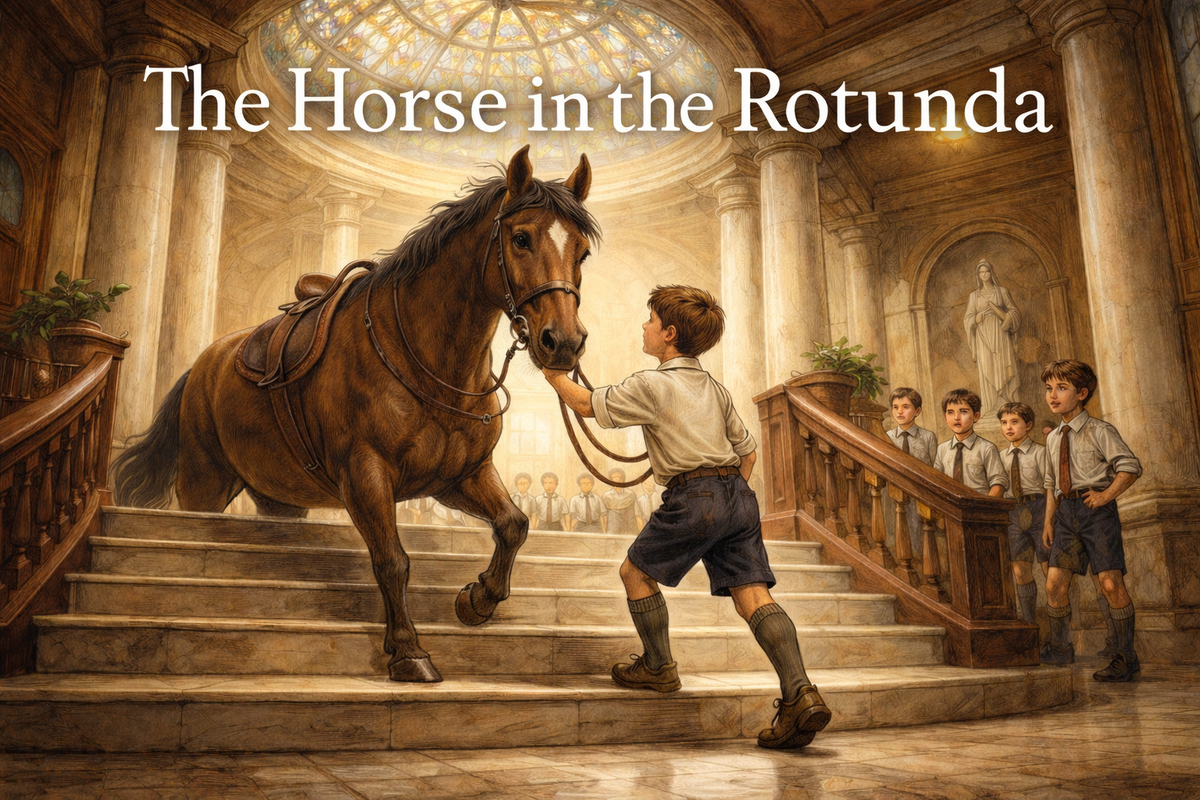
A man had pulled up with a horse-drawn wagon to collect discarded items. While he was inside, the boys gathered around the horse—large, calm, and familiar to Bobbie, who had been feeding him scraps of lunch for days. The horse trusted him. The other boys noticed that, and that was all it took.
“I dare you to take him up the steps.”
Bobbie later said a dare was just “peer pressure with better advertising.” Either way, he took the reins.
Ten marble steps. A landing. Then more.
The horse followed cautiously, trusting the small boy who had fed him. At the top, beneath the rotunda dome, Bobbie looked around and thought, This will be one for the history books.
Then the bell rang.
He went to class.
The horse stayed.
It didn’t take long for things to unravel. The nuns found the horse standing in the rotunda like a monument to poor judgment. One shrieked, another froze, and the horse remained calm, as if waiting for instruction—or absolution. No one knew how it had gotten there.
Sister Bernadino intended to find out.
She moved from classroom to classroom with an offer that sounded generous—and was carefully measured: anyone who could lead the horse safely down the steps would receive three days off school. Hands stayed down. Except one.
Bobbie’s.
He stepped forward, helpful and confident, not realizing he had just answered her question. He led the horse down slowly, one careful step at a time. The marble was slick; the horse hesitated, then trusted him again. Somehow they reached the bottom. Then, without thinking, Bobbie reattached the harness with practiced ease.
Sister Bernadino watched.
As he climbed back up, she called him over. “Put out your hands.” He did, expecting something closer to reward than punishment. She raised the heavy cluster of keys she carried and swung. He pulled back. She missed.
“Hold them out.”
He stepped back—just a little too far. His foot slipped. Instinctively, he grabbed for her leg, expecting it to steady him.
It didn’t.
He tumbled down the steps and landed at the bottom holding it—staring in shock as he realized, too late, that it wasn’t a leg at all, but wood. He looked from the leg to Sister Bernadino and back again, trying to make sense of how something so solid a moment before could suddenly come apart in his hands.
For a moment, neither of them moved.
Bobbie stared at it in shock. She stared down at him.
Then, as he always told it, “I figured no good conversation starts with ‘Here’s your leg,’ so I ran.”
The next morning, his mortified mother walked him back to St. Mary’s and straight into Father Stone’s office. The sisters were there, with Sister Bernadino nearest the door, determined that this time nothing would go unanswered.
“Son,” Father Stone began, “did you bring a horse into the school?”
“Yes, Father,” Bobbie said. “But he’s very well-behaved.”
Father Stone turned his chair toward the window.
The chair began to shake.
Bobbie noticed—and understood. Whatever was coming next, it wasn’t going to be quite what Sister Bernadino had in mind.
When he turned back, his face was composed, but only just. He dismissed the sisters—over Sister Bernadino’s reluctance—before anything more could be said, and asked Bobbie to explain.
Bobbie did. All of it.
The reins. The harness. The steps. The horse.
Father Stone turned back to the window, shoulders moving now, the effort to remain stern clearly losing ground. When he faced forward again, he restored order as best he could.
“You understand we have to do something about this.”
Bobbie nodded.
“A week’s suspension.”
Which, all things considered, was better than the three days he’d been promised—and probably the best outcome available.
It’s easy to laugh at a boy like that—until you remember a few moments of your own. Maybe not a horse. But something that seemed like a good idea at the time and went just a little too far.
When Bobbie was asked what happened, he told the truth. No excuses. And because of that, Father Stone could see more than the trouble—he could see the boy.
That’s the part that lingers. Not the horse, or even the fall, but the moment someone chose understanding before judgment. Most of us need that more than we’d like to admit.
And maybe that’s where God meets us—not after we’ve cleaned things up, but right in the middle of them, when we’re honest enough to be seen and still shaped.
Bobbie wasn’t going to stay in that tension forever. Something had to give.
Father Stone seemed to know which way it should go.
And Bobbie, whether he realized it or not, was already being pointed in that direction—hopefully without any more livestock.
Jeff Headley is pastor of the Dayton Valley Community Church, and a storyteller who blends humor, honesty, and hope. His weekly column reflects on resilience, grace, and the surprising ways faith shows up in ordinary life.