King's Corner: Right to the Edge
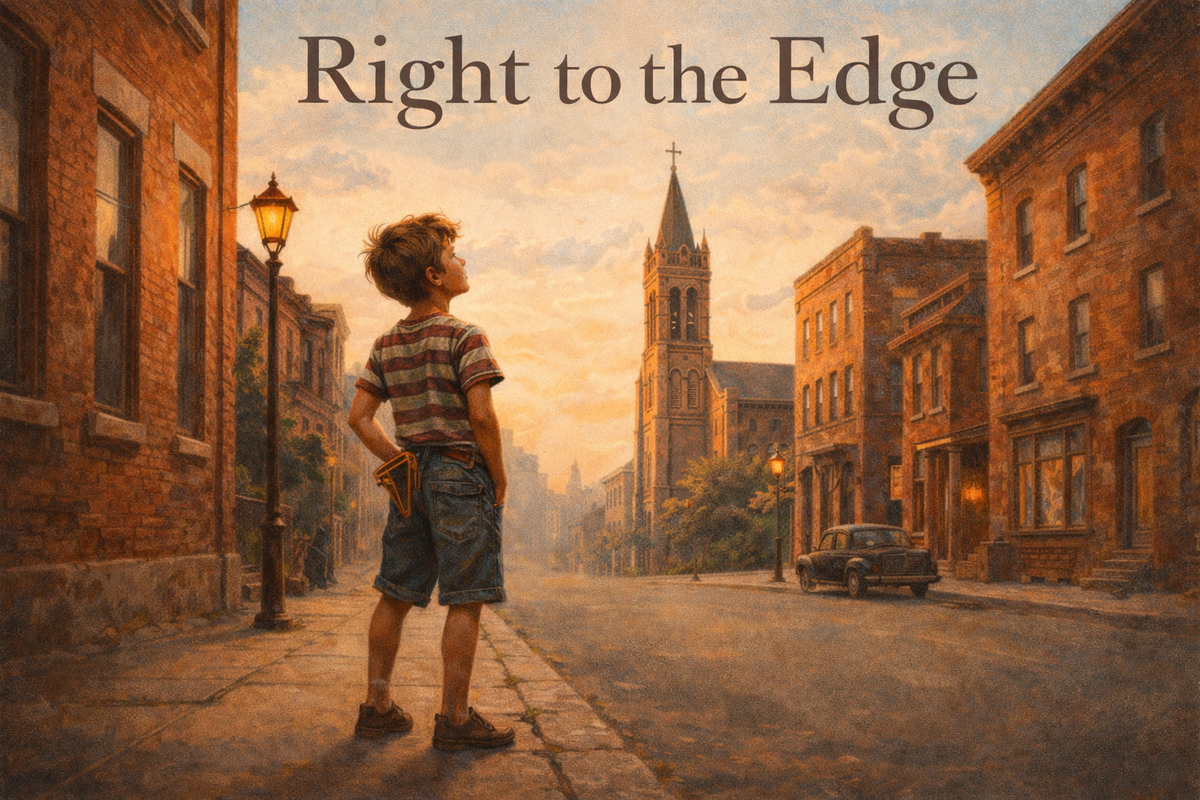
Some boys test the limits of everything—and everyone—around them. Most of us just learn to do it more quietly.
My father, Robert “Mark” King—Bobbie then—was not quiet about it. By the time he was in grade school, it was just him and his mother. His father, a policeman, had gone to prison when Bobbie was a baby and never returned. The one time that other life came close was outside his school, when a woman with a baby carriage told him the child inside was his sister—and that he could come live with them.
For a moment, another future opened. Then his mother closed it. She had already seen where that road could lead, and Bobbie stayed—trusting the one person who had never left him. It was one of the few times he didn’t push.
Most of the time, he did. And you could almost hear the question forming: what now?
The neighborhoods he grew up in didn’t reward hesitation. When three boys cornered him in a school bathroom, the outcome was decisive. One left with a closer acquaintance with a toilet than he had planned. It wasn’t refined—but it made a point, and likely prevented a sequel.
Bobbie didn’t hide it. When he was called in, he told the truth, even when it made things worse. The adults around him knew what they were dealing with—which was helpful, because they were dealing with a lot.
At the Catholic school, Father Stone was trying—patiently—to shape him. Bobbie kept providing opportunities. The church had a belfry, and the belfry had a roof, and the roof was, in Bobbie’s mind, clearly meant to be climbed and slid down. It was dangerous, destructive, and unnecessary.
He did it anyway.
Somewhere below, you can imagine Father Stone looking up and asking: what now?
Outdoors, the pattern continued. Bobbie picked up a snake, tucked it into his shirt, and brought it to school. When it appeared during class, the teacher reacted quickly. The police were called—not because of mischief, but because the snake was a water moccasin.
Bobbie had been carrying it against his skin.
He had not been bitten.
Which was either good fortune… or a sign that someone was keeping closer watch than Bobbie was. When asked, he told them exactly what he had done.
It didn’t slow him down much.
After seeing kittens escape a sack meant to drown them, he decided to test it himself. He had friends tie him into a weighted sack and throw him into a river. On land, escape is simple. Underwater, it is not. He barely made it out.
And afterward, no story, no softening—just the truth.
At this point, the question asks itself: what next?
Looking back, the pattern is clear. He stepped forward when others stepped back. He tested limits most people avoided. And he told the truth about it afterward, which meant something important.
It meant people could work with him.
His mother could guide him. Father Stone could shape him. Teachers—and even police—could step in when things went too far. He stretched those limits constantly—but never beyond the reach of those trying to keep him on course.
And somehow, again and again, he came through. Not because he was careful, and not because he always made good decisions, but because he was never completely on his own—and never completely hiding.
They didn’t take away his wildness.
They gave it direction.
Because underneath it all, something was forming. Courage. Resilience. A willingness to face things head-on. Traits that could have led him the wrong way—but didn’t. At times, he began to see beyond the next dare. Sitting in the loft at barn dances, watching life unfold below, he realized there was more ahead than whatever he could get into that day.
At his Confirmation, he chose the name Marcus. He likely didn’t know why then, but some decisions carry meaning before we understand them.
Some boys are formed by instruction. Others are formed by the edges they run into—and the people who are there when they do. And sometimes what looks like a series of close calls is something more than luck. It is a life being guarded, shaped, and quietly redirected—even while it is busy testing every boundary it can find.
Which brings it a little closer to home. Because if we’re honest, most of us have had our own versions of what now? moments—times we pushed too far, ignored what we knew, or found ourselves in situations that could have gone very differently. And somehow, they didn’t.
So maybe the better question isn’t just what we did—but who was there. Who held the line. Who stepped in. Who didn’t give up on us. And whether we’re still willing to be honest enough about our missteps that something—or Someone—can still work with us.
Because Bobbie wasn’t easy to raise, and if we’re honest, neither are we. Yet we were carried further than we should have been—not by our own wisdom or our own choices. Sometimes by people around us, and sometimes by God Himself—quietly guarding, correcting, and shaping us, even while we were busy testing every edge we could find.
Bobbie didn’t know where any of this was leading. Neither do we. But if God was at work in those early, reckless, unformed years…
then maybe He hasn’t stopped—even if we’ve given Him just as much to work with.
Jeff Headley is pastor of the Dayton Valley Community Church, and a storyteller who blends humor, honesty, and hope. His weekly column reflects on resilience, grace, and the surprising ways faith shows up in ordinary life.