King's Corner: For The Fallen
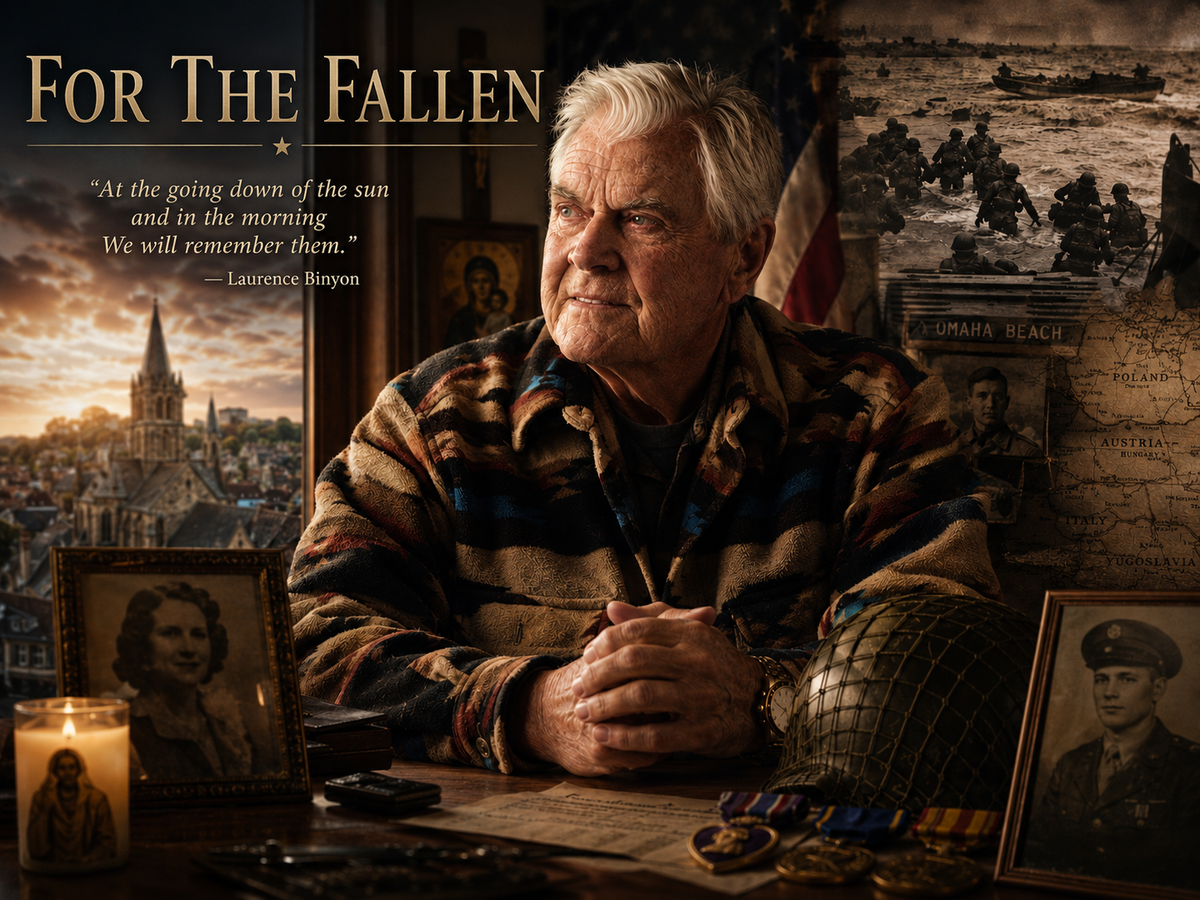
By the time a Reno television crew came to interview my father about D-Day, he was already well into his nineties. Age had slowed him physically, but not mentally. Some memories remained as sharp as ever.
The young reporter arrived eager to interview a surviving World War II veteran for a Memorial Day segment. Sitting in the quiet Nevada home of a man now in his nineties, she probably expected history. What she encountered instead was memory.
As the crew prepared their cameras, the reporter noticed several framed medals nearby, including a Purple Heart he had received for wounds suffered on June 6, 1944, during the Normandy invasion.
The conversation at first was light and comfortable. Mark began describing the months leading up to D-Day. Life in southern England before the invasion hardly felt like combat. He had first been sent to Fort Bliss, Texas, for training before being deployed to England as part of Operation Fortitude, the elaborate Allied deception campaign meant to convince Germany that Allied forces would land near Calais instead of Normandy.
His job mostly involved moving inflatable tanks, trucks, and landing craft around southern England to create the illusion of a massive military buildup. German V2 rockets occasionally struck nearby, though inaccurately enough that they landed almost randomly. When sirens sounded, everyone headed underground, then eventually returned to work.
On days off, he traveled into London to attend concerts meant to lift morale among civilians and troops alike. Listening to him, parts of England almost sounded pleasant.
Then the reporter asked him about D-Day itself.
Because he wore glasses, Mark had been assigned to the third assault wave. The first two waves consisted largely of the healthiest soldiers, the men expected to absorb the worst of the fighting.
No one in Mark’s boat yet understood what had already happened ahead of them.
By the time their Higgins boat approached Omaha Beach, the first assault waves had already been shattered. Many of the men who stepped off those earlier boats never made it farther than the waterline.
He remembered climbing down a thick rope ladder from his transport ship into the choppy waters of the English Channel. The Higgins boat pitched violently toward shore. Men were packed tightly together, soaked by seawater, fear, and seasickness.
Every man in the boat knew the ramp would eventually drop. No one knew what would still be waiting when it did. They only knew they were next.
At some point another soldier vomited down the back of Mark’s uniform.
“I slid in puke,” he said.
The floor of the landing craft was covered in it. Men preparing for battle were now trying not to collapse from seasickness and terror. Mark remembered wondering how anyone in that condition could possibly fight.
“As soon as that bullet comes by you, you get over being sick,” someone told him.
No one laughed.
Even the camera crew had gone quiet by then.
When the front ramp finally dropped, Mark stepped into neck-deep water. He later joked that he was grateful for it because it washed the vomit off his uniform.
Fortunately, many of the machine-gun nests that devastated the first assault waves had already been destroyed by the time Mark’s boat reached shore. But mortar and artillery fire still pounded the beach.
The men moved forward through bodies pushed against them by the incoming waves.
Some had floated there since the first assault waves that morning.
Many were bloated from the water, their uniforms dark with blood.
“The best and brightest had been the day’s first sacrifices,” he said. “Having to push them aside just to keep moving is something I’ll never forget.”
The beach itself was heavily mined and covered with obstacles: wooden stakes, steel tripods, barbed wire. Clearing paths through them cost many more lives.
Most of the men from Mark’s boat made it ashore. He reached the beach and climbed halfway up the cliffs before a bullet passed through his hand and into his hip. Fortunately, he was able to receive medical treatment.
As Mark described those memories in graphic detail, the reporter began to cry.
It was difficult to reconcile the elderly man sitting in a Nevada living room with the young soldier describing bodies floating at Omaha Beach.
Not because he dramatized it, but because he didn’t.
For the first time during the interview, Mark himself seemed close to losing composure. Instead, he redirected attention toward the men who never made it off the beach.
Memorial Day, in his view, belonged to the dead.
By the end of the interview, the young reporter was openly crying.
The station eventually decided not to air the footage. Instead, she delivered a quiet on-air Memorial Day tribute to those who had fallen.
For decades afterward, Mark carried those memories quietly while building a life here in Nevada.
Perhaps that is part of remembrance: not glorifying war, but refusing to let sacrifice disappear into abstraction. Most were still very young men. Many never returned. Those who survived carried the memory for the rest of their lives.
Perhaps remembrance carries a responsibility too — to live with enough gratitude and humility to honor sacrifices we never personally had to make.
As Laurence Binyon wrote in the poem For the Fallen,
“Age shall not weary them, nor the years condemn.
At the going down of the sun and in the morning
We will remember them.”
Jeff Headley is pastor of the Dayton Valley Community Church, and a storyteller who blends memory, honesty, and hope. His weekly column reflects on resilience, grace, and the surprising ways faith shows up in ordinary life.