King's Corner: Turning the Page
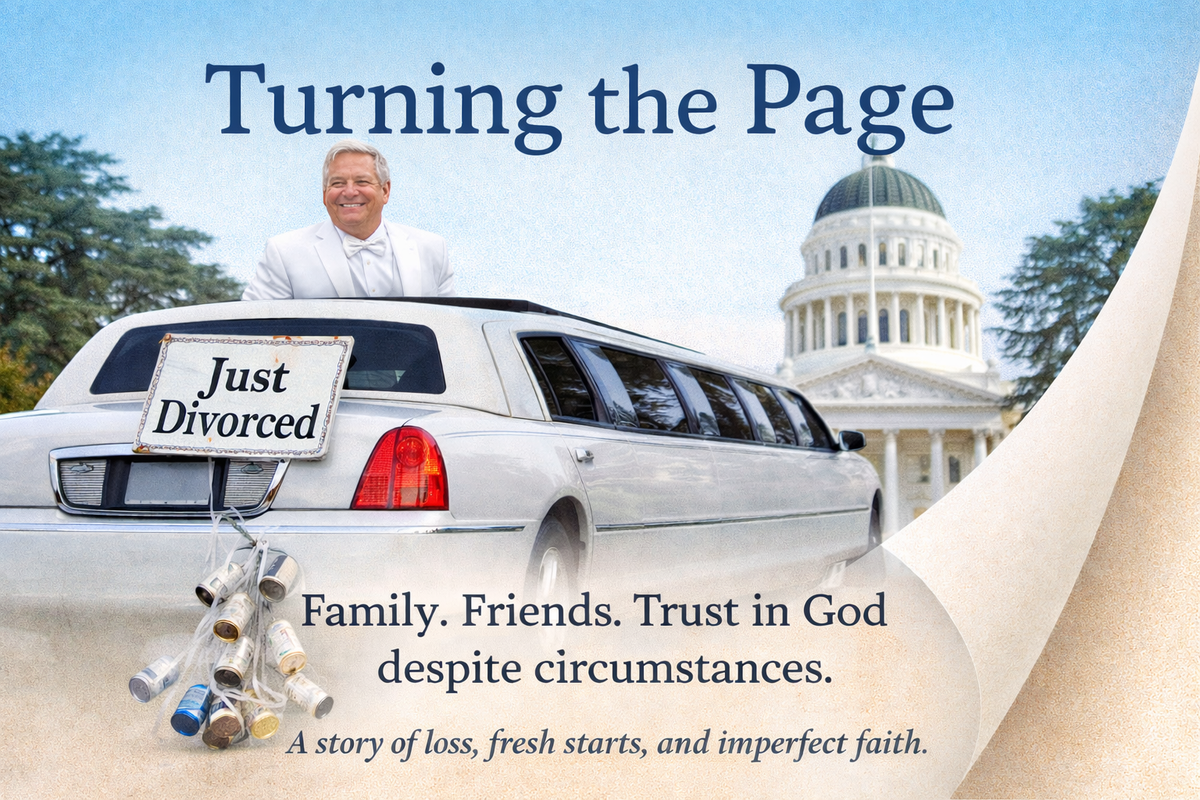
The stretch limo was solid white. The handsome man standing through the sunroof—wearing a solid white tuxedo and a grin you could see from orbit—was my dad. As the limo crept around California’s state capitol buildings, a string of cans rattled loudly behind it, doing exactly what cans are meant to do: announce something important. A large sign on the back read, “Just Divorced.”
That was my father, Robert “Mark” King, and this was his way of saying: Time to start over.
With the arrival of a new year, many of us feel that same impulse—though most of us settle for a new calendar, a gym membership we won’t use, or a resolution we quietly renegotiate by February. January invites reinvention. We like the symbolism of clean slates and fresh starts, even when real life is messier than a white tuxedo. Still, the hope is sincere: Maybe this year can be different.
Change, however, doesn’t wait for January. Life as we knew it doesn’t return. The road ahead is unavoidable, uncertain, and inconveniently short on clear signage. Our choices matter, even when we’re not sure what to choose.
After losing his wife Norma-Jean to cancer, Dad kept moving forward. She had pursued him with determination and delight, and their life together was a good one—too short, but deeply lived. Her death reshaped him in ways he never expected, leaving both gratitude and grief in its wake. Still, he stayed in a steady job, served in the reserves, earned a pension, and later worked as an electrician at an Air Force base.
Looking back, it’s tempting to see the women in my father’s life as markers along the road. Darien, my mother, was the love he wanted to marry before I was born, until life—and her mother—had other plans. Norma-Jean, his wife, made his life a delight until cancer took her far too soon. And then there was Jean, who took advantage of his generosity and left him poorer in more ways than one.
Each woman marked a chapter. None of them defined the whole story. When each chapter ended—through loss, disappointment, or death—Dad did what he had always done. He turned the page, sometimes with joy, sometimes with grief, and kept moving forward.
Rather than quietly mourning his second divorce, he marked the occasion in white-limo style.
Next, he volunteered for high-voltage electrical work on tall metal towers carrying 750,000 volts. (This is the point in the story where listeners stop nodding and start wondering about his judgment.) Midway up a tower, his partner accidentally electrified the entire structure. Dad blacked out, fell backward, and was saved only when his knee caught on the rail.
He woke in the hospital permanently disabled—alive, but done working. For a man who thrived on motion, it was yet another unexpected turn.
How much change are we built to handle? Have you moved recently? Changed careers? Fallen in or out of love? Lost someone—or gained a responsibility you never asked for? Some changes arrive like lightning; others come as a slow drip that wears us down before we realize we’re tired. Either way, the accumulation can feel like too much.
After Dad was back on his feet, we attended another unexpected event: my mother’s funeral. Their story had ended long before, but grief has a way of circling back. Later, over a quiet meal, I finally asked him how he coped with so much change and so much uncertainty about the future. I remember the pause before he answered, the way he looked down at his plate, then back up at me. Some conversations stay with you.
Dad spoke of his generation, shaped by war and loss, who learned to live with uncertainty long before it became fashionable. They leaned on family and friends, invested in relationships, celebrated small victories, and helped each other build something for tomorrow. They trusted God—not blaming Him, not seeing themselves as victims, but believing He could see them through.
By then Dad’s life revolved around horses, so naturally he illustrated his point with one. A careless visitor once startled the herd, and they stampeded over him. One hoof crushed his foot flat, breaking every bone. (Fortunately, they missed his head—small mercies matter.)
A new medical device suctioned his foot back into shape over three months. It healed completely. Once again, he moved forward.
Family. Friends. Trust in God despite circumstances. It sounds almost too simple—until you realize how often we look everywhere else first.
My father never planned the turns his life took, but he showed up for them anyway—sometimes in work boots, sometimes in a hospital gown, once in a white tuxedo. He trusted that God was not waiting at the finish line with a clipboard, but walking alongside him, even when the road made no sense.
As the new year begins, we may not get the fresh start we imagined. But faith has never required certainty—only willingness. If we are willing to trust God with what comes next, even imperfectly, we may find that starting over is not something we do alone after all.