The USS Nevada (BB-36): The Ship that Wouldn’t Sink
Guest Contributor: John Cassinelli
As a boy, I would often visit the Nevada State Museum at the old Mint in Carson City. Back then as we entered the Museum, one of the first exhibits seen was the Silver Service Set from the battleship USS Nevada (BB-36). The silver set includes 5,000 ounces of silver from the mines in Tonopah and includes a large punchbowl with 24 cups lined with gold from Goldfield mines, goblets, a tea set, and trays engraved with images of the Lahontan Dam, Virginia City, Tonopah, and Abraham Lincoln, who was President when Nevada became the 36th state. The silver set was presented to the Battleship at its commissioning on March 11, 1916, and was used on board the ship through WW2, including the bombing of Pearl Harbor. I had learned a little about the silver set in Nevada History class in school, but it
wasn’t until later that I learned of the interesting and unique story of the USS Nevada.
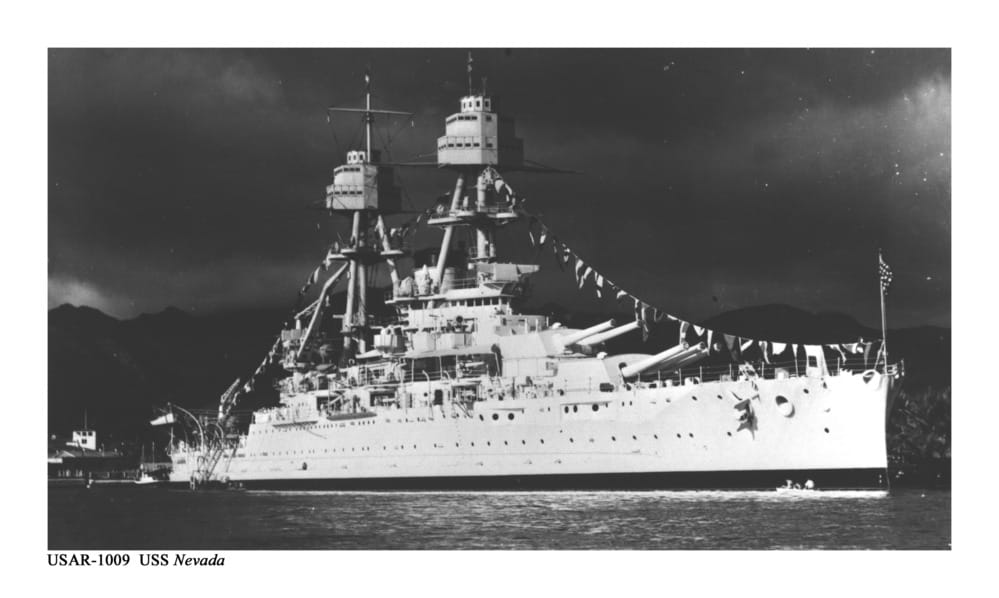
She was launched on July 11, 1914, in Massachusetts. The launch was well attended, including by then-Governor of Nevada, Tasker Oddie. The Nevada is the only ship in history whose hull number (BB-36) coincided with Her namesake state’s entry to the Union. The Nevada was the Navy’s first of 12 “Standard Type” battleships. She was the lead ship of the two “Nevada Class” ships that included triple turrets, 13.5-inch thick armor plating, and oil in place of coal for 12 oil-fired boiler steam power plants. The geared steam turbines gave Her greater range than others of the time, over 9,200 miles.
During WW1, She was part of the “Bantry Bay Squadron” stationed in Ireland to protect the many supply convoys heading to Great Britain.
After WW1, She sailed to Brazil for a public relations stop in Rio de Janeiro during the Brazilian Independence Celebration in 1922. During that stop, the New York Times credited the crew of the USS Nevada with introducing the sport of baseball to the locals. Nicknamed the “Cheer Up Ship”, in 1925 She again participated in a “good will” cruise, sailing to Australia and New Zealand, giving the Navy a chance to show off Her long-range trans-Pacific abilities.
On the morning of Dec. 7th, 1941, the USS Nevada was moored on Battleship Row just behind the USS Arizona (BB-39) in Pearl Harbor. This positioned Her near the end of the row at the start of the Japanese attack. During mooring, only one of the 12 boilers is running for basic power onboard the ship. On that morning, a junior officer made the decision to relieve the boiler that had been running for several days, and ordered a second boiler to be lit. That decision proved to be historic.
As the bombing began, the USS Nevada, with two of her 12 boilers running, was able to just barely get underway, and made a run for the mouth of the harbor. She was hit with a torpedo and at least six bombs, but managed to stay afloat. Realizing if sunk She could potentially block the entrance to the harbor, She was intentionally beached at Hospital Point. Out of 130 Navy vessels in Pearl Harbor that day, there were eight battleships, 96 warships, and various destroyers, cruisers, submarines, etc. – the Nevada was the only one to get underway. In the process, She is credited with shooting down eight of the 29 Japanese planes downed in the attack, as well as rescuing many crewman from other ships including the Arizona.
After Pearl Harbor, She was taken to Puget Sound Naval Yard for repair, then sent back into the war. She participated in amphibious assaults including invasions of Attu, and Southern France. She was selected as the flagship of Rear Admiral Deyo for the Invasion of Normandy, making the USS Nevada the only battleship present at both Pearl Harbor and the D-Day invasion. During D-Day, She is credited with destroying 12 German gun placements, and 84 Panzer and Tiger tanks while off Utah Beach.
After Normandy, She led the strike at Toulon known as “Operation Dragoon”. In 1944, She went to New York for gun barrel repairs, where they removed the guns from Turret One and replaced them with some very special armaments. The gun barrels from Turret Two of the USS Arizona were recovered, straightened, and re-lined, and installed on the USS Nevada. She then headed to Iwo Jima in 1945 in preparation of invasion. She provided gunfire support in both Iwo Jima and Okinawa, where She was struck by Kamikaze attacks, resulting in many casualties. After the war ended, She was stationed in Tokyo Bay Japan for occupation duty.
The USS Nevada was decommissioned in 1946, and used for target practice in ‘Operation Crossroads’ at Bikini Atoll where She survived two nuclear detonations. She took bombardment from a dozen Navy ships for nearly a week, yet still remained afloat. She was finally sunk by heavy gunnery and torpedo fire on July 31, 1948.
The USS Nevada survived Pearl Harbor, Normandy, Iwo Jima, Okinawa, and other battles, set records for speed and endurance, held the record for the most times through the Panama Canal, and two of Her crewman were among the first to receive the Medal of Honor in WW2. She now rests upside-down in 15,400 feet of water, approximately 75 miles from Pearl Harbor. Next time you visit the Nevada State Museum, visit the USS Nevada silver set, and think of the remarkable history of our state’s Namesake ship!