The Little Lodge on the Hill
Before Nevada existed as a state, Freemasonry was already here.
As mining camps spread across the Great Basin in the mid-nineteenth century, Masonic lodges formed alongside them, often among the first stable institutions in places defined by uncertainty. Long before courthouses were built or municipal governments fully organized, lodges provided structure, regular meetings, shared rules, charitable support, and continuity in communities that could rise or vanish within a few years.
At its core, Freemasonry is a voluntary fraternal organization centered on self-improvement, encouraging integrity, responsibility, and ethical conduct. That inward focus is expressed outwardly through fellowship, mutual aid, and quiet service to the communities where lodges are rooted.
Freemasonry’s role in Nevada’s development was rarely dramatic or political. Instead, it was steady. Lodges brought together miners, merchants, surveyors, and civic leaders under a shared framework of responsibility and continuity. In a frontier society shaped by rapid change, that consistency mattered. Lodges helped anchor towns long enough for them to become something more than temporary camps.
In early Nevada towns, Masonic lodges were rarely hidden away. They were often located directly on Main Street or just above it, over saloons, mercantile stores, boarding houses, or banks. Members met upstairs while commerce and community life unfolded below.
These buildings were practical rather than monumental. Designed for meetings, recordkeeping, and continuity, their visibility signaled stability in towns shaped by speculation and risk. A permanent fraternal hall suggested that a place might endure.
Over time, however, these same buildings became easy to overlook.
As membership declined statewide in the twentieth century and fewer people encountered lodges through family or community connections, Masonic halls remained physically present but socially invisible. Many visitors, and even long-time residents, assumed these buildings were closed to the public.
Historically, that was never the case. Masonic halls regularly hosted public meetings, civic gatherings, lectures, dances, and social events. Many still do. What has changed is not access, but familiarity.
Nowhere is this dynamic clearer than in Silver City.
Located in Gold Canyon along the historic Comstock corridor, Silver City reflects Nevada’s familiar rhythm of boom, decline, and endurance. Like many Nevada communities, it has a Masonic lodge whose history closely mirrors the town’s own fortunes.
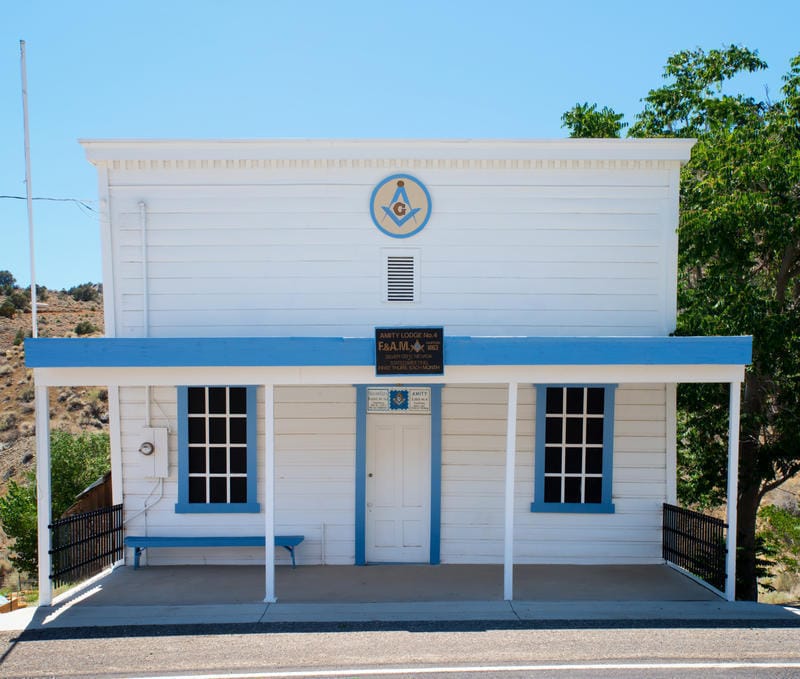
Established in 1863, Amity Lodge No. 4 has remained rooted on Silver City’s Main Street since its earliest years, first meeting in rented halls, relocating in 1867, and securing the permanent home it still occupies in 1888. The building was never intended to be ornate or monumental. In true Comstock fashion, the upper story sits at street level while the lower floor remains fully above ground, shaped by terrain rather than display.
Members affectionately refer to it as “the Little Lodge on the Hill,” a phrase reflecting familiarity more than elevation, a reminder that the building was meant to be used, returned to, and cared for over time.
Inside, more than 160 years of history accumulated quietly: handwritten minutes, membership petitions, correspondence, financial records, and photographs documenting both ordinary and ceremonial moments. Together, they form a nearly unbroken record of community life.
For much of that time, the records were simply stored, safe, but largely untouched. Like many volunteer organizations, the lodge prioritized ongoing operations over historical processing. Institutional memory lived primarily in the recollections of longtime members.
The turning point came quietly, with the recognition that time itself had become a risk.
Organizing the lodge’s records revealed a layered local history. Early meetings were held in rented halls above businesses and boarding houses, reflecting a town still finding its footing. Membership rosters overlapped with civic offices and Main Street businesses, storekeepers, mill workers, surveyors, and public officials whose lives were intertwined with Silver City’s development.
Minutes, correspondence, and financial records traced the lodge’s steady presence as Silver City transitioned from boomtown to historic community. These everyday records, votes, dues, petitions, and routine correspondence, provide a rare window into how a small Nevada town organized itself and sustained shared responsibility over time.
What emerged was not simply the history of a fraternal organization, but a microhistory of the Comstock itself.
At Amity Lodge No. 4, preservation has focused on documentation, stabilization, and thoughtful reuse rather than spectacle. Records are being organized and digitized in stages, ensuring that history remains accessible while the lodge continues to function as a living institution.
Equally important has been reopening the building to community use beyond Masonic meetings. Social gatherings and local events are reintroducing the space to the public, not as something new, but as a return to the building’s original purpose as a place of gathering.
This is what Main Street renewal often looks like in practice. It is not always driven by large restoration projects or tourism initiatives. Sometimes it begins simply by reopening doors and allowing historic buildings to reenter community life.
That continuity was formally recognized in 2025, when Amity Lodge No. 4 was added to the Nevada State Register of Historic Places (No. 250164), acknowledging both the building’s historic fabric and its enduring role in Silver City.
Preservation in Nevada is often associated with dramatic events, fires, strikes, bonanzas, and busts. Yet much of what endured did so quietly. Masonic lodges, like churches, schools, and volunteer halls, provided continuity when little else did.
In Silver City, that story continues. In a state defined by movement and change, continuity itself may be one of Nevada’s most enduring legacies.