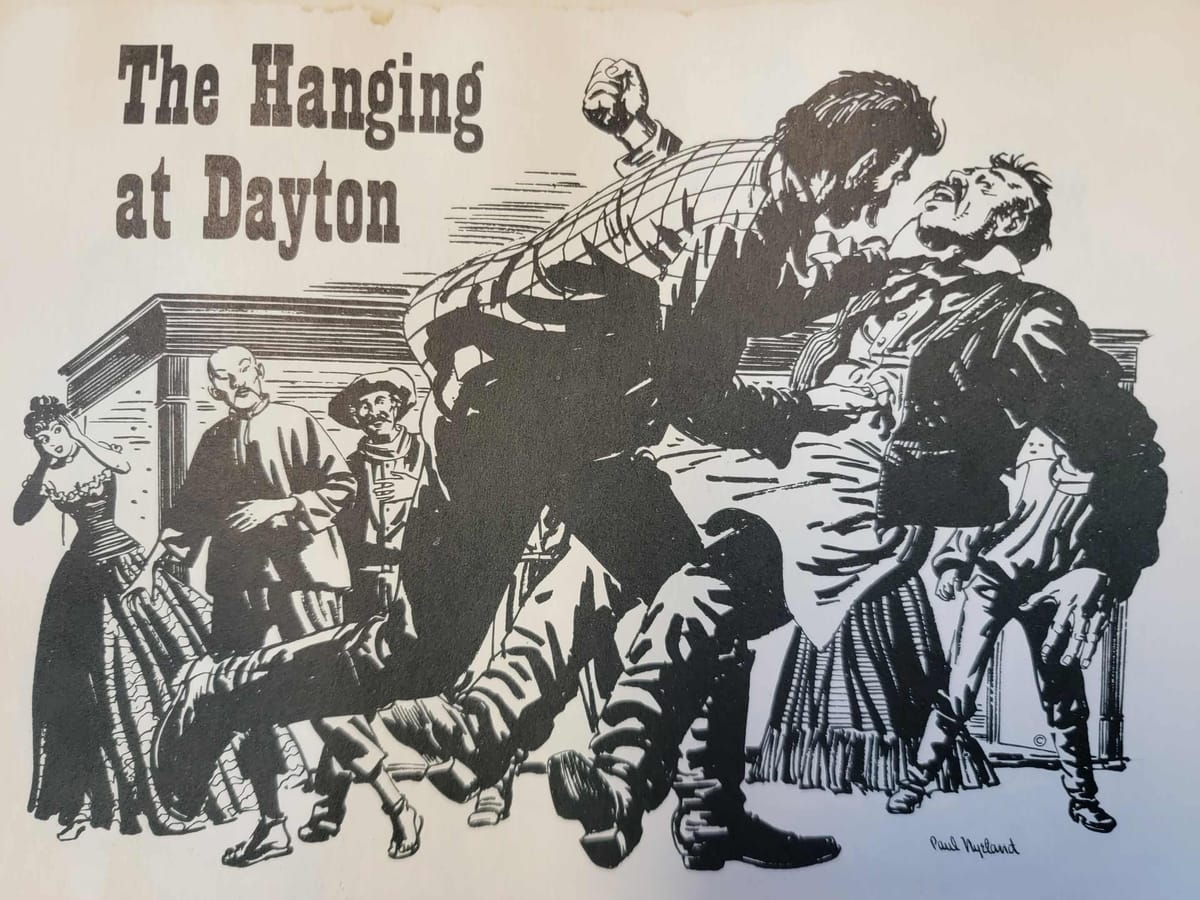
The Hanging at Dayton

From the Odeon Archives
I had planned for this story to have a different opening and to share it at a different time. But seeing as there was a bit of an incident at The Odeon, I suppose this is the best time for the retelling of this tale. We are grateful for the love and support of our community and the outpouring of patrons at our events. With all good there is the eventual bad side of things. There was an altercation by a couple of thugs that got one of our regular customers wound up in the hospital. The attackers were caught and taken in by our local sheriffs.
I'll make this very clear, violence is not tolerated at The Odeon, those assailants were arrested and trespassed for life and so will anyone that chooses violence at The Odeon. The following is a historical story of another altercation that once happened at The Odeon and what had happened to the assailant (For the record, this is history, not a suggestion.)
There is an incredible 1951 book called Pioneer Nevada published by Harolds Club (a long-gone, legendary Nevada casino). My grandpa, Jerry Adair, was actually featured in one of their books, I Want to Quit Winners, Harolds’ biography on the golden age of Nevada casinos, but that’s another story. A lot of the Nevada tales people tell today trace back to Pioneer Nevada. Most of them were written with a storyteller’s touch, so details got embellished, blended, or added over time. That’s the part I enjoy. I like to dig into these pieces and sort out what really happened from what was layered on later. Doing that has led me to some great stories that aren’t fully true, but they aren’t fully untrue either. Here is one of those 204 short stories from Pioneer Nevada.
"The Hanging at Dayton"
Pioneer Nevada,
Harolds Club, Copyright 1951
"THE LITTLE TOWN of Dayton was very proud of its early day reputation as a law-abiding camp. So when James Linn plunged his dagger into the heart of John Doyle on the main street, in 1864, the respectable citizens of the town all moved quickly to punish the murderer.
Dayton started in ’49 with the first house built in Nevada east of Carson. Traders and emigrants had panned a few colors at the mouth of gold canyon, known as Hall’s Station or McMarlin’s. In 1861 it was renamed for John Day, the county surveyor, and in 1864 John Reese imported hundreds of Chinese to build a ditch to run some mills. Locally the place was then called “Chinatown,” and many of the Orientals remained to pan around the countryside.
John Doyle ran a saloon and dance hall, and the girls lived above the saloon. He got in an argument with Linn, who was a customer, and the argument soon moved to the street, on a hot August night, and then flared into a fight. In the struggle, Linn stabbed Doyle and was then promptly seized by the citizens of the town.
While one committee guarded him in his jail cell, another group quietly built a gallows, and hid it under the little church. Another committee went about the town advising everyone to go home quietly, without further question. A group of masked men were quietly patrolling the streets, and soon all of Dayton was as quiet as a grave.
The next morning the sheriff was “astonished” to find Linn dead in his cell! It was soon reported that the vigilantes had taken Linn to the gallows late at night. When he tried to cry out for help, they had gagged him, filling his mouth with dirt; and the hanging had been quick and efficient. The body was then returned to the jail, the gallows taken apart, and the committee returned to bed.
An unexpected result was the immediate clearing the town of many undesirables, these worthies all departing before the early dawn of the next day. The news was received at nearby Fort Churchill with great excitement, and a detachment of troops dispatched at a gallop to “restore order to Dayton.” These soldiers were soon patrolling the town. And in Carson City, Governor Nye was equally disturbed and came post-haste with all his staff, having heard Dayton was filled with a disorderly mob.
When the Governor arrived he found all quiet and orderly, but he went upstairs to the balcony of Odeon Hall and there, for the first time in Nevada history, read the riot act. He read to a deserted street and then drove back to Carson. Dayton gradually resumed a normal air as the troops also departed. It had punished its own violence according to its own mining camp code."
Now, what do you think of this short story? True, false, or embellished? Maybe we'll never know. One thing we do know for sure is, fighting is not allowed at The Odeon and especially, don't stab the owner.