The Great Nevada Idea: Put the Commuters Back on Rails

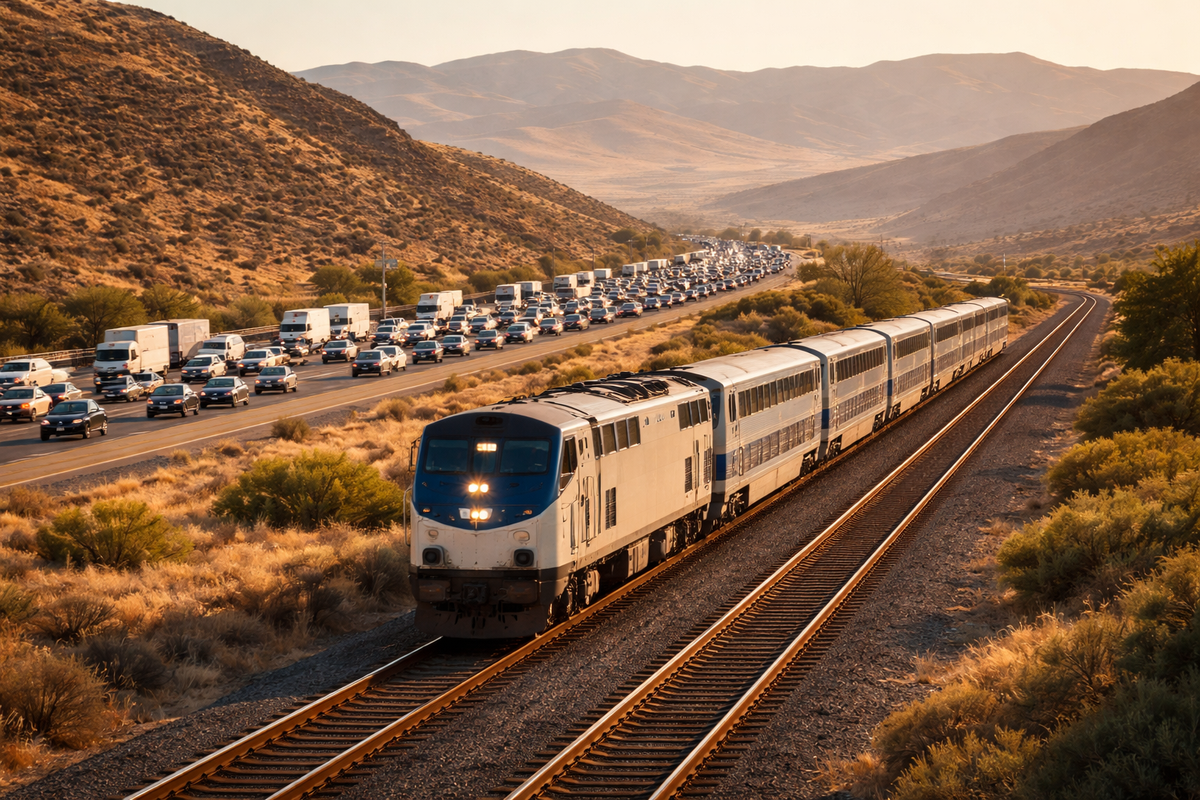
Well, now, I have lived long enough to see progress turn around, tip its hat, and walk back the way it came, claiming it discovered something new. It happens whenever a crowd gathers thick enough to convince itself that standing still is a form of travel.
Such is the case on Interstate 80, where every morning a determined parade of citizens sets out for USA Parkway with high hopes and low expectations, and arrives, if Providence is kind, sometime before supper. It is a road so crowded that a man may leave Reno with a full head of ambition and arrive in Storey County with nothing but resignation and a coffee gone cold.
Now the authorities, being men of thought and study, have hit upon a solution so bold it nearly startles the century: they propose to put folks on a train.
Yes, a train.
The revelation comes courtesy of the Regional Transportation Commission of Washoe County, which has spent a year examining whether the iron road, declared old-fashioned and abandoned to freight and nostalgia, might yet carry people again. They have consulted maps, figures, and no doubt a few worried expressions from Union Pacific, which owns the tracks and prefers its trains unbothered by the public.
Mr. James Gee, the man tasked with the transit and therefore burdened with reality, reports that the scheme is “feasible,” which is a government word meaning “possible, provided money behaves itself, and nobody objects too loudly.”
There is, however, the small matter of cost. The starter version of this grand notion is a modest $175 million, which is the sort of modesty one encounters only in public works. Should the plan grow to its full ambition, it may exceed a billion dollars, at which point it will be considered both visionary and inevitable.
The difficulty lies not merely in laying claim to such sums, but in persuading Union Pacific that sharing its rails with passengers will not lead to catastrophe, delay, or worse, conversation. Freight trains, you see, are creatures of habit and solitude, and do not take kindly to being asked to keep time with commuters who insist on arriving somewhere before retirement.
Meanwhile, the good people of I-80 continue their daily experiment in patience. The road boasts roughly 150 accidents a year, which averages out to one every other day, enough to keep hope in a permanent state of reconsideration. Some travelers have grown so accustomed to delay that they measure distance not in miles, but in sighs.
And so, the proposal unfolds in two acts. First, a short-term plan to get trains running quickly. "Quickly,” in this case meaning sometime before the freeway widening is completed in 2031, spoken of in tones usually reserved for distant eclipses.
Then, a long-term vision in which the rails stretch farther, the trains carry upward of 15,000 souls, and the whole enterprise begins to resemble the very system our great-grandfathers abandoned for the freedom of the open road. Then there are whispers of enlisting the great industrial powers, who might contribute funds in exchange for the benefit of having their workers arrive at work on time.
All of this is being studied, reviewed, discussed, and carefully placed into frameworks, which are the natural habitat of plans not yet ready to exist.
Still, one cannot help but admire the elegance of it. After years of widening roads, multiplying lanes, and encouraging every man, woman, and coffee cup to travel in separate vehicles, we have rediscovered the peculiar efficiency of sitting together and letting a single machine do the work.
It is a fine idea, and it was a fine idea the first time, too. And at this rate, I expect we shall reintroduce walking, though I trust we’ll study it thoroughly before committing.