Starting with Schools: A New Approach to Emergency Management in Storey County

When most people think about emergency management, they think about disasters.
But according to Storey County Emergency Management Director Adam Wilson, much of the work happens long before an emergency ever occurs.
“Most people don’t realize Emergency Management exists,” Wilson said. “Those who have heard of us don’t know what we do day to day.”
On any given day, Wilson and his team are writing plans, coordinating with partners, securing grants, and training alongside first responders. During disasters, they support operations in the field. Afterward, they manage reimbursement and compliance with state and federal agencies.
“We like to say, ‘we know a guy,’” Wilson said. “If responders need something, we find it and get it for them.”
Now, Wilson is focused on strengthening one of the county’s most important partnerships: local schools.
County Manager Austin Osborne echoed that sentiment, emphasizing that the work with local schools reflects a broader county-wide commitment to collaboration.
“I'm proud of the seamless collaborative relationship that exists between the county and the school district on numerous fronts,” Osborne said. “When agencies work together proactively, our entire community benefits.”
Starting with Schools
Wilson said the renewed focus on schools began when his office recognized a gap.
“Our schools are a critical part of our communities,” he said. “They have strong relationships with residents; they can help share information, and we can help them with training, exercises, planning, and finding resources to make schools safer.”
He described the impact as exponential.
“When a student or staff member learns about preparedness, participates in an exercise, or receives resources, that information goes home,” Wilson said. “Our readiness expands again. As students grow older, they carry that knowledge with them. Starting at the schools allows us to build resilience across the entire county.”
That partnership now includes regular collaboration between Emergency Management, the Sheriff’s Office, the Fire District, and the Storey County School District.
Storey County Sheriff Mike Cullen said his office plays a leading role in many school drills, depending on the scenario, and focuses on ensuring first responders and school employees are aligned.
“We plan for worst-case scenarios and train for them,” Cullen said. “Training, planning, and school drills include both man-made and natural disaster scenarios. We brief, conduct training, and debrief so that each event becomes a learning event.”
A Unified Approach
For Sheriff Cullen, familiarity is foundational. He describes it as being “tuned in.”
Deputies walk campuses, learn the layouts of facilities, build relationships with staff, and understand how schools function on a daily basis, from emergency procedures to routine pickup and drop-off operations.
He noted that partnerships between the agencies have significantly improved in recent years.
“We have seen a 100 percent improvement in that relationship,” Cullen said. “Our ability to put our communities first and provide the best service possible as a group has been outstanding.”
From a law enforcement perspective, Cullen said effective planning starts with strong relationships and flexibility.
“You start with a solid foundation,” he said. “That’s having strong partnerships and working together. You stay flexible and adapt to changing conditions with the goal in mind.”
Faster, More Focused Response
Storey County Fire Chief Bob Ryser said having Emergency Management embedded in school planning has fundamentally changed how the Fire District responds to school incidents.
“It lets us focus on our piece, which is critical to the speed of our operation,” Ryser said. “We know the integration is already in play.”
With emergency management coordinating logistics and reunification, and law enforcement handling scene control, fire personnel can concentrate on their specialized roles, including emergency medical services and technical rescue.
“You can’t do anything well if you’re stretched too thin,” Ryser said. “In the fire service, we sometimes try to be 100 yards wide and only an inch deep. With this structure in place, we can narrow that focus and go deep in our skill set instead of trying to manage the entire incident.”
That shift, he said, directly impacts response time.
“It’s changed dramatically,” Ryser said, describing unified response improvements between the Fire District, the Sheriff’s Office, and Emergency Management. “We’re not waiting as long to engage.”
In the past, fire crews might have staged outside a scene until certain benchmarks were met. Today, through joint training and clearer integration, responders are prepared to move in more quickly when circumstances allow.
“If it’s critical for us to get in, we’re going to be able to engage much faster,” Ryser said. “That decreases the potential for loss.”
Raising the Standard
Storey County School District Superintendent Joe Girdner said safety planning is a top priority for the district.
“Nothing is more important than the safety of our students and staff,” Girdner said. “Without planning and regular training, we would not be ready to respond when it matters most.”
With nearly three decades of experience in Northern Nevada school districts, Girdner described Storey County’s collaboration with emergency services as exceptional.
“This is the strongest working relationship with local emergency services I’ve ever seen,” he said.
Emergency Management, the Sheriff’s Office, and the Fire District are active members of the school district’s Emergency Operations Committee and help shape the district’s Emergency Operations Plan. They also participate in training on school campuses, so they are familiar with each facility.
“That level of involvement ensures our plans are realistic, coordinated, and well thought out,” Girdner said.
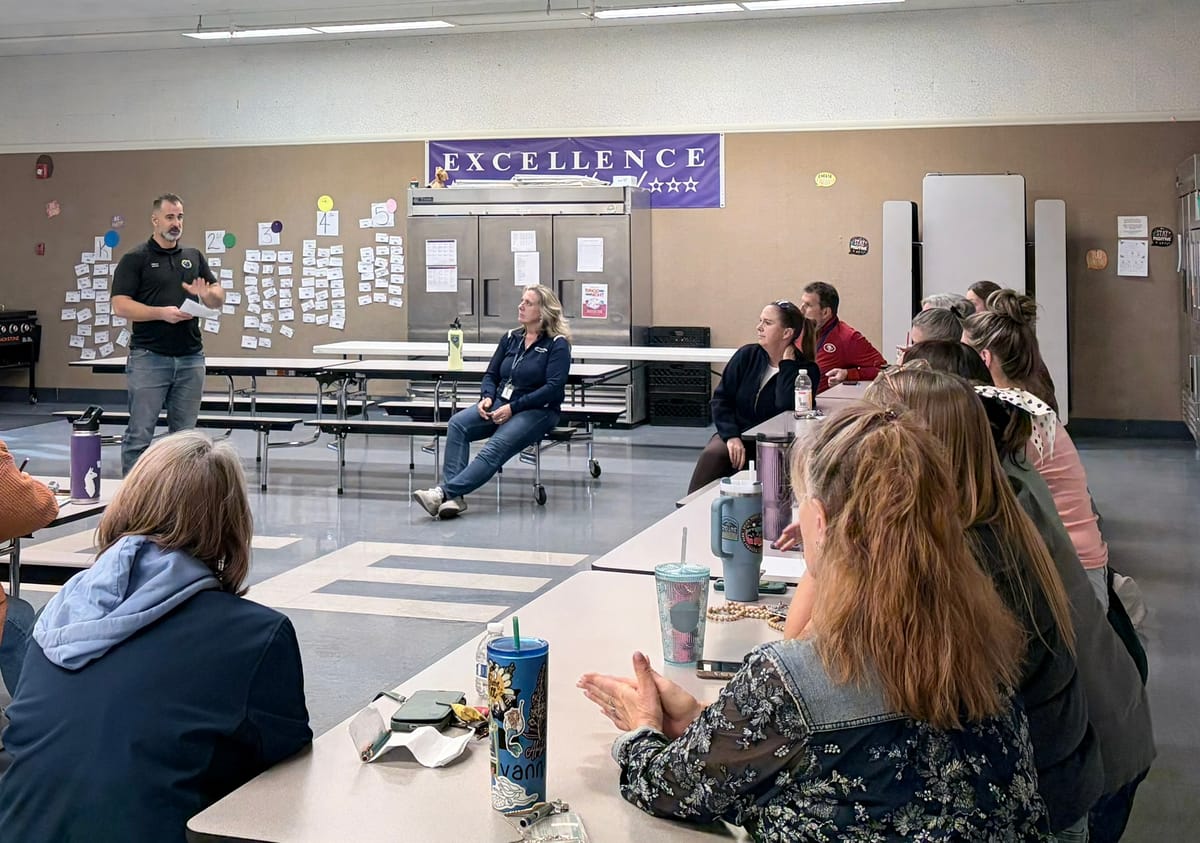
District staff trains monthly on emergency response procedures. Girdner said the visible presence of emergency partners during those trainings has increased staff confidence.
“Seeing familiar faces, building relationships, and training side-by-side reinforces trust,” Girdner added.
Behind the Scenes
For parents, much of this work is invisible.
“We are always planning and strategizing,” Cullen said. “We train, we conduct drills, and we meet and discuss how we can do better to best serve our community.”
And Girdner echoed that sentiment, calling school safety a shared responsibility across the community.
“For students and families, it means school safety is not something we handle alone,” he said. “It’s a shared responsibility with strong coordination and clear communication.”
Looking Ahead
Wilson’s long-term vision extends beyond plans and drills.
“I want Storey County to be a shining beacon across the state of coordination, preparedness, and resilience,” he said. “I want kids from Storey schools to grow up knowing what emergency management is.”
For Wilson, the goal is not just responding to emergencies but building a culture of preparedness.
And in Storey County, preparedness is no longer just a plan on a shelf. It’s a partnership in motion.