So... Did You Ride the Goat?
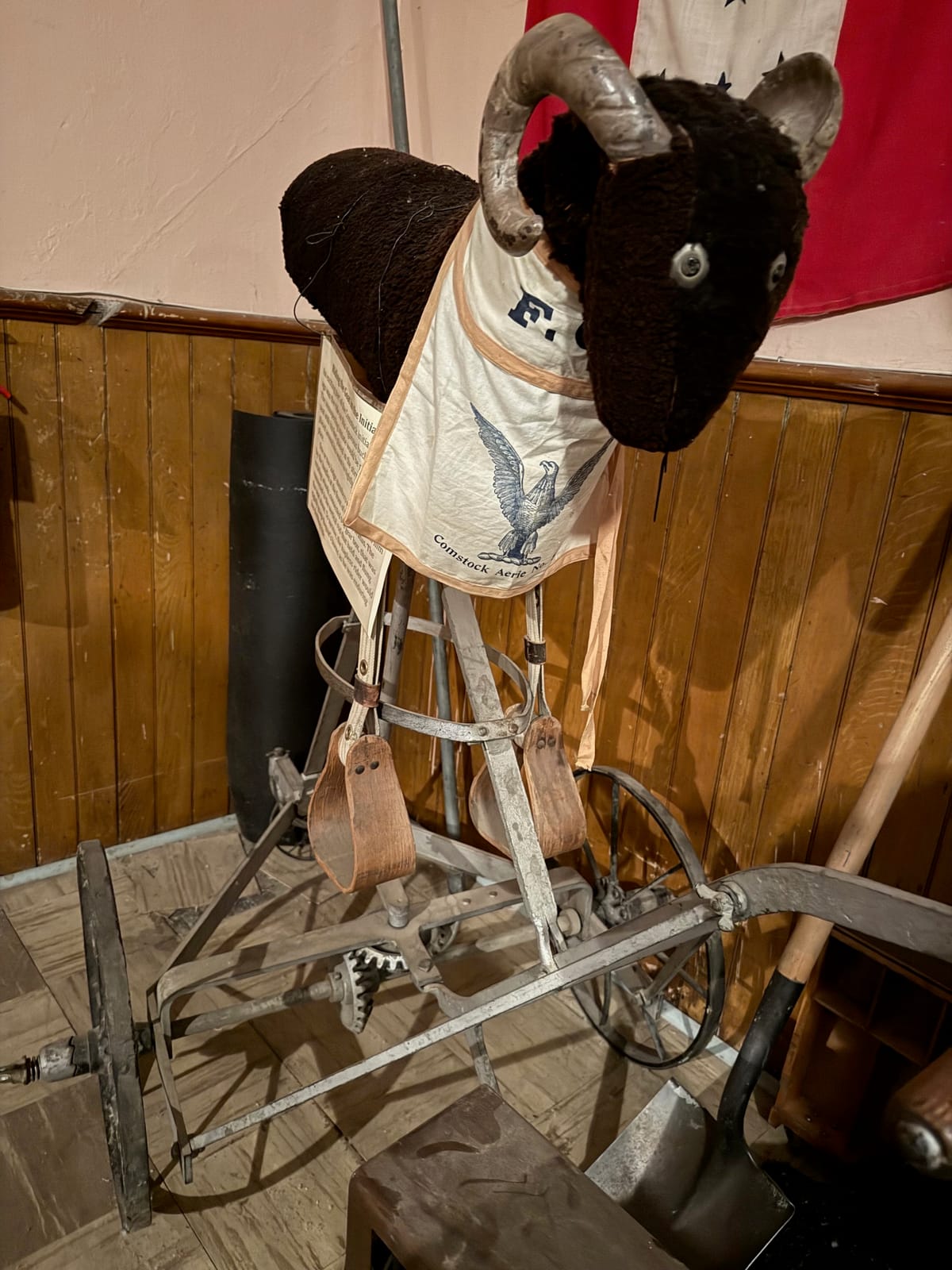
If you have spent any amount of time in Virginia City, or around people who have, you have likely heard the question. It is usually asked with a grin, sometimes with a nudge, and almost always by someone who already knows exactly where the conversation is headed.
“So… did you ride the goat?”
The question does not truly seek an answer. It merely invites the imagination to take the reins. Instantly, the listener supplies the scene: a dimly lit fraternal hall, solemn proceedings of questionable seriousness, muffled laughter behind closed doors, and somewhere in the middle of it all, a goat having a very bad night. The image is absurd, unforgettable, and permanently attached to fraternal life.
For years, the goat lived comfortably in rumor. Outsiders believed in it with genuine concern. Insiders neither confirmed nor denied anything, which proved to be the wisest course. The less that was explained, the better the story became. And then, because this is America, and Americans are rarely content to leave a perfectly good rumor alone, someone decided the goat ought to be made real.
That distinction belongs to DeMoulin Bros. & Co. of Greenville, Illinois.
Founded in 1892, DeMoulin would eventually become famous for marching band uniforms worn at parades, bowl games, and even the Olympics. But before plumes, drum majors, and halftime glory, the company built its early reputation supplying fraternal orders with novelty initiation devices, contraptions designed to entertain the members and unsettle the candidate. Their greatest contribution to American folklore was the mechanical goat.
These were not symbolic goats meant to impart moral lessons. They were fuzzy, wheeled inventions engineered to wobble, buck, rattle, and remove whatever dignity a candidate still possessed. Lodge catalogs described them with remarkable cheerfulness. Just when the rider believed the experience had settled into something manageable, the machine proved otherwise, usually with enthusiasm and never with good manners.
At that point, “riding the goat” ceased to be a figure of speech and became a memory.
Fraternal halls across the country embraced the joke. Not as part of solemn ritual, but as an added attraction, something to keep meetings lively and attendance reliable. Everyone endured it once. Everyone laughed afterward. And everyone thereafter enjoyed the privilege of smiling quietly when the subject came up again.
Virginia City was no exception.
At Fraternal Order of Eagles Aerie No. 523, meeting in the Miners Union Hall, candidates truly did ride the goat. Not figuratively. Not symbolically. They climbed aboard and held on while their future brothers ensured the occasion would not soon be forgotten.
In a mining town, this arrangement made a certain kind of sense. Underground, a man learned quickly that titles and reputations carried little weight when things went wrong. The goat operated on much the same principle, only with more laughter and considerably less dust. Rank vanished. Pride disappeared. For a few moments, everyone was equal, trying not to fall off a rolling animal while the room enjoyed itself immensely.
That, whether anyone bothered to say so aloud, was the entire point.
In its early years, the goat was meant to frighten the curious and scandalize the suspicious. Later on, it was kept around for a much nobler purpose: to see whether a man could endure embarrassment without losing his sense of humor.
Over time, the goat retired from active duty. Fraternal culture changed. Tastes softened. Liability lawyers multiplied. DeMoulin turned its attention to uniforms, robes, and regalia, and the goats were pushed into storage rooms, basements, and memory. The story, however, showed no interest in retiring.
It never does.
Because the goat is not really about secrecy, or machinery, or even goats. It is about fellowship. It is about a roomful of people deciding that the best way to welcome someone is to make sure they can laugh at themselves and survive the telling afterward. And it is about the peculiar human talent for improving a story every time it is repeated.
And so, the question still finds its way into conversation, usually when least expected.
“So… did you ride the goat?”
The correct response has always been the same. You pause. You smile. You offer just enough of an answer to keep the legend intact.
And if curiosity finally gets the better of you and you would like to see the goat for yourself, inquiries may be directed to Fraternal Order of Eagles Aerie No. 523. Just do not expect a full explanation. Around Virginia City, some traditions work best the way they always have, passed along with a grin, and left slightly unfinished.