Silver Springs: A Crossroads to Nevada Statehood
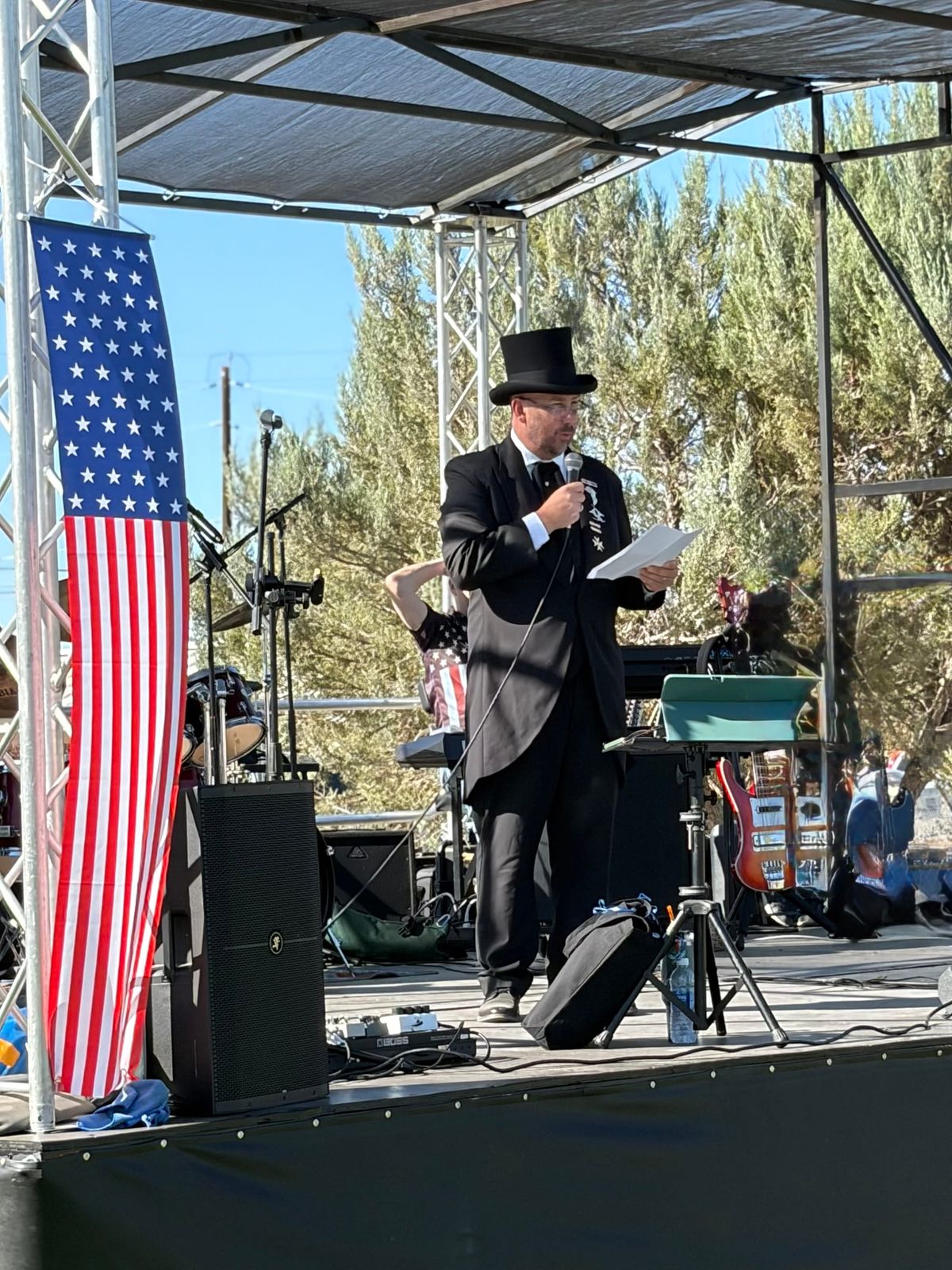
On Oct. 10, 2026, residents and visitors gathered at Penny Park for the Silver Springs & Stagecoach Founders Day celebration, held in conjunction with America's 250th anniversary. The occasion provided an opportunity to reflect on the historical significance of a community that has served as one of western Nevada's important crossroads for generations.
Today, Silver Springs is best known as the intersection of U.S. Hwy 50 and U.S. Hwy 95 Alternate. Yet long before paved highways and automobiles, this region connected Native American travel routes, emigrant trails, military roads, stagecoach lines, and the transportation networks that supported the Comstock mining district.
The highways are modern. The crossroads are not.
Long before American explorers arrived, Northern Paiute peoples lived and traveled throughout the region. They knew its rivers and springs, valleys and mountains, and the routes connecting them. These pathways formed part of a network that existed long before western Nevada appeared on American maps.
In 1844, John C. Frémont's exploring expedition, accompanied by Kit Carson, traveled through the region and reached the Carson River. Four years later, the discovery of gold in California transformed the American West. Thousands of emigrants headed west, many following the California Trail and its Carson Route through what would eventually become Nevada.
The Carson Route passed through the vicinity of present-day Silver Springs. Families traveling west carried nearly everything they owned in wagons, often arriving in western Nevada after more than a thousand miles of difficult travel. They needed water, grass for their animals, and established routes leading toward the Sierra Nevada.
As emigrant traffic increased, wagon trails became established roads carrying mail, freight, livestock, and supplies. In 1859, Army Captain James H. Simpson surveyed a shorter wagon route between Utah and California. While traveling west from Pleasant Grove toward Dayton, he followed an established emigrant road along the Carson River, describing it as being “as well beaten as any in the States.”
It was a remarkable observation for a region that had not yet become a state or even a separate territory. Western Nevada already had traffic, and it was about to become considerably busier.
The discovery of the Comstock Lode in 1859 dramatically changed western Nevada. Virginia City, Gold Hill, and the surrounding mining communities grew rapidly as thousands arrived seeking opportunity. The growing population required food, lumber, machinery, mining equipment, and other supplies. Roads that had once carried emigrants through Nevada toward California increasingly connected communities within Nevada itself.
For years, many travelers had regarded western Nevada primarily as a place to cross on their way to California. The Comstock gave thousands of people a reason to remain.
The importance of the crossroads near Silver Springs became particularly evident in 1865, when a station was established at a location first known as Stockstore Station and later as Stockton Well. According to the historical marker at Stockton Well, five trails converged at the site, including the Carson Immigrant Trail and the Carson-Humboldt Toll Road.
These routes served different purposes. Some carried emigrants toward California, while others supported Nevada's developing mining districts and settlements. Travelers needed places to rest and resupply. Animals required water and feed. Freighters and mail carriers depended upon established roads and reliable stopping places.
Stockton Well was therefore more than an isolated station. It stood at a junction essential to the movement of people and goods across western Nevada. The station did not create the crossroads. The crossroads created the need for the station.
In 1860, the United States Army established Fort Churchill along the Carson River, west of present-day Silver Springs. The fort was established during a difficult and violent period in the region's history, including conflict between settlers and Northern Paiute peoples. Its location placed a significant federal presence along an important transportation corridor at a time when western Nevada was undergoing rapid change.
That same year, the Pony Express began carrying mail between Missouri and California. Beginning in April 1860, riders traveled between relay stations, changing horses frequently to maintain their speed. The service demonstrated that mail could cross the continent in approximately 10 days, a remarkable achievement for the period.
Although Silver Springs itself was not a Pony Express station, the service operated through the broader Carson River region. Buckland's Station, near Fort Churchill, served as a Pony Express remount station. The route's proximity illustrates the importance of the Carson River corridor to communication across the West.
The Pony Express became one of the most enduring symbols of western transportation, but its existence was brief. Even while riders carried mail across Nevada, telegraph lines were being extended across the continent.
The horse was about to lose a race to a wire.
On Oct. 24, 1861, the transcontinental telegraph was completed, connecting California with the eastern United States. For generations, information could travel only as quickly as a person, horse, wagon, or ship could carry it. The telegraph changed that limitation almost overnight. Messages that once required days or weeks could now travel enormous distances in minutes.
On Oct. 26, just two days after the telegraph's completion, the Pony Express ceased operations after approximately 18 months of service.
Three years later, Nevada would demonstrate just how important this technology had become.
In 1864, the United States was in the midst of the Civil War. Abraham Lincoln was President, and Nevada remained a territory. Nevada had already attempted to become a state. In 1863, voters rejected the first proposed constitution. A second constitutional convention met in Carson City during the summer of 1864, and voters approved the revised constitution on Sept. 7.
Before President Lincoln could proclaim Nevada's admission to the Union, a certified copy of the approved constitution had to reach Washington, D.C. Territorial officials initially attempted to deliver the document through conventional transportation routes.
One copy was sent eastward by Overland Mail, accompanied by the official canvass of Nevada's election. Another was sent toward San Francisco for shipment by steamship through Panama and onward to the East Coast.
Neither copy reached Washington in time.
On Oct. 24, Governor James W. Nye received word that the official election canvass had arrived, but the constitution accompanying it had not. The copy sent by the other route had also failed to arrive.
Washington had Nevada's election results. Nevada had an approved constitution. Unfortunately, the two were in different parts of the country.
Horace Carpentier of the Overland Telegraph Company proposed an extraordinary solution: transmit the entire constitution by telegraph.
On Oct. 26, 1864, telegraph operators in Carson City began transmitting the Nevada Constitution across the continent. The document contained 16,543 words written on 44 handwritten pages. James H. Guild, superintendent of the Carson City telegraph office, participated in the lengthy transmission. The work required the constitution to be sent in Morse code and relayed through a series of telegraph offices across the country.
The transmission from Carson City to Salt Lake City alone required approximately seven hours. From there, the message continued through Chicago and Philadelphia before reaching the War Department Telegraph Office in Washington, D.C.
At each relay, operators received the message, recorded it, and transmitted it over the next section of the telegraph network. Accuracy was essential, as the document would become the foundation of Nevada's state government.
Other telegraph traffic along the route was suspended to allow the constitution to pass. During the Civil War, when those same wires carried military and government communications, this represented an extraordinary undertaking.
The complete transmission required nearly two days. When reconstructed in Washington, the 44 handwritten pages occupied 175 pages. The cost was $4,303.27, an extraordinary expense for the territorial government.
Nevertheless, the transmission accomplished what conventional transportation had failed to achieve.
A telegram sent from Carson City on Oct. 29 and received in Washington on Oct. 30 further illustrates the urgency surrounding Nevada's admission. The message informed federal officials that the entire constitution had been transmitted to the President to avoid the possibility of its not being received by mail. It also requested immediate notification once Nevada was admitted, explaining that political opponents were seeking to use the delay against the territorial administration.
The telegram demonstrates that the urgency surrounding statehood was not simply a matter of transporting a document. It also reflected the political circumstances of Nevada Territory during the closing months of the Civil War and the approaching presidential election.
On Oct. 31, 1864, President Abraham Lincoln proclaimed Nevada's admission to the Union as the nation's 36th state.
Only three years earlier, the Pony Express had carried mail across Nevada on horseback. Now, Nevada's constitution had crossed the continent as electrical signals traveling over telegraph wires. The distance between Carson City and Washington had not changed, but the time required to communicate across that distance had been transformed.
The history of Silver Springs reflects the transformation of western Nevada during the 19th century. Northern Paiute people traveled through and inhabited the region long before American exploration. Emigrants followed the Carson Route toward California. The discovery of the Comstock Lode brought new demands for transportation and commerce, while Fort Churchill and the Pony Express demonstrated the growing importance of the Carson River corridor.
The transcontinental telegraph connected Nevada with the rest of the nation and ultimately made possible the extraordinary transmission of the state's constitution in Oct. 1864.
As America commemorates its 250th anniversary, the history of Silver Springs reminds us that the nation's story was shaped not only in its eastern cities but also along the trails, rivers, mining districts, and communication routes of the American West.
Silver Springs was a crossroads long before modern highways appeared on the landscape. The methods of travel changed. The technology changed. Nevada itself changed.
Yet the common thread remained the same: connecting people, communities, and ultimately Nevada with the nation.
And when conventional transportation failed to deliver Nevada's constitution to Washington in time, the territory found another way.
Nevada wired itself into the Union.