Prohibition and Pearl Harbor

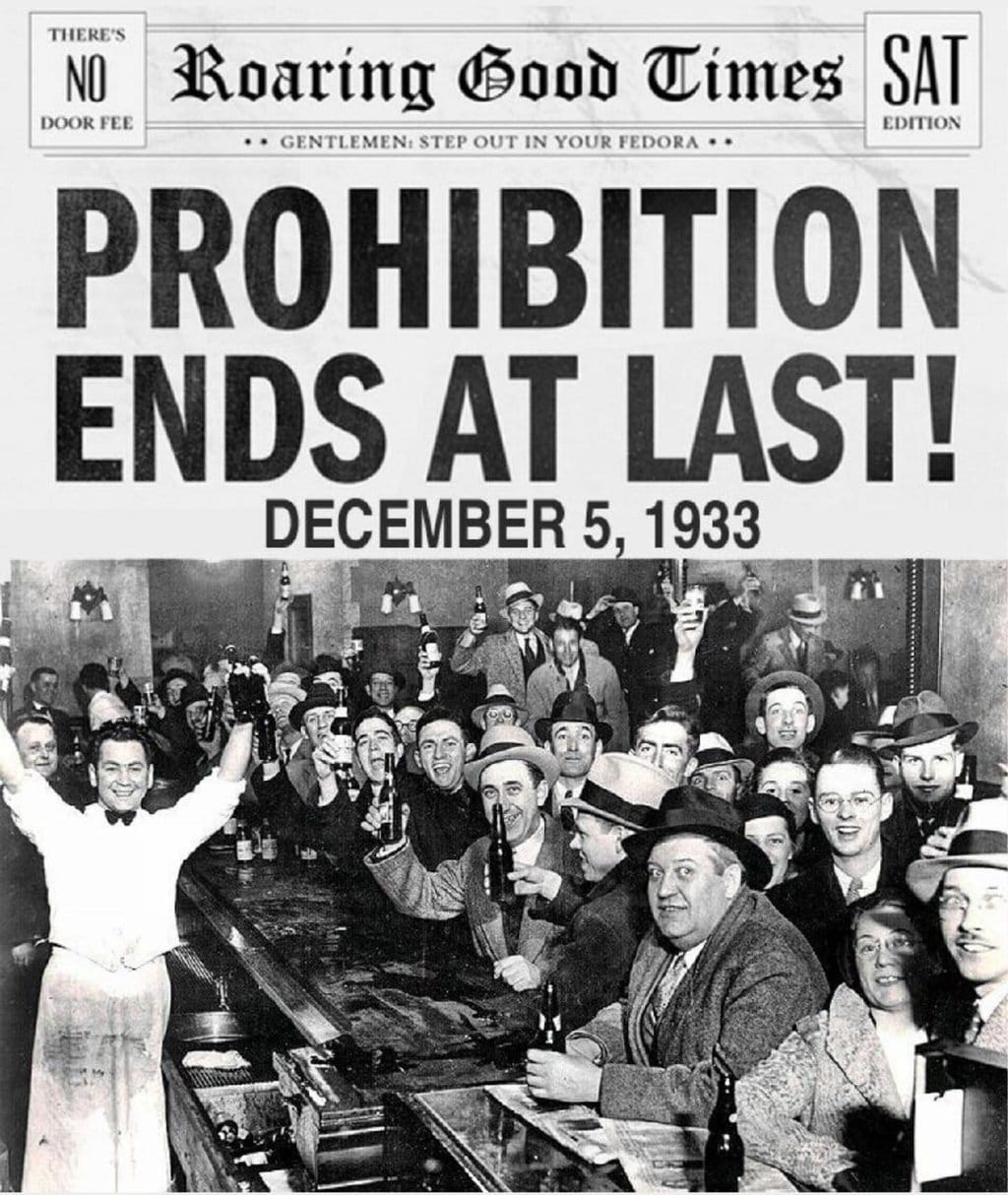
There is an incredibly important holiday on the calendar this week that we should never have forgotten but largely have. Maybe because of complacency, or just the way humans tend to forget why we have the freedoms we do and allow past mistakes to repeat themselves.
On this day in history, Dec. 5, 1933, we, the American people, repealed Prohibition. It’s a day we ought to celebrate with the drink of your choice and a toast to our forefathers.
Prohibition was pushed into law by the temperance movement. A movement that blamed all sorts of atrocities on alcohol. They argued that liquor was destructive because it supposedly caused divorce, poverty, pauperism, crime, child abuse, and insanity. They claimed that most crime, insanity, and poverty were caused by alcohol alone. They promoted ideas about hereditary “degeneration,” feeble mindedness, and “race suicide,” and pushed the notion that one drink started an inevitable slide to murder or suicide.
We now know that yes, there are real problems with alcohol, and that it’s something that should be enjoyed moderately and responsibly. Not demonized as the root of all evil.
Here’s a fun (and slightly crazy) Prohibition fact: did you know you could get a prescription for whiskey?
When national Prohibition hit in 1920, the Volstead Act left a huge escape hatch. Doctors with a federal permit could prescribe up to one pint of spirits every 10 days per patient, usually whiskey. Patients paid the doctor for the prescription and then paid the pharmacy to fill it, which made it very lucrative for both professions. Pharmacies like Walgreens exploded in size, growing from roughly a couple dozen stores to hundreds during the 1920s, in large part by filling these “medicinal” whiskey prescriptions.
What Prohibition really did, maybe more than anything else, was help turn the mafia and other organized crime into superpowers. The illegal alcohol trade made on the order of a few billion dollars a year in 1920s money, which translates to tens of billions per year in today’s dollars! Organized crime rode that river of money and built the networks, corruption, and muscle that are still problems today. Problems that would have looked very different if Prohibition had never been instituted.
And what do you need to fight “big crime”? You get big government.
In 1920, the federal government created a Prohibition Unit inside the Bureau of Internal Revenue (IRS). It started with roughly 960 “dry agents” and was supposed to track, raid, and prosecute illegal manufacture and sale of alcohol nationwide.
The Prohibition Unit quickly became a mess, understaffed, corrupt, and politically captured, so Congress passed H.R. 10729 on March 3, 1927, creating a standalone Bureau of Prohibition in the Treasury Department. By 1930, Treasury’s tax collection culture didn’t mesh with the increasingly violent organized crime war, so the Bureau of Prohibition’s crime fighting functions were moved to the Department of Justice.
Also in 1930, Congress created the Federal Bureau of Prisons to manage a federal prison population that had exploded largely due to Prohibition prosecutions, from about 3,700 inmates in 1920 to over 13,000 by 1933.
The best grounded estimate is that the federal government spent roughly $300 million enforcing Prohibition from 1920-1933, which is on the order of $5-6 billion in today’s dollars. At the same time, the government lost out on about $11 billion in liquor tax revenue, roughly $200-205 billion in today’s money.
So what’s the takeaway? Or, as Detective Smecker says in one of my favorite movies, The Boondock Saints:
“I’m sure the word you were looking for was ‘symbolism.’ What is the sss-himbolism there?”
For me, it’s a mix of things. It’s a reminder of what happens when fear and moral panic get written into law. It’s a reminder of how hard it is to claw back freedoms once we’ve given them up. And it’s a reminder that unintended consequences, like supercharged organized crime and massive government apparatus, can be far worse than the original problem.
You’re welcome to enjoy a shot of whiskey and a beer with me and discuss it at The Odeon.
And Another Date We Must Not Forget
While we’re talking about important December dates that are fading from memory, there’s another one we should never let slip:
Dec. 7 is Pearl Harbor Day.
On Dec. 7, 1941, Japan launched a surprise attack on the U.S. naval base at Pearl Harbor:
- 2,403 Americans were killed (sailors, soldiers, Marines, and civilians)
- 1,178 were wounded
Out of the U.S. Pacific Fleet at anchor:
- 8 battleships were hit
- 4 battleships sunk: Arizona, Oklahoma, West Virginia, California
- 4 others badly damaged: Tennessee, Maryland, Nevada, Pennsylvania
- In total, 19–21 ships were sunk or damaged, including:
- 3 cruisers damaged
- 3 destroyers damaged
- 1 ex-battleship and several auxiliary ships and tugs sunk or damaged
The USS Arizona was the worst loss: a magazine explosion tore the ship apart, killing 1,177 crewmen almost instantly.
In the air:
- About 188 U.S. aircraft were destroyed
- Around 159 were damaged—many caught on the ground, lined up wingtip to wingtip
Japanese losses included:
- 29 aircraft destroyed, about 74 damaged
- 5 midget submarines lost
- About 129 Japanese personnel killed and 1 captured
Pearl Harbor pulled the United States fully into World War II and changed the course of history. It is a date that, as President Roosevelt said, would “live in infamy” but only if we choose to remember.
So this week, raise a glass to the end of Prohibition on Dec. 5, 1933, and take a moment on Dec. 7 to remember those who died at Pearl Harbor. Both dates remind us that freedom, memory, and responsibility are things we have to keep choosing, over and over again.