Pike Street

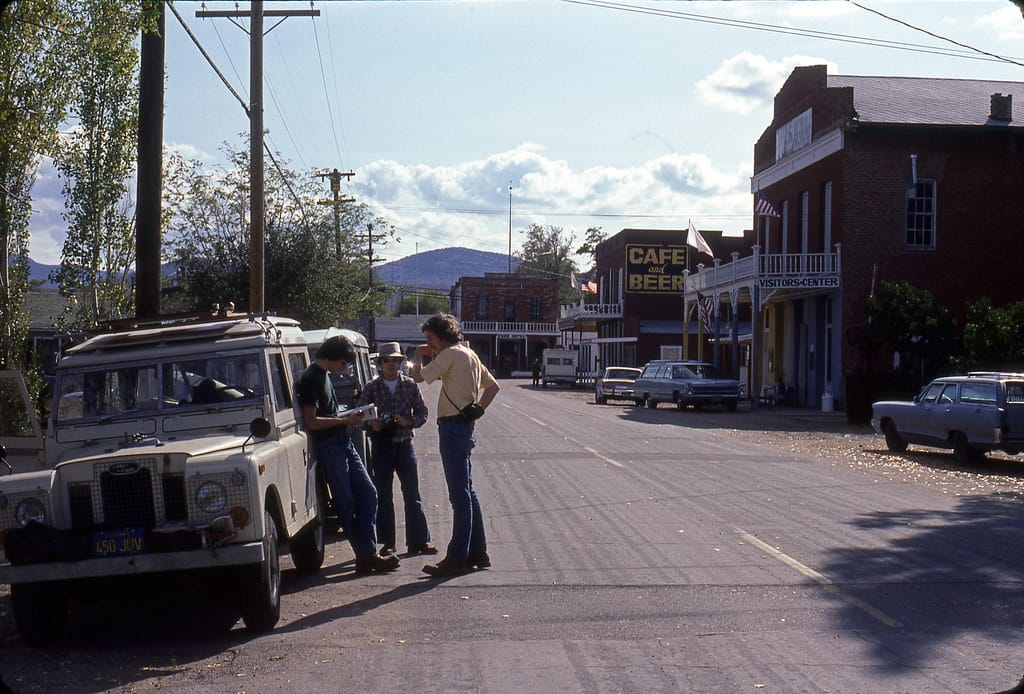
I’ve often wondered why the street that The Odeon sits on is called Pike Street.
At first glance, the obvious guess is the Northern Pike, but that doesn’t hold up. Northern pike aren’t indigenous to Nevada. They were introduced into at least one Nevada water (Comins Lake near Ely is the example most people point to), and they’re treated as an invasive predator because of the damage they can do to trout fisheries, so much so that anglers are encouraged to remove them when found. So whatever Pike Street is named for, it’s almost certainly not the fish.
So if it’s not the fish, what about the word “Pike”?
In a Nevada Appeal article dated Nov. 8, 2008, Ruby McFarland wrote:
“I can't find out how it got its name, but the answer may be that the early miners were called ‘Pikes,’ and the street was named for them. Following the footsteps of the pioneers were the Pony Express and Wells Fargo stages.”
That’s a reasonable theory at first… but “Pikes” as a mining nickname doesn’t fit Dayton very well. The most famous “Pike” mining reference is Colorado’s 1859 Pikes Peak Gold Rush, where miners were usually called “Fifty-Niners.” Some people elsewhere used “Pikes” loosely, but it’s not a clean match for early Dayton.
So what does that leave?
Maybe “Pike” is just an old term for a main road, like a “turnpike,” or “the pike?” I’m not convinced, but it’s possible. Pike Street was absolutely a travel corridor. It followed the footsteps of the Overland Emigrant Trail, one of the great human rivers that pushed west in the 1840s through the 1860s, peaking around the Gold Rush years. Later, Pike Street also became part of the Lincoln Highway, America’s first transcontinental auto route. Those facts tell us Pike Street mattered, but they still don’t explain why it’s called Pike.
Then, while reading a book called "As I Remember Them" by C. C. Goodwin, a light bulb went on.
"As I Remember Them" is Goodwin’s portrait of the people who shaped the West, especially the world that formed between California, Nevada, and the Comstock era. It contains dozens of stories ranging from famous names (Sutter, Ralston, Mackay, Sutro, Twain, De Quille, "Lucky" Baldwin and more) to character types and town atmospheres. What makes it so valuable is that Goodwin is often describing what he saw and what he remembered, people as they actually appeared, sounded, and behaved.
For example, he describes Adolph Sutro like this:
“He was a massive and masterful man physically. He must have been six feet and two inches in height and big every way. When I knew him best, he weighed perhaps two hundred and thirty-five pounds, but was active as a boy and seemed ever driven on by an energy that never tired. He had a lion-like face and a brain that was always alert and strong.”
That’s not a modern summary. That’s a man painting another man from memory.
And one of Goodwin’s chapters is titled “The Gentleman from Pike”.
A “Gentleman from Pike” refers to the famous emigrant stereotype associated with Pike County, Missouri. So common in the migration era that “Pike County men” (or “pikers”) became a catch all label for certain emigrants and newcomers pushing west. Goodwin doesn’t describe them as empire builders in the romantic sense. He describes them as practical people, families, who wanted land, grass, room, and a place to live without being crowded out.
From Goodwin (paraphrased by the passage itself):
He wasn’t dreaming of conquering kingdoms. He wasn’t trying to start a religion or build a government. In fact, he believed there was already too much government. What he wanted was more land, especially grass land, and if it came with woods, game, berries, nuts, and honey, all the better.
This wasn’t a “forceful” type of conquest. It was settlement. Men, women, and children moving across the continent, planting themselves, and building lives from Missouri to San Francisco, with Dayton sitting right on the route between worlds.
And that’s where Pike Street starts to look different to me.
If Dayton’s main corridor road was shaped by emigrant traffic, stage routes, and the flow of people west, and if the term “Pike” was already culturally loaded in the 1800s as shorthand for those emigrants, then I think it’s possible that “Pike Street” preserved that old language: a street named not after a fish, and not after Colorado’s rush, but after the archetypal emigrants, the “Pike County men”, who helped populate and reshape the American West.
Still, this is exactly why books and original sources matter. If you try to research this question online, you’ll get scattered fragments, partial explanations, repeated guesses, and modern summaries that often lose the meaning of the older language. The closer you get to original texts, early records, and firsthand accounts, the clearer the picture becomes, and the harder it is for later retellings to bend the story into whatever narrative is fashionable at the moment.
The Comstock era had so many newspapers for a reason: every editor had a viewpoint, every paper had an agenda, and even then people argued about what was “true.” If you want to learn the Comstock and the world around it, I recommend going as close to original sources as possible, Mark Twain, Dan De Quille, Alf Doten, and yes, C. C. Goodwin. Because those voices preserve a texture that doesn’t survive in simplified modern retellings.
And if we can finally pin down the earliest use of “Pike Street” in Dayton, when it first appears on paper, and what it might have been called before, then we may be able to say with confidence whether Pike Street was named for a person, a road, a place, or for the “Gentleman from Pike” themselves.
But I prefer it my way, I think I'll continue to believe that Pike Street is named in honor of the “Gentleman from Pike”. That is, of course, unless we can find some more first hand accounts and documentations.