Ma Nature Loses Her Mind

I had intended to take a lighthearted jaunt through the dictionary, stopping now and then to admire a word, kick a few grammatical tires, and eventually arrive at the story of Nevada weather and my recent evacuation. It was going to be a pleasant little excursion, the literary equivalent of a Sunday drive, except that Nevada weather has never been particularly good at observing speed limits, posted directions, or any other reasonable suggestion.
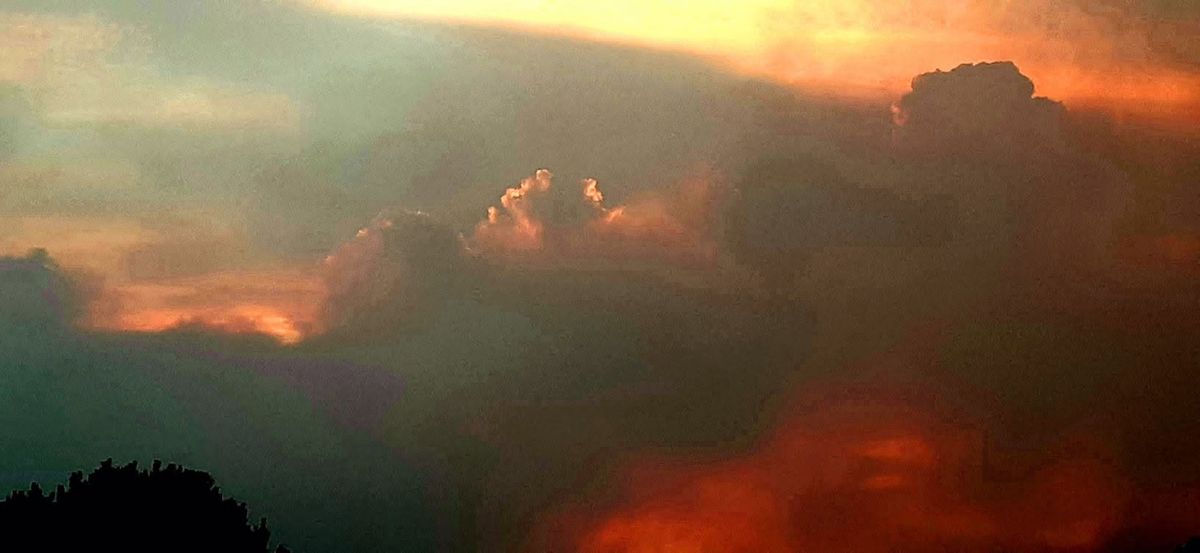
Then came hot wind, dry brush, and flames. Voilà: a wildfire.
The latest one jumped to roughly 2,500 acres in a matter of minutes west of Reno, with evacuation orders in place. It is being called the Hawk Fire.
A man who has spent his life believing that fire happens to other people suddenly develops a deep and scholarly interest in wind direction. He studies maps, watches smoke, learns the names of roads he never knew existed, and looks at the hills with the suspicious eye normally reserved for a stranger standing too close to his automobile.
I had even been joking that if our house burned down, at least I would no longer have to worry about cleaning my office. My wife has been asking me to do that for some time, and I have been employing the ancient male strategy of postponement, which has served husbands admirably since the invention of dust.
There is, however, an enormous difference between saying, “If the house burns down, I won't have to clean my office,” and actually watching a wildfire move toward your neighborhood. The first is a joke; the second causes the joke to remove its hat, lower its voice, and quietly leave the room.
My office is not technically a room so much as an archaeological site. There are papers in there that may have been written during the Lincoln administration, books I intended to read, books somebody said I ought to read, and books I cannot explain at all.
There are cables whose purposes have been forgotten by society, and there are notebooks containing important information that would be extremely useful if only I could remember which notebook held it. My wife calls it clutter. I call it a working system.
A working system, I should explain, is any arrangement incomprehensible to everyone except the person who created it. Then the fire came close enough to make the matter less amusing.
Northern Nevada was already scorching beneath a blazing sun, with temperatures around 100 degrees becoming less a weather report than a permanent condition. A hundred degrees used to be an event. Now it is merely Tuesday.
Meanwhile, one place is burning while another is flooding, and hail and rain are dropping from the sky as though somebody upstairs has misplaced the instruction manual. Apparently, the rain decided to flood the wrong places, but I understand. Even Ma Nature must have trouble keeping up with Nevada's zoning laws.
Nevada itself appears to have been planned by several committees working independently, none of whom attended the final meeting. One committee wanted desert, another demanded mountains, a third insisted on ancient volcanoes, and somebody else wanted geothermal activity.
Then a fellow in the back raised his hand and asked whether we might also have earthquakes, tornadoes, sinkholes, snow, flash floods, and the occasional wildfire. The chairman apparently said, “Put them all in.” And so they did.
Tornadoes have been flirting with the skyline, sinkholes have been opening like surprise portals to another dimension, earthquakes have been shaking the general atmosphere loose, and snow is still falling in the higher mountains.
In Nevada, the ground beneath you has a more intricate history than many nations. It has erupted, cracked, shifted, cooled, flooded, dried, lifted, and collapsed, and it is apparently not finished yet. Nature has been sending us brochures for years, and we have responded by building houses.
Wednesday evening was the worst of it. The whole area seemed to blow up at once, as though the weather, the fire and the geography had called a meeting, looked over the situation, and unanimously decided that everybody needed a memorable evening.
There is a peculiar moment during an emergency when the human mind changes gears. Before that moment, you are a citizen going about ordinary business.
Afterward, you are a quartermaster, calculating water, medications, important papers, keys, shoes, phone chargers, external hard drives and, if you are a man, underwear. These are the great questions of civilization.
We loaded up to evacuate on three different evenings, Wednesday included. My wife packed one overnight bag containing her necessities and the important paperwork representing a lifetime of being a responsible adult. Meanwhile, our daughter-in-law packed four bags and immediately announced that she needed to retrieve several more.
I, meanwhile, demonstrated the magnificent efficiency of the male mind under emergency conditions. I tossed a couple of pairs of underwear, a T-shirt, and three sets of socks into a plastic grocery bag, added my medications, external hard drive, and cellphone power cord, and declared myself ready for the End of Days.
I enjoy packing light. If the apocalypse arrives and all I have left is a plastic grocery bag containing one sock and an empty prescription bottle, I shall at least be able to walk into the everafter looking like a man who had a plan.
My wife, on the other hand, would arrive with documents, clothing, necessities, and several objects whose purpose I would not understand until civilization had been restored. This is why marriage works. One person prepares for the apocalypse, and the other makes sure the first person doesn't show up naked.
The curious thing about evacuation is that the actual packing is easier than the waiting. If someone says, “Leave now,” there is a certain clarity to the matter. You leave. You get in the vehicle. You go somewhere safer.
But when the order is to prepare, you enter a strange territory between ordinary life and disaster. You drink coffee, check out the news, look outside, wash a dish, and check the news again.
Every cloud acquires significance. Every gust of wind becomes a possible messenger, and smoke in the distance is no longer scenery.
That is where wildfire stops being a joke. The Bug Fire has destroyed at least nine homes, and there is no satire in that.
Fire has no respect for property values, mortgage payments, family photographs, sentimental possessions, or that flower bed somebody spent half a Saturday trying to make respectable. It burns the important and the unimportant with equal enthusiasm.
In some areas, the land and roads are now marked with black scars from the fire, while great swaths of hot-pink retardant stain the landscape. It is a peculiar sort of beauty, the kind that might inspire an abstract painter, although I suspect the homeowner would prefer that the artist choose another canvas. Yet the mountains remain, the sky continues its ancient business, and the roads run through country that has been scorched and changed while the unburned land waits beneath the same sun.
The word “home” takes on a different weight after you have spent an evening wondering whether you will still have one. Even when the orders shrink, however, the anxiety does not disappear immediately. A person can return to his house while still listening for the next alert and wondering what the wind will do.
And if Ma Nature gives me another warning, I shall be ready. I have a bag packed, three pairs of socks, some underwear, a T-shirt, my medications, my hard drive, and a cellphone charger.
I am prepared for nearly anything, except, of course, cleaning the office. I have principles.