King's Corner: When Adventure Grows Up
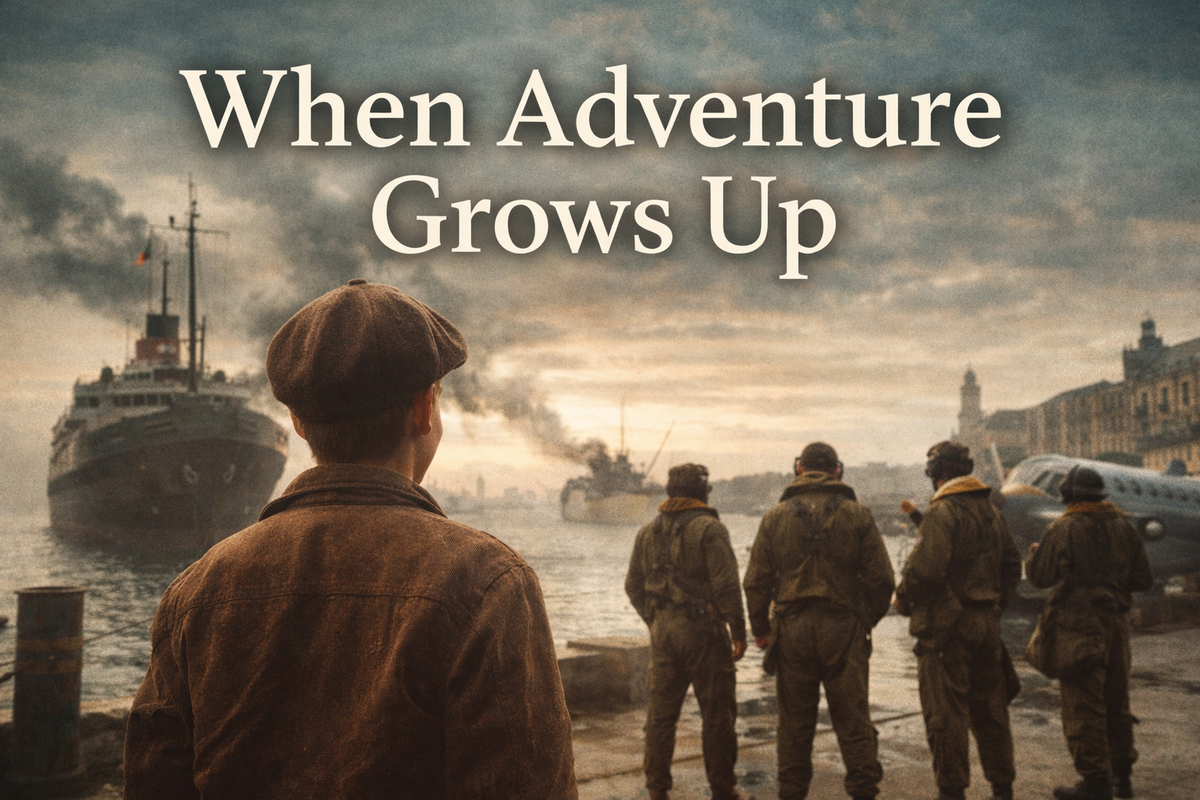
Perth sits where the Swan River meets the Indian Ocean, two and a half miles wide at its mouth, on the western edge of Australia—about as far from New Jersey as a 13-year-old boy could get without falling off the map. Ships entering the river are often escorted by bottlenose dolphins into the busy port of Fremantle, active since the 1820s, when the British raced France to establish a colony there.
When my dad, Mark King, sailed into that harbor in 1940 on a cargo ship carrying a prized bull and 20 head of cattle from Wyoming, he thought he had reached the far edge of an adventure. What he didn’t know was that he wouldn’t be sailing out again. He was gliding into a war.
Mark had nearly ended the adventure before it began.
At 13, curiosity was his strongest instinct, and restraint was still theoretical. Early in the voyage, his fascination with the lifeboats led him to climb out and inspect one more closely than was wise. He accidentally released the forward restraint, and the lifeboat dropped into a vertical position, sending loose gear tumbling into the ocean. Mark managed not to follow it, which was fortunate. The captain’s response was less forgiving.
That was Mark’s first lesson that adventure doesn’t just reward curiosity—it tests responsibility.
So when a later incident involving a rope and a manure bucket nearly dragged him overboard, the captain’s patience was already gone. By the time they reached Australia, Mark understood that some lines, once crossed, aren’t crossed twice.
Standing on deck now, watching the Swan River open before him, Mark was still enjoying the thrill. The water teemed with life—bull sharks, pelicans, black swans, fish he couldn’t name. Solid stone buildings lined the shore, built by convicts decades earlier. And just before entering the river, they passed a German surface raider sent to sink anything trying to leave.
That detail stayed with him.
Sometimes history doesn’t announce itself. Sometimes it simply glides past you and waits.
America wouldn’t officially enter World War II for almost two more years, but Mark was about to discover it was already very much present in Perth. The bull and cattle were unloaded and hauled inland, and Mark stayed on as a farmhand and cowhand. The work was steady, the hills were green, and the distant mountains made it easy to believe this was still just another chapter in a grand adventure.
But adventures eventually ask for something back.
When Mark returned to Perth, he learned that no ships were leaving. None. German submarines waited offshore, and no one was eager to test them. He wasn’t desperate—but he was suddenly aware that charm, optimism, and curiosity might not be enough this time.
The adventure hadn’t failed. It had simply stopped moving—and standing still, he was discovering, could be just as uncomfortable as being in trouble.
He began eating at a small diner, doing quiet arithmetic over coffee and pie. The head waitress noticed. She offered extra-large slices along with advice that was less comforting and more challenging. It was time, she suggested gently, to stop drifting through the story and start deciding who he wanted to be.
American flyers ate there too, though they spoke carefully and watched the room. At first, they weren’t sure what to make of Mark. A teenage American alone in wartime Perth raised questions. But one pilot was from Minneapolis–St. Paul, and soon they were swapping stories about Mother Merel’s on Seventh Street, Micky’s Dining Car, the St. Paul Rec Center, and fishing for muskie on White Bear Lake.
Familiar places opened the door. Character kept it open.
As Mark listened, he began to notice things. These men joked, but the joking stopped quickly when serious matters surfaced. They listened more than they spoke. They weren’t impressed by daring stories or bold claims. They seemed impressed by steadiness. For the first time, Mark sensed that being grown up had less to do with confidence—and more to do with weight.
Gradually, he realized he had wandered into something much larger than himself. The United States couldn’t openly support Britain, but American aircraft were quietly flying supplies to Perth, which were then forwarded on to England. These men were volunteers—men who had grown up, taken responsibility, and chosen purpose over comfort.
Until then, Mark’s adventure had mostly been about seeing how far he could go before someone stopped him. Now he was beginning to sense that the stops themselves mattered—that each one was asking something more of him than cleverness or nerve.
He still needed a way home. That much hadn’t changed.
But something else had.
Watching those flyers, listening to their stories, and feeling the weight of a world at war, Mark understood that growing up wasn’t about losing his appetite for adventure. It was about discovering that he belonged to something larger than himself—and being willing to take responsibility for his place in it.
When the chance came to join a short-handed flight back to the United States, it wasn’t just another bold yes. It was a step across a line—from boyhood into something sturdier.
Most of us don’t cross that line all at once. We reach it through embarrassment, hard lessons, and quiet courage. And sometimes, if we’re paying attention, God uses adventure not to entertain us—but to shape us.
The question isn’t just what you’re capable of.
It’s who you’re becoming when it matters.
Jeff Headley is pastor of the Dayton Valley Community Church, and a storyteller who blends humor, honesty, and hope. His weekly column reflects on resilience, grace, and the surprising ways faith shows up in ordinary life.