King's Corner: The Way Home
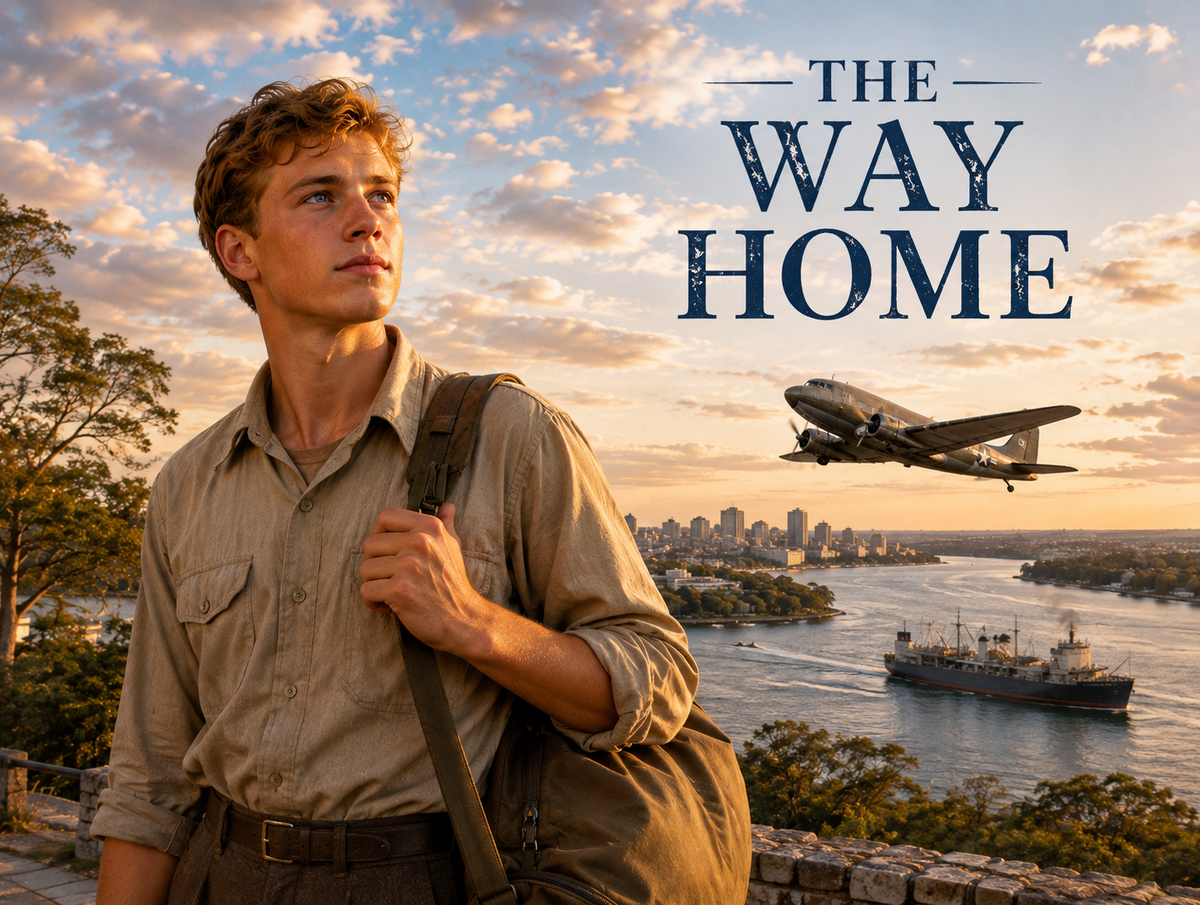
For the first time in five months in Australia, Mark King had money in his pocket and nowhere he had to be.
The cattle season was over. After the final roundup, one of the family drove Mark back to Perth. They had treated the 13-year-old American warmly, and he left with five months' wages and good memories. God had been good to him here. Mark had no reason to think getting home would be any different.
But first, Perth.
For months the city had been tantalizingly close and mostly out of reach. Now Mark could wander. From the heights of Kings Park, Perth opened below him. The broad Swan River spread out on one side, while beyond the city in the other direction lay the Indian Ocean. Downriver was Fremantle, its harbor and ships opening onto that ocean. Upriver, airplanes rose and settled onto Maylands Aerodrome beside the water. Mark watched them come and go without giving them much thought.
He explored streets, shops, gardens and waterfronts, fitting in rather well—until he opened his mouth. Then “the Yank” was back. But this was May 1940, and there was another Perth beneath the beautiful one. The Depression had left scars. Australia was at war. Women knitted and sewed for servicemen, while from Kings Park the State War Memorial overlooked a country sending another generation overseas. At Fremantle, troopships carried young Australians away.
The war Mark had heard about on the cattle station now had faces.
Eventually sightseeing gave way to getting home. Mark had crossed the ocean by ship, so naturally he looked downriver to Fremantle for one going the other way.
He couldn't find one.
German surface raiders threatened Allied shipping, while troops and supplies for Britain took priority. Passage to America was scarce.
Mark asked. He checked again. He waited.
Days became weeks, his wages dwindled, and Mark began running short of solutions. One place became familiar: a café where a waitress, as he remembered it, “took him under her wing.” She listened, reassured him and quietly made certain his portions were generous.
Especially the pie.
She also knew some Americans who frequented the café and encouraged Mark to meet them. Perhaps being Americans was reason enough. Perhaps they liked the same pie. Whatever her reasoning, one day she brought them together.
The men weren't in uniform, but their close-cropped hair and barely civilian clothes suggested military. They came from nearby Maylands Aerodrome.
America wasn't at war.
What were American military men doing in Perth?
Mark's questions made the Americans wonder about him too. Who was this boy with no passport claiming to have crossed the Pacific with cattle and spent five months on an Australian station?
Then one pilot learned Mark had lived for a time in St. Paul, Minnesota, after leaving the Wisconsin farm where he grew up.
So had he.
Mark knew Seventh Street and St. Peter. Mickey's Diner. The recreation center on Seventh. White Bear Lake, where friends had taken him fishing.
Question by question, the interrogation became a conversation.
They were two Americans talking about home.
Once the pilot believed him, he asked what a 13-year-old from St. Paul was doing in Perth. Mark told him: the cattle ship, the station, the weeks searching for passage home. His money was disappearing. He had no passport, no identifying papers and no idea what to try next.
Only then did the men explain why they were there. Officially, the United States was neutral, and their mission wasn't something they discussed casually. Their flights brought American goods to Australia to be transferred to ships bound for Britain.
Mark had spent weeks looking for a ship.
He was talking to men who had an airplane.
Then the captain said their aircraft normally flew with seven crewmen.
This time they had six.
For the first time in weeks, Mark could see a way home.
But he had no papers proving who he was, much less permission to board a military aircraft. The captain drove him in a military jeep to the American Consulate. With the pilot confirming his story, officials established Mark's identity and approved him to travel on the flight.
Back at the jeep, Mark noticed an empty military bag on the floor.
“Can I have that?”
The captain said yes and found him a shirt suitable for travelling with the crew.
On departure day, Mark arrived at the civilian side of Maylands wearing the shirt and carrying the bag. His airplane waited beyond the restricted military section.
The guards wouldn't let him through.
So Mark waited.
After everything else, he stood within sight of his way home and still couldn't reach it.
Then a military jeep came through the gate.
The captain had come to get him.
Mark climbed in, tossed his bag into the back beside the captain's, and they drove toward the waiting aircraft.
Six men were preparing to leave.
Now there were seven.
The engines came alive. The aircraft gathered speed beside the Swan and climbed. Below lay Perth, Kings Park and the Swan winding down to Fremantle and the ships that couldn't take him home.
A few weeks earlier, Mark had stood in Kings Park watching airplanes rise from Maylands. His way home had already been in sight. He simply hadn't known what he was looking for.
Sometimes God's answers are like that.
Mark had spent weeks looking downriver for a ship.
A waitress had simply helped him look in another direction.
Jeff Headley is pastor of the Dayton Valley Community Church, and a storyteller who blends humor, honesty, and hope. His weekly column reflects on resilience, grace, and the surprising ways faith shows up in ordinary life. Mark King, whose adventures are recounted in this series, was his father.