King's Corner: The Penny in the Pudding
Light filtered through the window well before the 5:09 sunrise, announcing another long summer day. Even after supper, the sun would still be hanging above the western horizon.
It was Christmas Day.
For someone raised in the northern United States, almost everything about that sentence feels wrong. Christmas belongs with short days, frosty mornings, and perhaps a dusting of snow. Yet on a cattle station in the hills east of Perth, Christmas arrived with rolled-up sleeves, gum trees casting long patches of shade, and the promise of another warm afternoon before the welcome sea breeze wandered in from the Indian Ocean.
Almost everything looked different.
Only the reason for the day remained exactly the same.
My father, Mark King, had arrived only a few weeks earlier. He had travelled halfway around the world expecting to spend a season working cattle. By Christmas morning he already knew the rhythm of the station. Before breakfast the horses gathered expectantly near the yards, ready for water and feed. Fences still needed checking. Stock still needed tending. Cattle, sheep and horses have never paid much attention to calendars.
People do.
Christmas on the station began with gratitude. There was no cathedral choir and no stained-glass windows, yet no one seemed to think Christmas was diminished. Before anyone reached for a serving spoon, heads bowed around the table. Thanks was offered for the food before them, for one another, and for the Child whose birth had brought them together.
For a few quiet moments, English, Irish, Australian, Aboriginal and American voices all belonged to the same prayer.
Then the ordinary work of the morning quietly resumed. Animals still needed caring for before people sat down to celebrate. The first people invited to welcome the newborn Christ were shepherds. On this station, Christmas was also being celebrated by people whose lives revolved around livestock. They understood early mornings, patient care and the quiet responsibility of tending creatures that depended upon them.
Out in the stockyards, good horsemen recognized one another long before they knew one another's stories. English, Irish, Australian, Aboriginal and American—it mattered far less than whether you could be trusted with a horse, a gate or a long day's work. Respect had quietly come first. Friendship was following close behind.
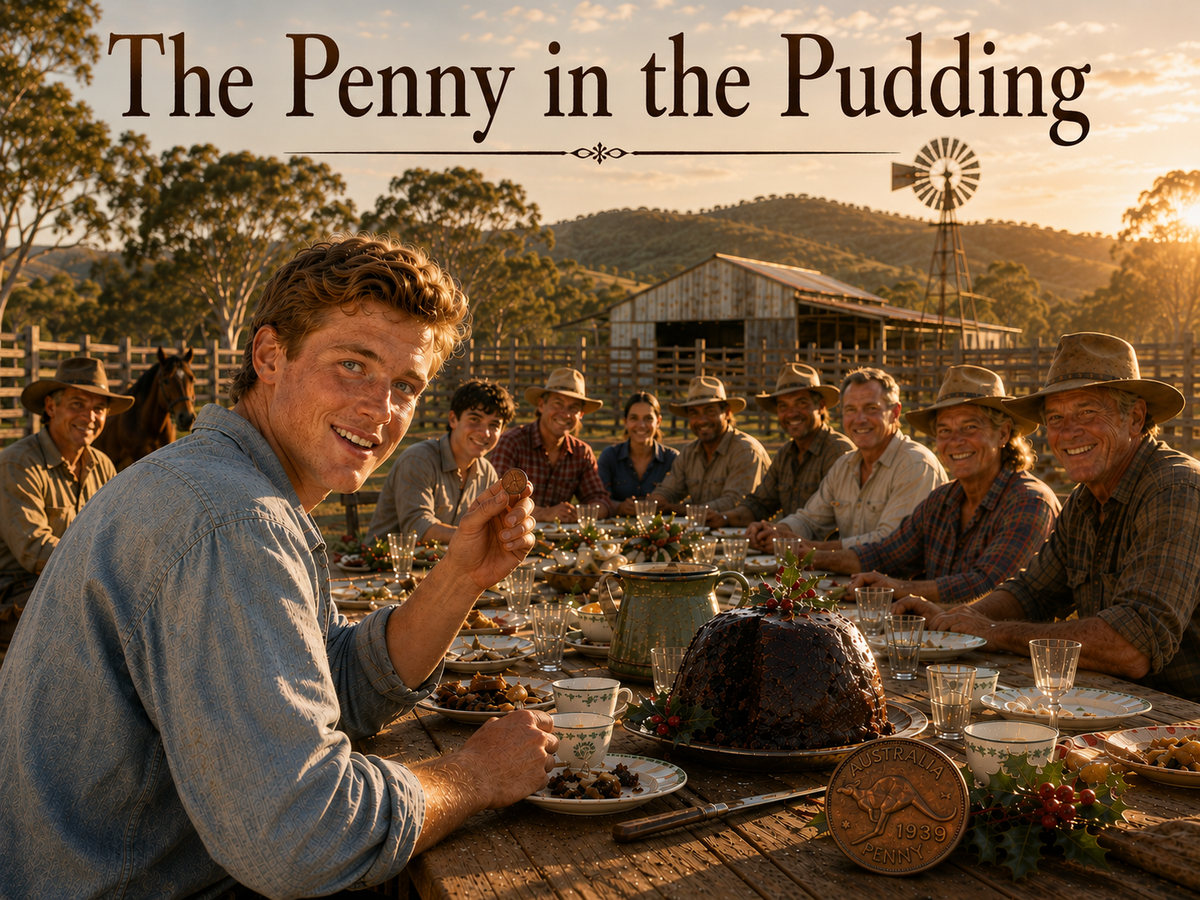
By midday the work was finished, boots had been brushed clean, and everyone gathered around the long Christmas table. Family sat beside station hands. Conversation wandered easily from one end of the table to the other. Three weeks earlier Mark had arrived as "the Yank." By Christmas Day the nickname had become little more than affectionate teasing. Somewhere between working horses, mending fences and sharing long summer days, he had quietly stopped being the newcomer.
The meal lingered as comfortably as the daylight. Plates were cleared, but no one hurried away. Conversation drifted beneath the gum trees while the afternoon breeze finally arrived from the west. The day itself seemed content to stay a little longer.
Only then did someone remember the Christmas pudding.
It had been patiently waiting for this moment.
Months earlier, the lady of the house had begun preparing it long before anyone knew an American would be sharing Christmas dinner with them. Fruit had soaked for days before being mixed, wrapped in cloth, boiled for hours and carefully stored until Christmas. Somewhere along the way she had quietly pressed a bronze Australian penny into the rich mixture.
The tradition was simple. Whoever found the penny would enjoy good fortune in the coming year—and keep the coin as an extra Christmas present.
Nobody knew whose slice would hold it.
Mark certainly didn't.
He discovered it the traditional way.
With an unexpected clink against his teeth.
For a moment he looked puzzled.
The whole table burst into laughter.
The Yank had found the penny.
They insisted he keep it.
Looking back, I don't think the penny was the real gift.
The real gift had begun months earlier when someone lovingly stirred a pudding for people she cared about, never imagining that a young man from the other side of the world would one day sit at her table. It continued through weeks of shared work, shared meals and growing trust until strangers had quietly become family.
Perhaps that's one of the quiet wonders of Christmas.
Long before Bethlehem...
Long before the shepherds...
Long before the wise men...
God had already been preparing His greatest gift.
I've often thought He still works that way.
He delights in preparing tomorrow's gifts long before we know we'll need them. Sometimes they arrive as friendships forged through honest work. Sometimes as a place where strangers quietly become family. Sometimes they look so ordinary that we don't recognize them until many years have passed.
This morning, that little bronze Australian penny is catching the light on my desk as I write these words.
Eighty-seven years have passed since a thirteen-year-old Yank bit into a Christmas pudding on a station in the hills outside Perth. The coin is worn now, but you can still read the name of King George VI and see the kangaroos on the reverse.
Most people would see an old penny.
I see a place at a Christmas table that God had quietly prepared long before my father knew he was coming.
The smallest gifts often become the ones we carry the longest.
Jeff Headley is pastor of the Dayton Valley Community Church, and a storyteller who blends humor, honesty, and hope. His weekly column reflects on resilience, grace, and the surprising ways faith shows up in ordinary life.