King's Corner: The Army That Saw What It Wanted to See
Why would a young man go to war?
It's a question America had been answering since Pearl Harbor. Young men were leaving farms, factories, classrooms and families to fight in places many had never heard of. Some went from duty, some from patriotism, some because their friends were going. Others couldn't bear to stand aside while history was being made.
My father, Robert Mark King, had a little of all those motivations. He also possessed a considerable appetite for adventure, but less appreciation of consequences.
Readers who've followed his adventures with 20 head of cattle, two prize bulls, assorted horses, a dog, sheep, a four-wheeled bull and an exceptionally uncooperative alligator may have noticed this tendency.
Mark loved the Old West, with its promise of adventure and colorful characters who sometimes acted before considering the consequences. Perhaps he recognized something of himself in them.
By the summer of 1943, Mark was determined to join the Army. He had watched troops departing Australia, crossed the Pacific with an American military flight crew, and seen enough to know something enormous was happening. America had gone to war, and he intended to go with it.
There were two problems. He was 16, and his eyesight wasn't perfect.
Neither seemed especially important to Mark.
He joined the Enlisted Reserve Corps in July, hoping to enter active service. But the Army examined his eyes, discovered a slight astigmatism in his right eye, and rejected him.
Most young men would have gone home disappointed. Mark went outside, where he encountered a family with an unusual proposition.
Their son was eligible for military service, but they didn't want him exposed to war. They planned to send him to Canada. Meanwhile, they were offering $1,500 to someone willing to enlist under his name.
Fifteen hundred dollars was an extraordinary sum in 1943. Mark wanted to serve, and the family wanted their son safely out of the war. Both saw an opportunity.
The young man's name was Leroy M. Lange.
Leroy was older than Mark, and his parents were available if permission became an issue. The arrangement solved the age problem. Mark still had to find a way around the eye examination.
He accepted the money and returned to the recruiting center under his new identity. Unfortunately, changing one's name does nothing to improve one's eyesight.
While waiting for his examination, however, he noticed something useful. The men ahead of him were being asked to read the same line on the eye chart. Mark listened carefully, memorized their answers, and repeated them when his turn came.
This time, he passed.
The Army had examined Robert Mark King's eyes and found them wanting. Leroy Lange's hearing and memory, apparently, were excellent.
On Aug. 13, 1943, the Army's records began listing Leroy Lange on active duty. Somewhere inside that uniform was a 16-year-old named Mark King, just eight days from his 17th birthday, who had finally achieved his ambition.
America was mobilizing for a war whose outcome nobody could guarantee. Young men were becoming soldiers, factories were producing weapons at astonishing speed, and a nation was discovering what determination, ingenuity and improvisation could accomplish.
Neither Mark nor his country knew what the coming years would demand. Both were determined to find a way forward.
After basic training, Mark was sent to England.
There, the Army eventually discovered that its new soldier needed glasses.
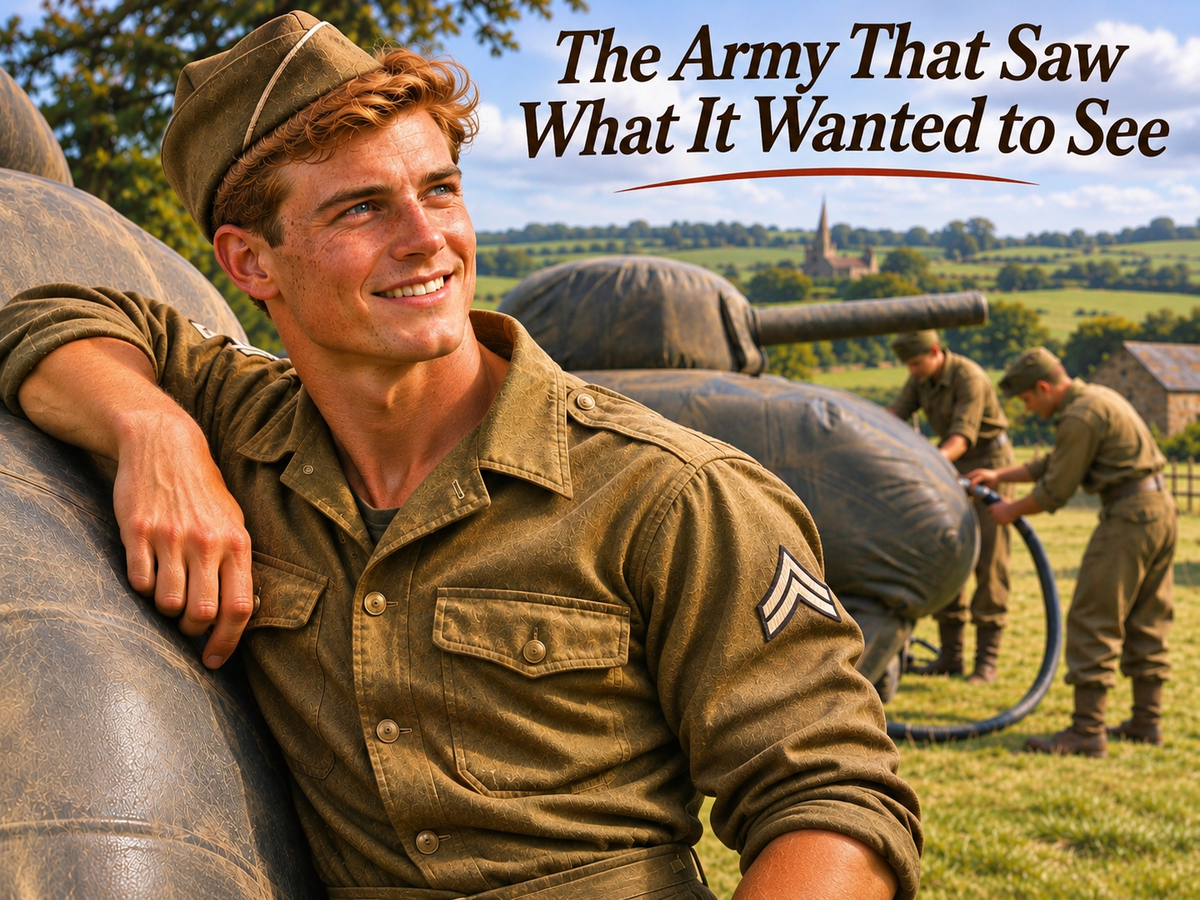
By then, however, Mark was helping move tanks and military vehicles around the English countryside. Rather than send him home, the Army issued him glasses and put him back to work.
The tanks, incidentally, were made of rubber.
Mark had become part of Operation Fortitude, an elaborate Allied deception designed to convince German reconnaissance that a massive invasion force was gathering opposite the French port of Calais. Inflatable tanks, dummy vehicles and imaginary formations helped create the appearance of an army preparing to strike where the Germans expected it.
The real invasion would come elsewhere.
Think about that for a moment.
My father had entered the Army by pretending to be someone else. Now the Army was employing him to help pretend that something else was there.
And the Germans were supposed to believe their eyes.
There's something wonderfully ironic about a young man rejected for poor eyesight helping construct one of history's great exercises in misleading eyesight.
Mark was genuinely willing to serve his country, even though his enlistment involved deception. The inflatable tanks weren't real, but the danger they were intended to counter certainly was. And the men preparing to cross the English Channel would soon face consequences far beyond anything Mark had imagined outside that recruiting center.
Sometimes we see an opportunity without seeing where it may lead. Sometimes our determination outruns our judgment. And sometimes, looking back, we discover that grace was present even in circumstances we had made unnecessarily complicated.
I think of the father in Jesus' story who allowed his adventurous son to leave home, knowing he couldn't prevent every foolish decision. His love remained, even when the boy's judgment did not.
Sometimes God guides us. Sometimes He rescues us. And every time, there's something to learn, if we're willing to listen.
For the moment, though, Mark was enjoying life in southern England. He had a uniform, a pair of government-issued glasses, and a job moving an imaginary army around the countryside.
He had finally made it into the war.
And, for a little while, the war seemed almost like another adventure.
Jeff Headley is pastor of the Dayton Valley Community Church, and a storyteller who blends humor, honesty, and hope. His weekly column reflects on resilience, grace, and the surprising ways faith shows up in ordinary life.