King's Corner: Thanksgiving, with a Song
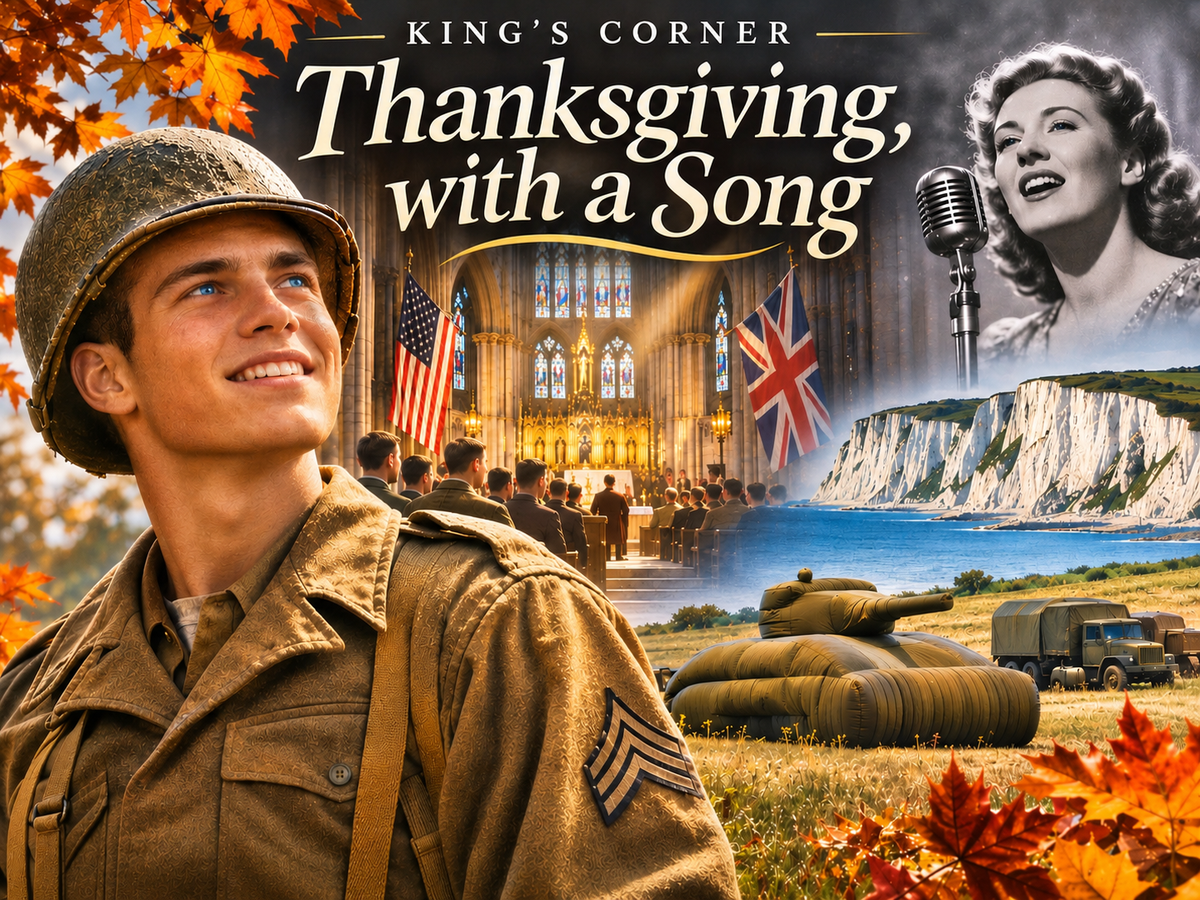
In November 1943, my father, Robert Mark King—known to everyone as Mark—was 17 years old, serving in the United States Army in southern England, and discovering that life could be a remarkable adventure.
Mark had enjoyed success in rodeo, but he'd decided there was a greater challenge worth pursuing. He wanted to serve his country in a war that was changing the world, leaving behind something he knew he could do for something he had yet to discover he could become.
Getting into the Army had presented a challenge of its own.
As readers may remember, Mark enlisted under another young man's name after being rejected because of his eyesight. He'd memorized the eye chart, passed the examination, and found himself on his way to England.
He had reasons to be thankful. Not all were reasons his commanding officers would have appreciated.
Shortly after arriving, the Army discovered that Private Leroy Lange was actually Robert King. Ordinarily, that might have ended his military career.
But Mark had found an unusual job. Near Dover, the Allies were creating the appearance of an army that didn't exist. Inflatable rubber tanks, trucks, and other vehicles were arranged to convince German reconnaissance aircraft that a formidable force was gathering below.
Some were stretched over wooden frames and fitted with small motors to make them easier to move. Mark knew how to keep those motors running. After all, he'd once built a four-wheeled mechanical bull for halftime entertainment at a rodeo.
Apparently, keeping an imaginary army moving wasn't such a leap from entertaining a rodeo crowd.
His mechanical abilities and easy manner had made him welcome in the unit. Rather than send him home, his commanders issued glasses and identification bearing his real name.
He had entered the Army as Leroy Lange. Now he could remain as Robert King.
Sometimes God's blessings arrive in ways we could never have planned. Even Mark's unlikely experiences were preparing him for opportunities he hadn't imagined.
His months in Australia had also proved useful. He understood Australian expressions and British customs, and felt comfortable among the English. His easy manner brought opportunities to visit London on his days off.
Britain had endured years of war, yet people still gathered to enjoy music. Among their most beloved performers was Vera Lynn. Mark attended several concerts, and two songs stayed with him: “The White Cliffs of Dover” and “We'll Meet Again.”
The white cliffs were especially appropriate. Mark was stationed near Dover, helping maintain an army that existed largely in the imagination, while Vera Lynn sang about the day peace would return to those shores.
As I discovered growing up, Mark was not a man who believed a good song should be sung only once.
But November brought another occasion he would remember for the rest of his life.
For Thanksgiving, Mark joined American servicemen at Westminster Abbey. Beneath its soaring stone arches, surrounded by centuries of Christian history, they gathered to give thanks to God.
When Mark spoke of that day, what remained with him was the awe and privilege of being there. At 17, far from home and surrounded by the uncertainties of war, he stood in a magnificent church built to glorify God, where generations had worshipped before him. Now he, too, could lift his heart in thanksgiving.
More than 300 years earlier, English settlers had crossed the Atlantic to begin new lives in America. Their harvest celebration at Plymouth in 1621 became part of the tradition Americans would eventually call Thanksgiving.
Now Americans had crossed the Atlantic in the opposite direction, not to leave England behind but to help defend it. In one of Britain's most historic churches, they celebrated an American holiday.
The war was far from over. Families were separated by an ocean, and no one knew what the coming months would bring. Yet these men had not gathered because everything was right with the world. Even in uncertainty, there were blessings worth recognizing.
Thanksgiving that day was more than remembering God's blessings. It was an expression of trust that the God who had sustained them thus far would remain with them through whatever lay ahead.
The Apostle Paul wrote, “Give thanks in all circumstances” (1 Thessalonians 5:18). Not because every circumstance is good, but because God's goodness is not confined to easy moments.
Mark had found a place where his abilities mattered, made friends, and discovered a city full of life. As the years passed, gratitude became remembrance.
My father loved telling stories and singing. A song could occur to him almost anywhere, and once it did, there was little reason to keep it to himself.
“We'll Meet Again” and “The White Cliffs of Dover” remained part of his repertoire throughout his life. I heard him sing those songs many times, long after the young soldier had become a father and grandfather.
In June 2020, Vera Lynn died at 103. Mark and I talked about her, those concerts in wartime London, and the music he had carried with him for so many years.
This Thanksgiving, I think about that young soldier in Westminster Abbey, thanking God for a life still unfolding. And I think about the older man who never tired of telling me what those days had been like, or singing the songs that had meant so much to him.
In 1943, Mark had reasons to give thanks.
Nearly 80 later, he was still telling the stories and singing the songs to family and friends.
And this Thanksgiving, I'm grateful that he did.
Jeff Headley is pastor of the Dayton Valley Community Church, and a storyteller who blends humor, honesty, and hope. His weekly column reflects on resilience, grace, and the surprising ways faith shows up in ordinary life.