King's Corner: Something Moving Beneath the Snow
After fifth grade, Mark King’s education became a rather intermittent affair.
On the farm in Wisconsin, he had faithfully walked five miles each way to school, even through snow. When he and his mother returned to New Jersey, where the schoolyard could become a battlefield, Mark chose work instead. He found a job on a garbage truck, earning a full-time wage and helping his mother re-establish their life.
By 12, Mark had reached his adult height of 6'1", with muscles developed by doing a man’s physical job every day. But this was the Depression, and eventually people complained that a boy was earning a man’s wage when grown men needed the work.
So, approaching his 13th birthday and the prospect of returning to school, Mark chose to go West instead.
For the next year his education came almost entirely through people and experience: harvest in the Dakotas, horses and cattle in Wyoming, sheep and station life in Australia, then trains, ships and eventually an airplane. Wherever he went, someone knew something he didn’t.
Mark watched, listened and learned.
Then he returned to Wapiti, and winter was approaching.
A Wyoming winter had a way of making the world smaller. The winter Mark had missed by going to Australia brought about ten feet of snow. Two years earlier, more than 14 feet had fallen.
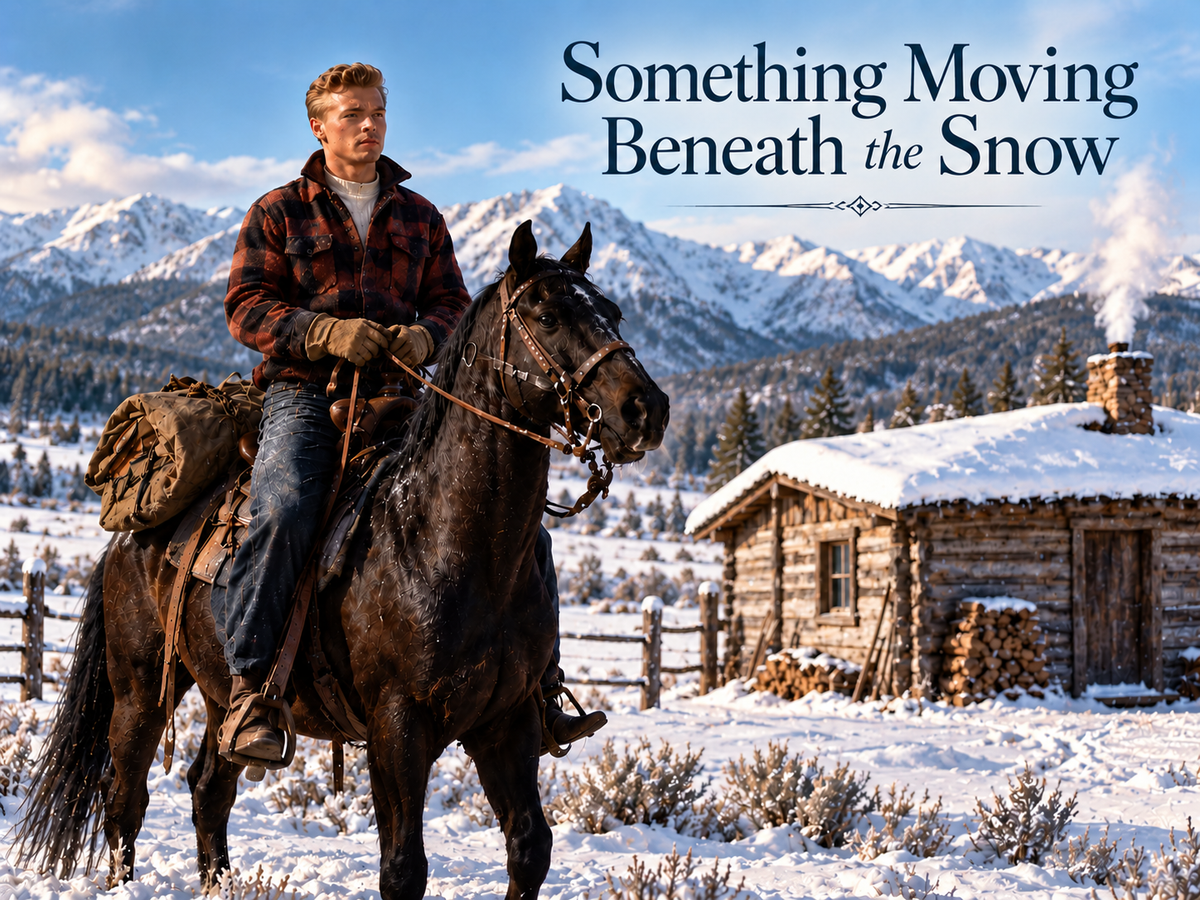
Mark was offered an unusual winter job. For almost six months he would live in a small line shack, riding fences, repairing breaks and protecting cattle from predators. Supplies would arrive about once every three weeks. There was no electricity or radio. Most of the time, there would be no other human voice.
On his way there, Mark passed a schoolhouse where new textbooks had arrived and the old ones were being discarded. He bought every book they had and loaded them onto his horse, nearly overloading the poor animal.
The boy who had gone West rather than return to school was riding into the wilderness carrying the school with him.
Then winter closed around him.
Each day Mark saddled his horse and rode through bitter cold and snow, following miles of wire. Unfortunately, nobody had explained to the cattle that winter was supposed to be a quiet season.
Or to the wildlife.
Fences still broke. Cattle still found reasons to be on the wrong side of them. A broken fence didn’t become less broken because Mark’s fingers were numb. The previous summer someone had taught him how to repair wire wearing gloves.
Now he understood why.
Riding the same country day after day also taught Mark to notice things. He remembered a fox standing almost motionless in the snow, listening intently to something Mark couldn’t hear. Suddenly it leapt into the air and dived headfirst into the snow.
A moment later, it emerged with its next meal.
Eventually Mark turned his horse toward the line shack. Outside were frozen wire, deep snow and bitter cold. Inside was firelight.
Mark cared for his horse, stamped the snow from his boots and stepped through the door. Gloves and wet clothes found places near the fire. Something went on to eat. Then, when the day’s work was finished, Mark reached for a book.
The cabin wasn’t comfortable by most definitions.
But after a Wyoming fence line in winter, it was home.
Before long, those books began lining the walls. The shack had never been designed with a library in mind, so Mark began cutting pieces of firewood into flatter lengths that could serve as makeshift shelves. Apparently the solution to having too many books was not fewer books.
It was more shelves.
Rudyard Kipling moved in. So did William Shakespeare. Isaac Newton joined them as Mark worked through mathematics. Mark Twain brought humor. History introduced people and places far beyond Wyoming, while the King James Bible gave him stories and words he would carry for the rest of his life.
It was becoming quite a crowded little cabin.
About once every three weeks, someone from the ranch arrived with supplies. After heavy snowfall, even finding the shack could be difficult; sometimes the clue was smoke rising from its nearly buried chimney. Mark welcomed the company, and as his enthusiasm for reading became obvious, visitors began bringing books with the other supplies. They enjoyed his hospitality but couldn’t linger long in the weather.
Eventually the visitor headed home.
Mark stayed.
So did the books.
Outside, snow was making Mark’s world smaller. Inside, books were making it larger.
The books captured his imagination while God captured his attention.
Mark noticed the stars above the cabin. He noticed how animals adapted to winter. He noticed a fox listening for life beneath the snow.
And in the long evenings beside the fire, Mark listened too.
Years later, he remembered those nights as having “a fire close by, stars in a crystal clear sky, and plenty of time to talk with God.”
Eventually, academic testing would reveal how far the boy whose formal education ended after fifth grade had come. Mark would even begin medical school.
But a test could only measure part of what happened in that little cabin.
Mark had spent the previous year traveling across the world. Now there was nowhere else he needed to be.
He had found a place to call home.
And somehow, it called to him.
Perhaps some of the quietest seasons of our lives aren’t as empty as they appear.
Sometimes there is still something moving beneath the snow.
We may simply have to become quiet enough to hear it.
Jeff Headley is pastor of the Dayton Valley Community Church, and a storyteller who blends humor, honesty, and hope. His weekly column reflects on resilience, grace, and the surprising ways faith shows up in ordinary life. Mark King, whose adventures are recounted in this series, was his father.