King's Corner: Rhinestone Cowboys
The crowd erupted.
Mark liked that.
I may have understated the matter.
When Mark returned to Wapiti Valley, Wyoming, in the summer of 1940, Ken began teaching him rodeo. At first they stayed fairly close to home, practicing at the dude ranch and at nearby events. Ken knew rodeo. Mark knew horses and was eager to learn everything else.
Somewhere among the horses, steers and dust, teacher and pupil also became friends.
Neither of them needed to announce it. Friendship often grows while we're doing something else—working beside someone, laughing at the same things and eventually realizing we have begun to depend upon each other.
Perhaps that's one of the quieter ways God works in our lives.
Sometimes His gifts arrive as people.
Ken brought experience and steadiness. Mark brought youth, curiosity and an adventurous streak that sometimes got ahead of experience.
They were good for each other.
After Mark's winter in the line shack, they began entering proper rodeos together. As Mark's skills grew, so did the map.
Their rodeo world eventually stretched through Wyoming, Idaho, Montana, the Dakotas and across the Canadian border into Alberta. Calgary was roughly 650 miles north of Wapiti; Boise about 500 miles west.
This was rodeo country.
There was just a lot of country between the rodeos.
They competed seriously and pooled their winnings.
That was another kind of trust.
Ken was teaching Mark how to make more money by getting better at rodeo.
Mark began wondering whether they might also make money by making fun of it.
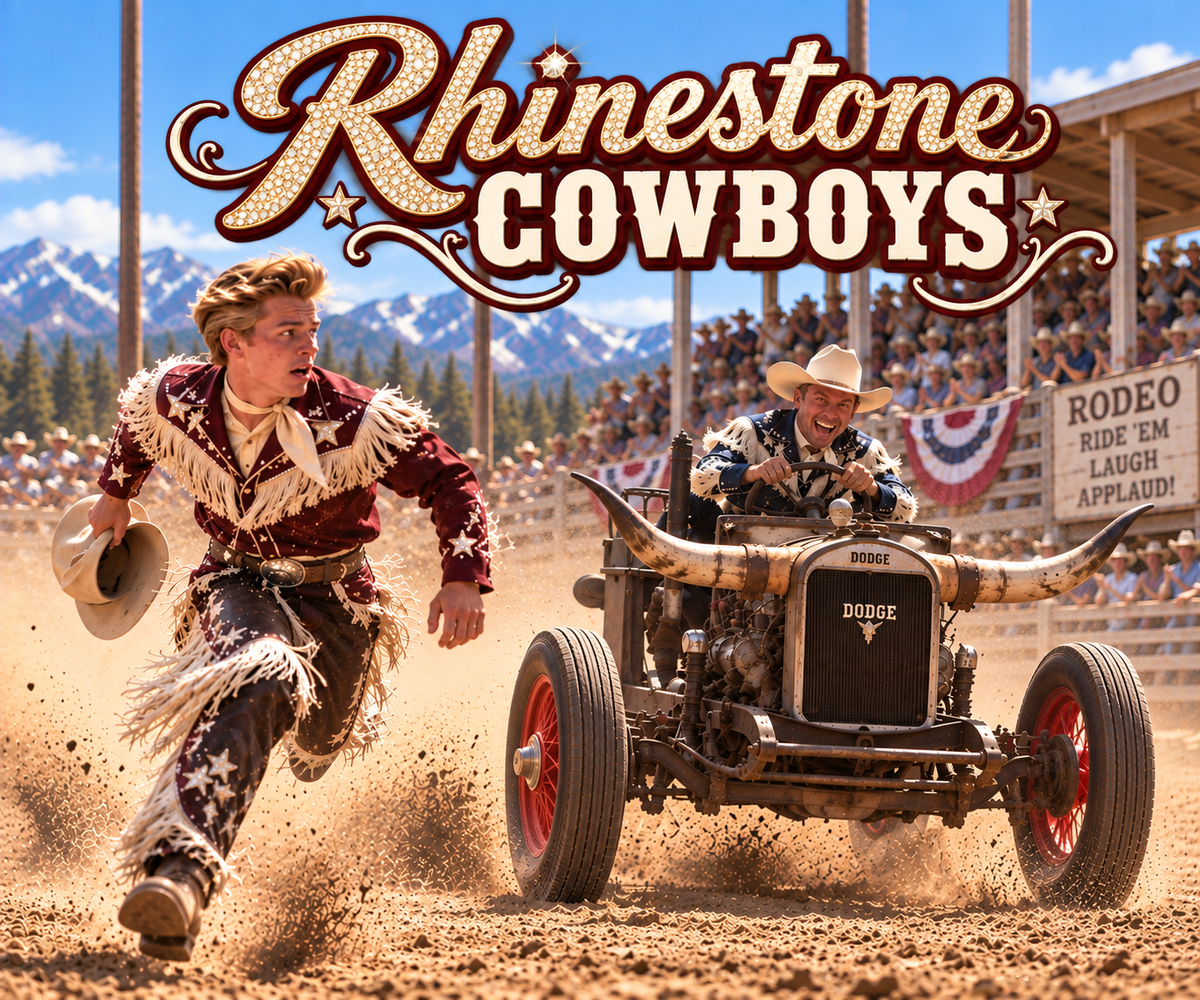
Rodeos could be wonderfully serious about themselves. Formal openings sometimes featured splendidly dressed rhinestone cowboys being introduced to appreciative crowds.
Mark noticed.
This gave him an idea.
His next idea required an automobile.
So Mark bought an old Dodge.
At 14 or 15, that might have presented a problem almost anywhere else. But this was Wyoming, and Mark could legally get a driver's license.
So he did.
That was probably the most responsible part of what happened next.
Mark took the Dodge apart.
He wasn't trying to destroy it. He wanted to know how it worked. He taught himself mechanics by tearing it down and rebuilding it, then found someone who knew how to weld.
They mounted enormous metal bull horns on the front.
Then they added handholds.
Mark turned his attention to the car horn. Old automobile horns made that familiar ah-ooh-ga, but a screw on the back could change the sound.
Mark kept adjusting.
The ah-ooh-ga became lower.
Something remarkably like a bull.
It was time for Ken to drive the bull.
In the halftime arena.
At halftime, Mark and Ken rode in together on horseback, transformed into magnificently exaggerated rhinestone cowboys. They waved their fancy hats, played to the crowd and sent up the very rodeo pageantry they spent the rest of the day taking seriously.
Then Mark dismounted.
Ken rode out, leading Mark's horse with him.
Mark stayed.
He paraded around the arena on foot, waving his hat and making quite certain nobody overlooked his importance.
Then Ken came back.
He had changed mounts.
Into the arena came the old Dodge, enormous metal horns out front and its altered horn bellowing like a bull.
The magnificent rhinestone cowboy suddenly found himself without a horse.
Mark ran.
Ken gave chase.
The crowd knew exactly what to do.
They laughed and cheered, urging the bull after Mark while applauding their fleeing cowboy whenever he managed to stay ahead of it. Around the arena they went, Mark running, the Dodge bellowing and the crowd becoming part of the chase.
Eventually, of course, the bull had to win.
It caught him.
Mark grabbed the handholds and ended up spread-eagle across the front while Ken drove his captured rhinestone cowboy around the arena.
The crowd erupted.
The joke was ridiculous.
Making it work wasn't.
A year earlier, Mark had learned to put a steer exactly where Ken needed it.
Now Ken was putting a bull exactly where Mark needed it.
Close enough to catch him.
Preferably not close enough to run him over.
They had become quite a team.
And other people noticed. As their rodeo skills improved and their travels took them farther from Wapiti, word about the halftime act began traveling too. They could arrive at a rodeo intending to register as competitors and find themselves hired to entertain the crowd as well.
Ecclesiastes says, “Two are better than one, because they have a good return for their labor.”
Mark and Ken could have taken that quite literally.
But then comes that curious final line: “A cord of three strands is not quickly broken.”
Mark and Ken trusted each other. And both were learning to trust God.
There were three strands in this friendship.
Eventually the 1941 rodeo season ended. The arenas emptied, the crowds went home and winter settled over Wapiti again.
But this winter was different.
What had begun with Ken teaching a fourteen-year-old how to ride beside him had become a friendship and a partnership. They had competed, traveled, earned money, made people laugh and discovered how much they could trust one another.
Now they had all winter to wonder how far they might go next.
Ken had ridden the bigger circuit before.
He knew what was waiting farther down the road.
Mark didn't.
Not yet.
All winter, they each dreamed about what might come next. Together, they made their plans—and excitedly trusted God with the road ahead.
Jeff Headley is pastor of the Dayton Valley Community Church, and a storyteller who blends humor, honesty, and hope. His weekly column reflects on resilience, grace, and the surprising ways faith shows up in ordinary life. Mark King, whose adventures are recounted in this series, was his father.