King's Corner: Learning to See
By July 1943, Mark King had made up his mind. At 16, he had already traveled farther, worked harder, and survived more adventures than many men twice his age. He had ridden bucking horses, won rodeos, and learned that determination and ingenuity could overcome most obstacles. Now he wanted to join the Army. There was just one difficulty. The Army wanted its soldiers to be older than 16.
Mark had never considered an inconvenient regulation sufficient reason to abandon a worthwhile ambition.
On July 23, 1943, he enlisted in the reserve corps. Whether his age was overlooked or received a little assistance from Mark's imagination isn't entirely clear. What mattered was that they accepted him. He was in the service at Fort Bliss, near El Paso, Texas, and hoping to move into full military duty.
Mark had found a way through a door that seemed firmly closed. At 16, he was inclined to regard that as proof he belonged on the other side. Whether God had opened the door, or Mark had simply been unusually determined to get through it, was a question he hadn't stopped to consider.
For a young cowboy accustomed to learning from older men, the Army offered more than another adventure. Here were men who had entered the world he wanted to join. He admired them, trusted their experience, and was eager to belong. Unfortunately, experience and wisdom aren't always distributed in equal quantities.
Across the Rio Grande from El Paso lay Ciudad Juárez, Mexico. One evening, some of Mark's new companions took him across the border. There were bars to visit, drinks to enjoy, and apparently very little thought given to how the evening might end.
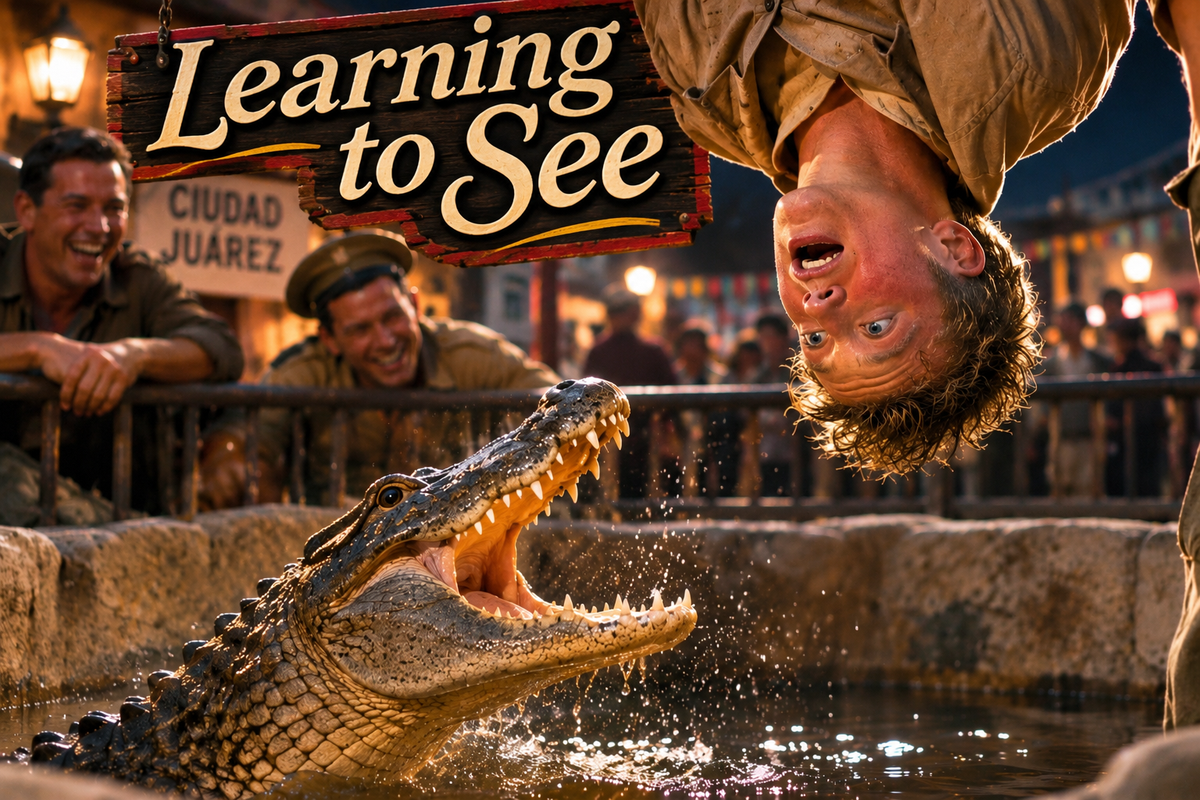
Mark recalled a large pit containing an alligator near the bridge into Juárez. It was the sort of thing a visitor might stop to stare at, wondering why anyone would keep such a creature in the middle of town. There was little reason to imagine that, before the evening was over, Mark would be seeing it from quite another angle.
After considerable drinking, Mark's companions decided he needed sobering up. Their proposed treatment was imaginative, immediate, and entirely lacking in medical justification.
They grabbed him by the legs and held him upside down over the alligator pit.
Mark was accustomed to dangerous animals. He had ridden horses determined to throw him into the next county. He knew how quickly a powerful creature could move. But dangling headfirst above an alligator was different. There was no saddle, and the men responsible for keeping him alive were in no better condition to make sensible decisions than he was.
Then the alligator jumped.
According to Mark, its jaws came within inches of his face.
His response was immediate and spectacular. He vomited all over the animal and nearly choked as the contents of his stomach collected in his nose.
The alligator's opinion of this unexpected development has not been recorded.
Mark emerged from the evening without injury, apart from a rather bruised sense of his own judgment. There was more mercy in that outcome than anyone's decisions that evening deserved. It would have been easy to blame the older men who had held him over the pit. But he had joined them willingly, trusted their decisions, and discovered how dangerous that trust could become. Facing the alligator had been frightening enough. Facing his own part in getting there required considerably more honesty.
After an evening like that, one might reasonably expect Mark's next encounter with a medical examiner to involve the consequences of his excursion into Juárez. But the Army had something altogether different in mind.
Back at Fort Bliss, Mark pursued full military service. That required a medical examination. He had already won shooting competitions and developed the steady eye of an accomplished marksman. He expected to pass.
The Army thought otherwise.
The examination revealed astigmatism in his right eye. His age may also have received closer scrutiny. On Aug. 12, 1943, just 20 days after being accepted, Mark was discharged.
For a young man who could hit a distant target and had recently seen an alligator's teeth from inches away, being told he couldn't see properly must have seemed a peculiar verdict. But the Army had discovered something he couldn't overcome simply by insisting otherwise.
Mark knew how to face danger when he could see it coming. Accepting something unwelcome about himself, without surrendering his determination, required another kind of courage.
Most of us eventually discover that seeing and understanding aren't always the same thing. We admire people who seem to know more than we do, and often we're right to learn from them. But someone else's confidence is no substitute for our own judgment. Sometimes that lesson arrives through disappointment. Occasionally, it arrives with a considerable number of teeth.
Not every door we force open was opened by God. Sometimes we discover that only after we've walked through it. But God's grace doesn't stop at the doorway. He can give us the courage to face what we'd rather not see, the humility to learn from it, and the hope to keep moving forward.
Mark's first attempt to join the Army had lasted less than three weeks. He had learned something about the judgment of others, something about his own limitations, and perhaps something about the difference between determination and wisdom.
He was disappointed, but he wasn't finished.
The Army had told him he couldn't serve.
Mark had heard them perfectly well.
He just wasn't convinced they should have the last word.
Jeff Headley is pastor of the Dayton Valley Community Church, and a storyteller who blends humor, honesty, and hope. His weekly column reflects on resilience, grace, and the surprising ways faith shows up in ordinary life. Mark King, whose adventures are recounted in this series, was his father.