King's Corner: Learning to Follow
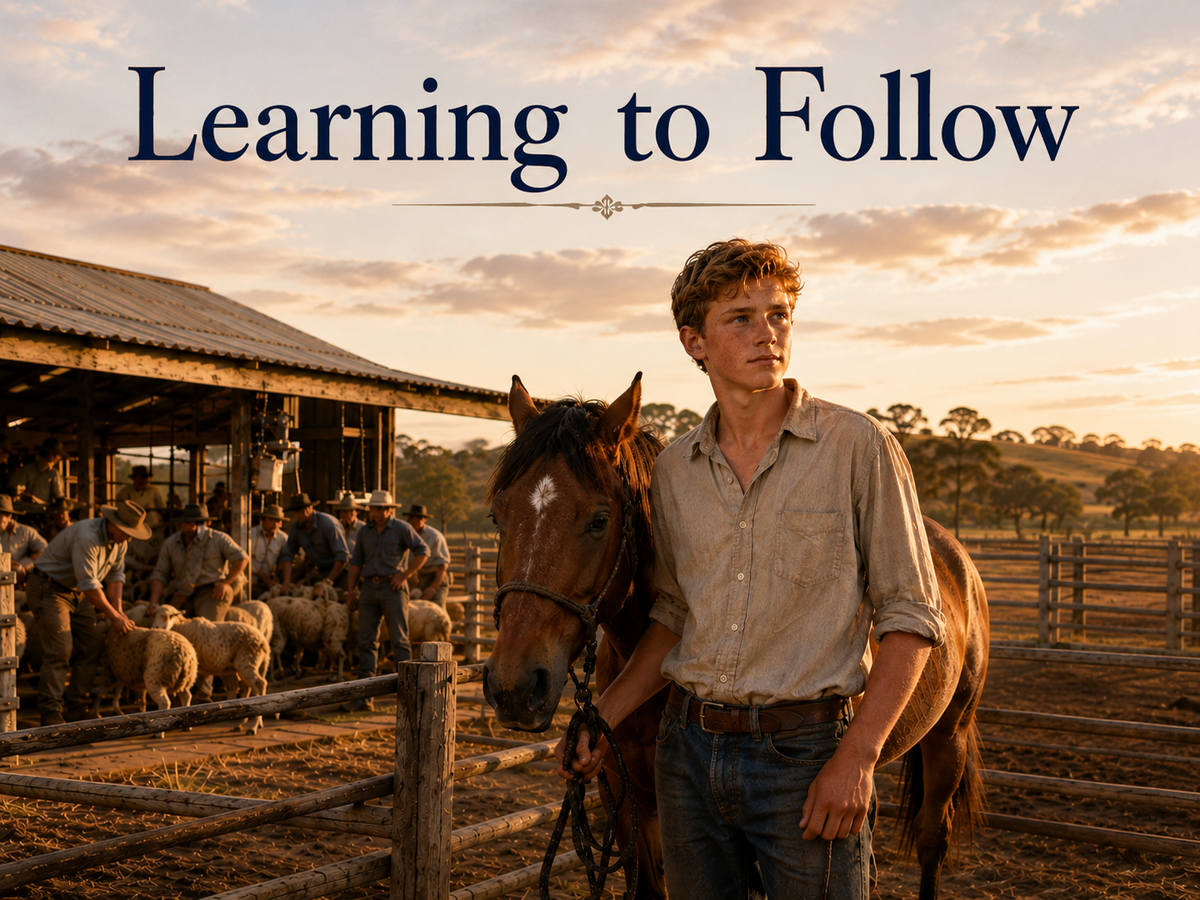
For several days, the station had been getting ready. The shearing shed, quiet for much of the year, was swept and cleared. Equipment was checked, extra food laid in, sleeping space prepared, and sheep gathered near the shed. Thirteen-year-old Mark King pitched in wherever another pair of hands was needed. Everyone knew who was coming: the shearers.
It was March 1940—autumn in Australia, another reversal of the seasons Mark had known back home. For nearly three months he had lived on this cattle and sheep station in the hills east of Perth after crossing the Pacific with a shipment of cattle. He knew the people, the horses, the routines and the jokes. Even “the Yank,” once a description of the American newcomer, had become friendly teasing. So Mark watched the road with everyone else.
Then came horses, wagons, the sound of an engine, men and equipment moving through the gate. The shearers had arrived. These crews travelled from station to station, bringing shearers, rouseabouts, a cook and their gear—and stories and news from beyond the station.
Three months earlier, Mark had been the stranger coming through that gate. This time he was one of the people welcoming the newcomers.
By the time the first sheep was pulled from a catching pen, Mark had found a place to watch. The shed roared to life. A shearer settled the animal between his legs and the mechanical handpiece began its practiced sweep. Belly wool came off first, then stroke followed stroke until the fleece fell away nearly whole. A rouseabout gathered it while the shearer was already reaching for another sheep. Sheep, shears, fleece, another sheep—the rhythm continued hour after hour.
Hand blades had largely given way to mechanical shears, just as horses and wagons increasingly shared the road with trucks. Mark never sheared a sheep. These men knew something he didn't, and that itself was worth learning. Adults trusted him with cattle and horses, but competence also meant recognizing competence in someone else. So he watched—how a shearer handled the sheep, how a rouseabout knew where to be before he was needed, how the crew worked without wasting motion.
At smoko the machines stopped, bent backs straightened, and tea and food appeared from the crew's cook. The men traded jokes, stories of other stations and news from beyond the hills. Then the machines started and the shed roared again. Even the wool connected this isolated place with a changing world. Britain was Australia's great overseas market, but Britain was now at war, and ships carrying Australian produce crossed increasingly dangerous seas. Mark's world was larger and more connected than he had imagined. Perhaps God had brought him to Australia for more than cattle.
For a week the shed thundered with activity. Then the last sheep was shorn. Equipment was packed, horses readied and goodbyes exchanged. The crew headed through the gate toward another station. The dust settled.
Mark stayed.
And God wasn't finished.
Horses were the backbone of station life, and Mark already knew how to ride them. Now one of the experienced horsemen began taking him into the training ring and teaching him something different: how to train one. After the noise and speed of the shearing shed, the training ring offered space—one horse, one trainer, and a 13-year-old boy learning to pay attention.
Some of the language came from an older world of working horses and draft animals: “gee” for right, “haw” for left, words generations had used to turn their teams. The language was old. What Mark was learning about the relationship between horse and trainer was new. A horse didn't always have to be conquered before it could be led. The trainer communicated through movement, pressure and release, watching for the smallest response and knowing when to act and when to wait.
Mark had spent a week watching men who were very good at something he had never done. Australia had taught him to watch first, listen, and recognize that someone else might know a better way. Now the lesson was becoming his own. Before Mark could lead the horse, he first had to follow the man teaching him.
Sometimes we learn to follow. Sometimes we learn to lead. Sometimes one enables the other. Mark was beginning to recognize God's hand in the people who taught him both.
The horse moved around the training ring as Mark watched from nearer the center. An ear turned toward him. Mark responded as he had been taught. Gradually the horse's attention shifted. Then Mark did something that must have seemed almost backward. He turned away. No chasing. No grabbing for a halter. He simply gave the horse room to choose.
And waited.
Mark began to walk.
Behind him came a hoofstep.
Then another.
No rope pulled the horse forward. Nothing compelled it to come. Somewhere between pressure and release, patience and trust, something had changed. The horse had chosen to follow. Horsemen have a name for that moment: joining up.
We often ask God to prepare the road ahead. Sometimes He prepares the traveler instead.
Mark couldn't know where any of this would lead. At 13, he didn't need to.
God knew.
For Mark, there was only an Australian autumn, a station that no longer felt strange, and the soft sound of a hoofstep behind him.
Then another.
He had learned to follow.
Now the horse was following him.
Jeff Headley is pastor of the Dayton Valley Community Church and a storyteller who blends humor, honesty, and hope. His weekly column reflects on resilience, grace, and the surprising ways faith shows up in ordinary life. Mark King, whose adventures are recounted in this series, was his father.