King's Corner: In the Blood
There was a time when you could keep a family secret.
Not anymore.
But the real surprise isn’t that we can now discover things. It’s that the truth seems to have been waiting for us all along.
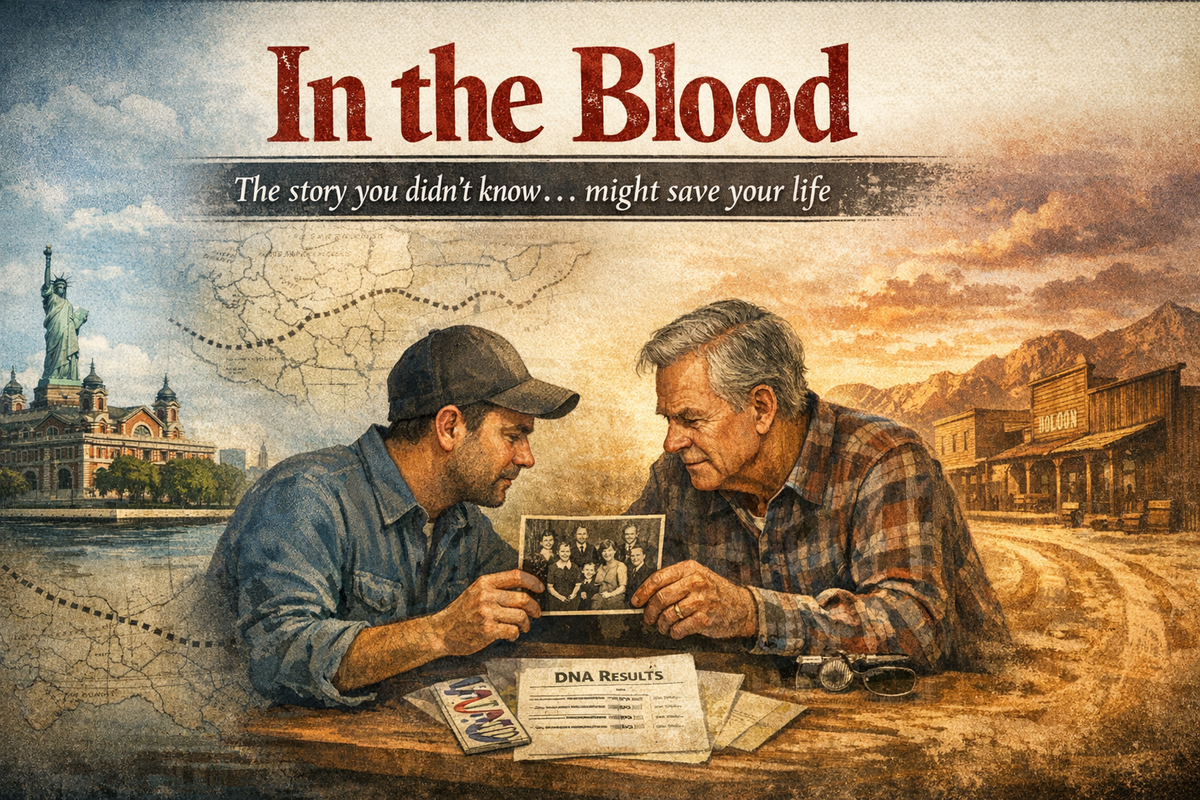
I saw that the day my dad, Mark King, looked at an old photograph.
It was one of those formal family portraits from the early 1930s—everyone posed stiffly, as if blinking might ruin the moment. A man and woman seated, four children arranged around them.
I had just received it by email from a man named Chris—a complete stranger who, according to a DNA database, was closely related to us. He lived in Morristown, New Jersey… the same town where my dad had grown up.
I opened the photo and started to explain where it had come from.
I didn’t get the chance.
Dad pointed immediately to one of the girls and said, “That’s Bertha. She used to pull me around in my little red wagon. We went to the circus together.”
He said it like identifying his own sister.
The problem was, according to the caption, her name wasn’t Bertha. It was Shirley.
I wrote back. Chris replied: “Shirley’s middle name was Bertha. She went by her middle name.”
We sent a photo of my dad as a boy with his red wagon. Chris showed it to Bertha—then over 100—and she recognized him instantly. She even remembered the circus. The main act had been Wilno, the Human Cannonball. Chris found the original poster.
Apparently, memory ages better than paperwork.
Except, of course, for the biggest question.
Why were they related?
As it turned out, unknown to either of them, Bertha was his aunt.
I always knew I was adopted.
There’s something grounding about knowing where you come from—seeing your own face echoed in someone else. When you’re adopted, that part of your story begins as a blank page.
Some people are fine with that. Others aren’t.
When I went looking, I found my birth parents and was welcomed in. My mother’s first words were, “What took you so long?”
My dad—Mark—showed up the next morning. We went to lunch and talked so long the restaurant probably considered charging us rent.
Later, we sat across from each other while the women whispered and laughed at how, despite just meeting, we had identical mannerisms.
Some things you inherit whether you know it or not.
And some you don’t know you’re missing until you find them.
My dad’s story had its own missing pieces.
His mother, Julia, was born in 1906 on a ship arriving at Ellis Island. Her mother died giving birth to her. Her father placed her with another family in New Jersey, along with enough money to ensure she was well cared for, and then disappeared.
She grew up with a different name, a different family, and no real understanding of where she came from—right there in Morristown, surrounded by people who unknowingly held pieces of her story.
The truth wasn’t hidden. It was just… waiting its turn.
As a young boy, my dad once saw documents that hinted at something unusual. He glanced at them, processed it for about five seconds, and then asked if he could go outside and play.
Which, in hindsight, may have been the healthiest response in the entire family history.
Years later, DNA filled in the gaps.
Connections appeared. Names. Relationships. Fragments stretching back further than anyone realized. Families separated, identities softened, histories rearranged—quietly, and for reasons that made sense at the time.
People weren’t trying to deceive.
They were trying to protect.
But the truth doesn’t disappear.
It waits.
And somehow, it catches up with you—whether your life stays in one place or carries you far from where it began.
And sometimes, it does more than satisfy curiosity.
It saves your life.
My dad had a form of cancer that didn’t show up in standard tests. It was discovered almost by accident—just in time.
Years later, I began having symptoms that didn’t quite make sense. Test after test showed nothing. But because of what we knew about my dad, the doctors kept looking.
On the fifth round of testing, they found it—aggressive, advanced, but still removable.
Had I not known his story, they told me, I likely wouldn’t be here.
Which is a strange thing to realize.
That discovering who you are… might be the reason you’re still alive to ask the question.
There’s a verse in Jeremiah where God asks, “Who can hide in secret places so I cannot see them?”
We’ve built remarkable tools—DNA databases, historical records—but we’re only uncovering what God already knows.
Nothing about you is hidden from Him.
Not your history.
Not your questions.
Not even the parts you don’t yet understand.
You may not uncover long-lost relatives or forgotten branches in your family tree.
But you do have a story.
There are things about you—your instincts, your longings, your strengths—that didn’t appear by accident. They have roots. They have meaning.
Some stories begin in places like Morristown…
…and unfold far from where they started.
The question is whether you’re willing to follow them.
To ask not just where you came from—but who you were meant to become.
Because the truth about your life isn’t something you create.
It’s something God already knows.
And if you’re willing to ask Him…
…He just might help you discover it.
Jeff Headley is pastor of the Dayton Valley Community Church, and a storyteller who blends humor, honesty, and hope. His weekly column reflects on resilience, grace, and the surprising ways faith shows up in ordinary life.