King's Corner: Hitting the Mark
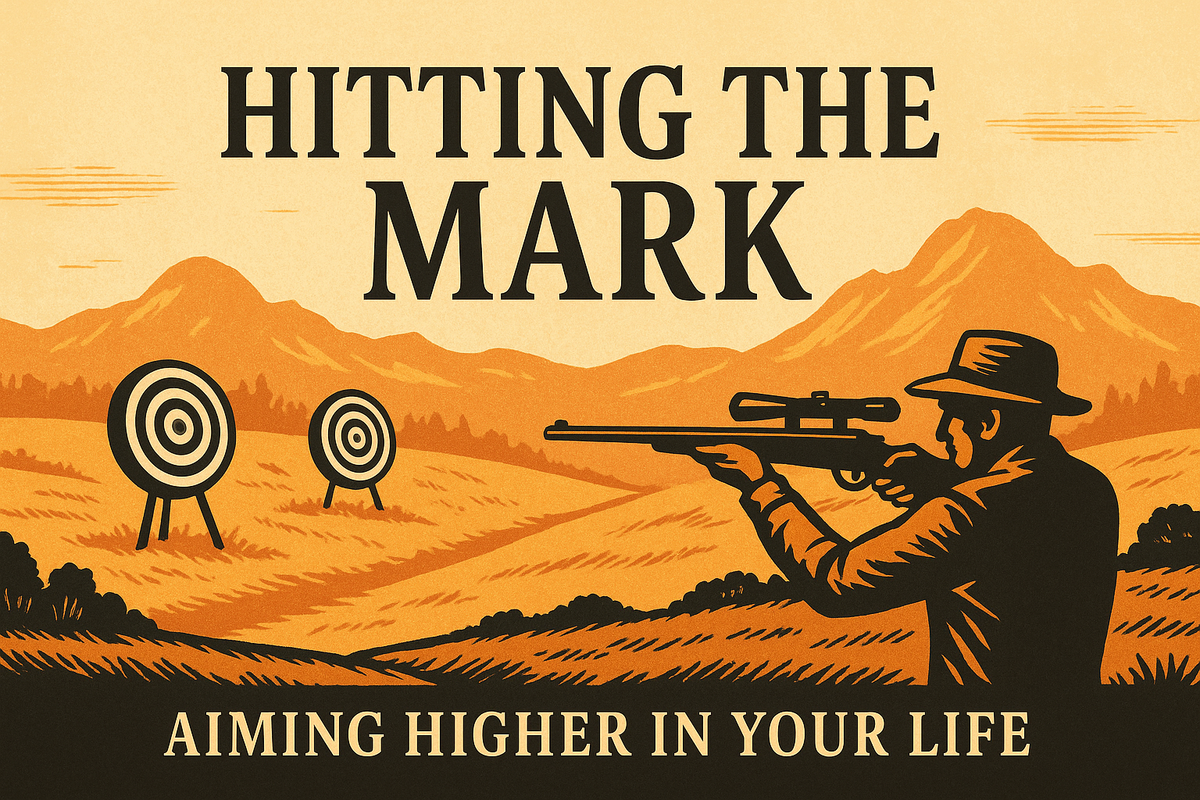
At eleven years old, my father, Mark King, moved to a farm in Wisconsin near a tribal nation. There he befriended an Indian boy his age, and the two forged a bond grounded in the purest form of childhood friendship: shooting things. Their favorite pastime was target practice with arrows and BB guns, and their competitiveness was fierce enough to qualify as an early economic system. Mark spent a small but meaningful fortune learning to fire with accuracy, but in return gained the skill and the lifelong passion that came with it.
Part of the enduring allure of the Old West is the myth of the sharpshooter — that lone figure whose ability to hit the mark conferred a kind of frontier nobility. Mark collected bolt single-shot rifles in various calibers, from weathered relics of the late 1800s to more modern pieces whose shine suggested they hadn’t yet faced hardship. He took them frequently to the shooting range, where the bullseye was not merely a target but a symbol. Precision mattered to him, not for show, but for the satisfaction of living up to his own standard.
Accuracy, of course, has always been more than a technical goal. Ancient Greeks had a word for missing the mark: hamartia, meaning “a fundamental flaw.” Ancient Hebrews used chata with the same meaning. Over time, the term became an archery word in several languages — and evolved into the word we now translate as sin.
So a missed shot, metaphorically speaking, is more than an arrow gone astray. It is the universal human condition. Mark, who occasionally attended church, practiced his resistance to “sin” in the most literal way: by putting every attempt squarely into the center of a paper target.
Aiming higher in life — in skill, character, or ambition — is never simple, but always worthwhile. It reveals what you're capable of, and forces you into the kind of growth that doesn’t happen by accident. The settlers who traveled west in the 1800s understood this. Some no doubt sought to escape trouble or create their own rules, but many others were lured by possibility itself, willing to endure the grueling work of mining towns to build a future better than the one they left behind.
Today, the best way to build your own future is still to hold a clear goal before you and work toward it with everything you’ve got. Yet even with focus and determination, most of us eventually discover we can’t do it alone. No matter how earnestly you strive not to “miss the mark,” you will likely need God’s guidance, love, forgiveness, and the renewed strength that comes from asking for help.
Mark once went deer hunting in the Sierra Nevada mountains with a friend and a group of men they barely knew, all guests of a man who owned a large stretch of rugged, wooded land. After seeing no deer on the first day, they camped along a trail. In the morning, they woke to find deer tracks circling their sleeping bags — a silent message from the deer population that they had been inspected and summarily mocked.
By late afternoon of the second day, they trudged back toward the cars, empty-handed but rich in hoofprint-based humiliation. Then, across the valley on a far hillside nearly 400 yards away, they spotted a magnificent buck grazing with the careless grace of a creature confident in its distance. A debate erupted over whether such a shot was even possible.
Mark, in a mischievous mood, volunteered himself. The group immediately challenged him. He sprawled dramatically across the hood of his car, adjusted his rifle and scope with deliberate ceremony, and even asked where they’d like the deer hit. Someone offered, with questionable kindness, “the right eye.” Mark nodded with mock seriousness — and then aimed two or three feet above the deer, intending only to send it running.
He fired. The deer fell.
The silence that followed was almost theological.
A young man was dispatched to cross the valley and confirm what surely could not be true. Nearly an hour later, exhausted, he returned. They asked where the deer had been hit.
“In the left eye,” he reported.
Mark blinked once and replied, “Well, my right eye was his left eye — easy mistake.”
The group stared at him in wordless contemplation, then quietly began loading the cars. The landowner suggested he'd retrieve the deer himself later. Mark’s friend leaned over and murmured with a grin, “We’re not getting invited back.”
Sometimes, by pure grace or good fortune, we avoid “missing the mark.” But more often, we need help — from friends, from God, from anyone who can steady our aim. Still, the pursuit itself matters. To aim for the higher mark, to become the marksman of your own life story, is a worthy endeavor. And asking God about the times you’ve missed, and how He can help you aim true, may be the very thing that guides you to the center of your life’s purpose.
Jeff Headley is pastor of the Dayton Valley Community Church, and a storyteller who blends humor, honesty, and hope. His weekly column reflects on resilience, grace, and the surprising ways faith shows up in ordinary life.