Book Review: The Sasquatch Hunter's Field Guide

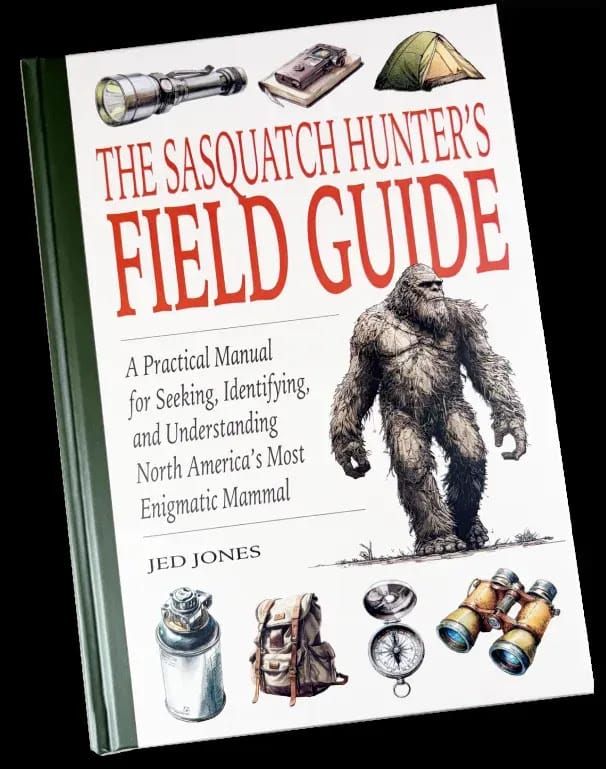
I had no more notion of hunting the hairy mountain man than a fisherman has of climbing Sun Mountain, yet the moment that hardback volume arrived from Utah—freighted with 11 full-color chapters and a price tag of exactly twenty-four dollars and ninety-five cents—I felt the old fever rise in me like the spring rise of the river.
It is titled "The Sasquatch Hunter's Field Guide: A Practical Manual for Seeking, Identifying and Understanding North America's Most Enigmatic Mammal" (at huntingsquatch.com), and written by Jed Jones. The book announced itself with solemn dignity: skeleton comparisons, muscle structure, facial proportions, habitat, tracks, and field technique.
It took the question seriously. That was its first and greatest crime.
I sat down in the shade of my porch and opened it with the reverence a man ordinarily reserves for a new deck of cards or a bottle of whiskey. Chapter One presented the Sasquatch skeleton laid out beside a human one, as if the two creatures had agreed to pose for a family portrait.
The differences come marked with arrows and Latin names that would choke a horse. I studied them carefully.
The creature’s arm bones looked long enough to scratch its ankles without bending, and its foot bones suggested a fellow who could stomp a bear into jelly and still have energy left for a square dance. I nodded wisely, as if I had known this all along.
Chapter Two dealt with muscle structure. Here the author grew lyrical.
The Sasquatch, it seemed, is made of sinews that could pull up oak trees by the roots and then use the same arms to pick blackberries without bruising a single one. I practiced the recommended field technique of flexing my own modest biceps in front of a looking-glass.
The glass remained unimpressed. When compared to the diagrams, my muscles resembled a pair of underfed earthworms that had given up hope.
Facial proportions occupied a chapter of their own. The nose was broad, the brow heavy, the jaw capable of cracking walnuts or a skeptic's skull.
I spent half an hour adjusting my expression in the mirror until I achieved a look of profound stupidity mixed with mild ferocity. My dog, Buddy, took one glance and hid under the bed. I considered it a promising start.
Tracks received the full scientific treatment—depth, stride, toe spread, and the subtle difference between a genuine print and one left by a practical joker wearing oversized boots. The book advised the hunter to carry a ruler, a camera, and a calm disposition.
I possess none of these items in working order. My ruler is warped, my camera hasn't seen film since the last administration, and my friends describe me as “volatile,” and “a public nuisance.”
Habitat chapters say the beast prefers remote forests, dense underbrush, and places where the nearest saloon is a two-day walk. This struck me as the most sensible arrangement yet described. Any creature smart enough to stay clear of civilization deserved respect.
By the time I reached the final chapter on field technique—how to sit motionless for six hours, how to distinguish a genuine howl from the wind in the pines, how to remain unafraid when something eight feet tall steps out from behind a fir tree—I had grown fond of the whole enterprise. Twenty-four dollars and ninety-five cents bought me not only 11 illustrated lectures but a first-rate education in how far a person will go to believe in something larger, hairier, and more elusive than himself.
I closed the book, patted its cover, and decided the only rational course was to keep it on the shelf as a warning to others. Should any neighbor inquire about the Sasquatch, I shall lend him the volume at once.
Let him study the skeleton comparisons and the facial proportions. Let him practice the field techniques. And when he returns empty-handed, as he surely will, we can sit together and congratulate ourselves on having spent our time and money wisely on a mystery that prefers to remain unsolved.
After all, a world without a few large, hairy questions left unanswered would be a dull place indeed—and far too expensive for the likes of me.