A Boom Town Searching for a County

No doubt most of you who have read my dispatches to the Comstock Chronicle over the years will recognize the name, Tinker Moss. Tinker is an old friend of mine, which is to say I have known him long enough to recognize the particular expression he wears when he's discovered an idea that will either make him rich or require the sheriff.
A couple of years ago he left the Comstock and settled for a while in Verdi, where, I presume, he was waiting for civilization to catch up with him. It never did. Last Friday he invited me to come along and see his latest venture, and I went because curiosity is one of the few diseases which has no respectable cure.
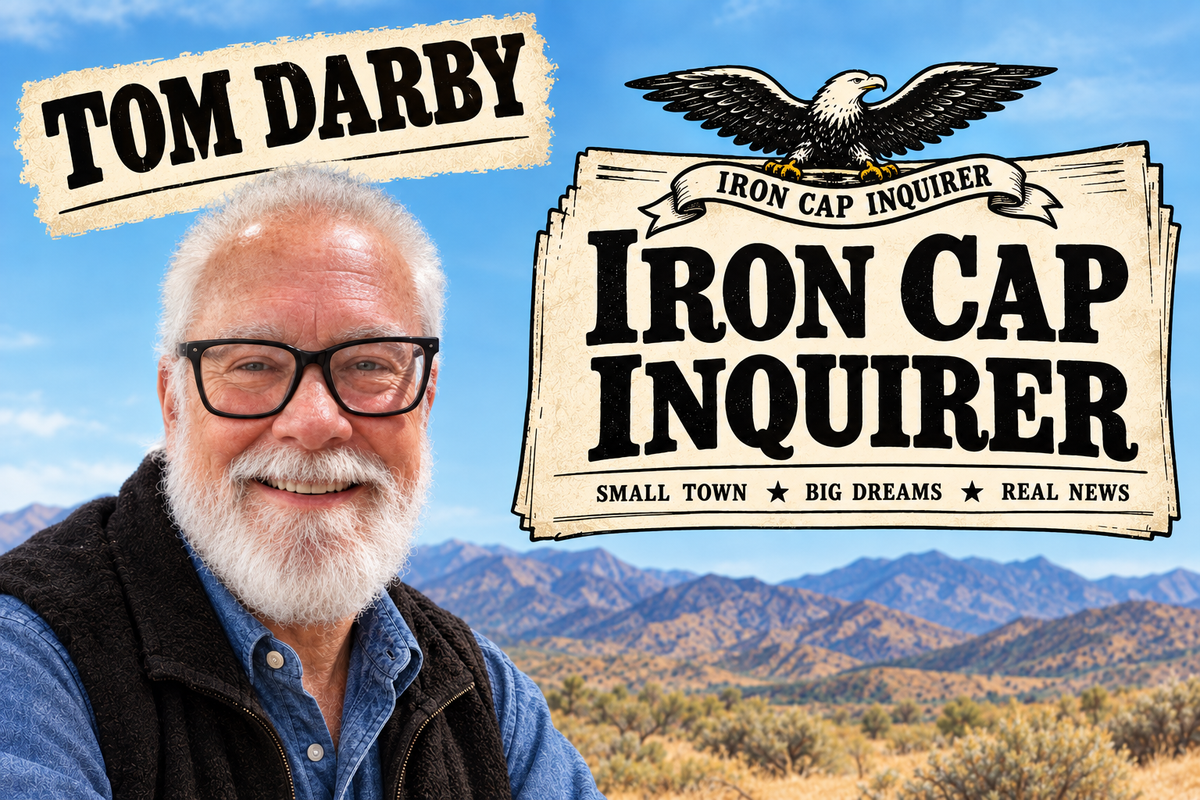
Tinker had become Mayor-Pro-Tem of a new boom town called Iron Cap, and he wanted me to come out and witness the beginning of what he assured me would become a settlement of consequence. He also wanted me to help establish a newspaper, which he had already named the Iron Cap Inquirer.
I should have known then that the town was serious. A man may build a town without a church, a courthouse, a bank, a jail, or even a reliable water supply, but should he have a newspaper, civilization is clearly only a few editorial columns away.
I followed Tinker’s little off-road machine into the wilderness at a speed that suggested either he knew precisely where he was going or had become too embarrassed to admit he did not. After some time we arrived at what he announced was Iron Cap.
I looked around. There were three small travel trailers, two large tents, and a wooden structure which appeared to have been constructed from two store-bought storage sheds that had been persuaded, under considerable pressure, to become one building.
Tinker surveyed the place with the pride of a man beholding Rome after the fire.
“See?” he said. “A perfect boom town.”
“No, it’s not perfect.”
He looked at me with the wounded expression of a mayor whose zoning board had just insulted his mother.
“Why do you say that?”
“You don’t have a church, or a saloon, or ladies of the night.”
From somewhere behind us came the voice of his brother-in-law, George.
“Told you so!”
That was my introduction to the municipal government of Iron Cap.
Tinker and George then escorted me approximately a hundred yards from what they called Main Street. Main Street, as I recall, was a patch of ground between two trailers where three men could stand without getting in one another’s way.
Beyond it stood a drilling rig, and here I discovered the true reason for the town’s existence. They were looking for gold.
Iron Cap, I was told, referred to what geologists call gossan, a weathered, rusty-red, orange, or yellow-brown rock that may occur at the surface above an underground ore deposit. I immediately felt we were getting into technical territory, so I resolved to nod intelligently whenever anybody used a word containing more than three syllables.
Three men were working around the drill site, all trained geologists, which made me feel inferior almost immediately. They had come searching for lithium and, in the ancient tradition of prospectors everywhere, had discovered something they had not been looking for.
In this case, they had found a gold vein. The men showed me several holes they had drilled into the earth.
There were six of them, deep enough to make me wonder whether they intended to find gold or Australia. Tailings lay beside the holes, and the geologists explained that they were measuring the mineral content against the surrounding material to determine whether the deposit might be worth pursuing and whether a claim could eventually be established.
Then they gave me the numbers. One of them said something about 0.67 million ounces of gold at an average grade of 4.88 grams per ton.
I listened carefully, looked at the holes, then the rocks, and finally back at the geologists. It occurred to me that I had been transported to a foreign country in which the official language was arithmetic.
They might as well have been explaining Egyptian hieroglyphics to me. I knew gold when I saw it, and I knew dirt when I saw it, but the difference between promising dirt and disappointing dirt seemed a matter best left to men who possessed degrees.
I withdrew from the geological conference before somebody asked me to calculate something.
Back at the settlement, Tinker offered me coffee. This was a dangerous proposition, for George had apparently been assigned the coffee-making duties.
I had already learned that George could not brew a pot of coffee to save his soul. It was either too strong or too weak, but it was always hot, which demonstrated that he had at least mastered the temperature.
Tinker then produced the proposed first edition of the Iron Cap Inquirer. It was handwritten on a sheet of paper beneath a drawing of an eagle clutching what appeared to be a wide ribbon. On the ribbon, the words “Iron Cap Inquirer” were written in a hand that suggested the eagle had been holding the pen.
The first article concerned Eugene, one of the geologists, who had burned his fingers while cooking bacon. The injury was visible, but Eugene continued preparing breakfast with the determination of a man who understood that geological exploration could wait but bacon could not. I considered this a sound editorial policy.
The second article, which I consider a piece of investigative journalism, focused on George and his coffee-making skills. George could produce coffee of extraordinary strength or astonishing weakness, but never at the expense of heat. The man had apparently established a personal treaty with boiling water and was unwilling to violate it.
The third article concerned the county, and this was where matters became genuinely complicated.
It appeared that the five men, the population of Iron Cap, were unsure which county they operated in. Tinker thought it might be Washoe.
Someone else had suggested Pershing. Humboldt had also been mentioned.
The founding fathers therefore concluded that until they determined where they were, they would have to continue establishing the settlement. Make it sufficiently robust that no governmental agency could easily come along and interfere with their operations.
I told Tinker I did not know if I could do any better.
“Each paragraph is to the point,” I said. “All the words are spelled correctly, and every period is in its place.”
“Good,” he said. “Then you’ll do it?”
I did not answer.
I finished my coffee. It tasted perfectly good to me, which meant either George had improved or I had survived long enough to become accustomed to it.
I suggested I unload my cot and sleeping bag. I spent the night in one of the sheds.
By morning I discovered the shed served as general store, bartering center, meeting hall, bunkhouse, newsroom, and, presumably, city hall whenever the mayor was not out looking for the county line. It was the most efficient government building I had ever encountered, largely because there was not enough room inside for anybody to form a committee.
Before leaving, I agreed to help produce the Iron Cap Inquirer. I will do the work from the comfort of my study and transmit the finished product by computer each Friday evening, provided somebody sends me something to write about. If nobody sends anything, I shall lie through my teeth.
This is not an unusual practice in journalism, though most newspapers have the decency to give it a more respectable name. Along with the warning towards outlandish whoppers and that, if circumstances permit, I might even discover some ingenious method of cheating them out of their profits.
They accepted the offer with handshakes all around. Thus I am the newest employee-pro-tem of a newspaper serving a town whose population may contain more geologists than citizens, whose general store is also its bunkhouse, whose coffee is always hot, whose bacon has already drawn blood, whose mayor does not know what county he governs in, and whose principal industry is digging holes in the ground in the hope that somebody else will eventually explain what is in them.
Iron Cap may become the next great Nevada boom town. Or it may not.
But I have learned one thing with certainty: if gold is found, they will know it. And when the county is found, I expect they will know that eventually, too.
And if the Iron Cap Inquirer fails, I shall report that an eagle stole it. Mark Twain could do no worse.