King's Corner: A Fireside Chat
King's Corner column for June 6, 2025
Some holidays are unmissable. On either Thanksgiving or Christmas you’ll probably set aside time to be with family. You may even attend church at Christmas to watch kids in shepherd outfits act out the scene where Christ was born in a manger. For some, their other Sunday morning visit is Easter where they can join the faithful in celebrating that Christ is risen from the dead. But even the faithful often miss the faith’s other major day: Pentecost. The holiday that isn’t.
Perhaps surprisingly, it’s originally a Jewish holiday, as the name – meaning ‘fiftieth’ in Hebrew – counts the number of days after the Passover. It also celebrated an event that occurred every fiftieth year, called The Jubilee, in which everyone more or less took the year off work. Imagine, one year in your whole lifetime where you can stop the tedium or madness of everyday demands, and instead reflect on your life, your blessings, your challenges and your future. If not a year then maybe just one day, one holy day.
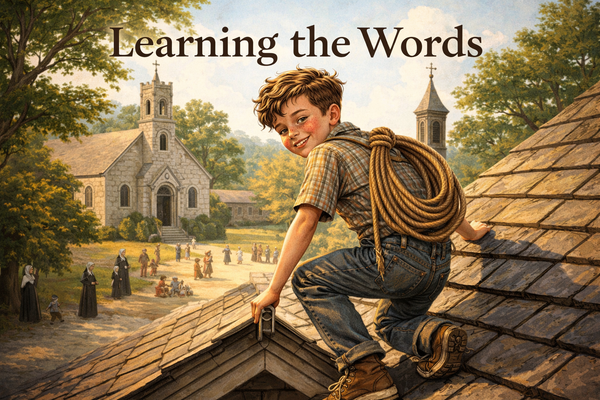
My dad, Mark King, left home at thirteen to build a life working out west: harvest time in South Dakota, mustering cattle in Wyoming, teaching horseback riding at a ‘dude ranch’ within Yellowstone, and generally keeping busy in the saddle. But work wasn’t always available, especially in the ‘off’ season, and he took what he could get. One unusual job offered extra pay to offset its unusual requirements. For almost six months of the snowy season he was to live in an isolated cabin by himself, and regularly ride the fence line in that region to find and repair any damage.
The terms were strict. No one else was to be there, and he wasn’t to leave except to check the fences. Supplies would be delivered once every three weeks, and he needed to make sure they lasted. No radio – no power – but they’d bring mail if he had any. He was also to deal with any predators threatening the stock. Otherwise, lots of spare time if the cattle stayed safely enclosed.
As he rode up there to start his role, he came by a schoolhouse that was just starting its new year. They had all new books, and were getting rid of old ones. Mark bought every book that was available and almost overloaded his horse. He’d have time for reading in coming months.
Some winter weeks he had to dig a tunnel through the snow piled at his door to have any hope of getting out. A few times he had to rebuild sections of fence when he could barely feel his fingers. But in-between there was a lot of time to discover different places and times in books.
Years later he could still recite Runyard Kipling’s stories and especially his poem “If” which emphasizes resilience, risk-taking, and the willpower to continue even when there’s nothing left. He could quote Hamlet’s “To be, or not to be…” at length. He read the Bible cover-to-cover in the King James English, with its many classic passages featuring “thee” and “thou”. And he read about worlds he could only dream of visiting. Then he would so entertain his once-every-three-week visitors that they began to bring him more books.
He'd only completed fifth grade, but without realizing it he acquired both an education and a sense of purpose. Soon after that WWII recruited him, but upon his return to the states he took an education test. Not only was he credited with finishing high school, but also enough college that he could apply to – and be approved for – medical school. Not bad for a ranch hand who self-taught his way out of isolation and loneliness, through nights where there was nothing but “a fire close by, stars in a crystal clear sky, and plenty of time to talk with God.”
This time of reflection is what the Hebrew tradition intended with its once-every-fifty-years Jubilee year, to have a time to stop and begin anew. This is also what they meant with their annual festival fifty days after Passover to celebrate “the first fruits of the wheat harvest” that ensured ample supplies for winter.
And that celebration took on a whole new meaning after Jesus Christ’s crucifixion when some of the hundreds of people who’d seen him alive afterwards were now celebrating this traditional holiday. A roaring wind brought “tongues of fire” that separated and settled on each of them. Visitors from many cultures heard their native languages being spoken. Locals teased all of them that they’d had too much to drink. But over three thousand chose to be baptized that day, believing God was doing something new with them.
You’d think that a day this important historically would be a public holiday. But not all ‘holy days’ are meant for public celebration. Some, more importantly, are meant for that even more rare moment of personal reflection. Whether you have months, weeks, a day or just a moment, can you use that to discover – or re-discover – who you could become through personal faith and personal growth? Can you remember your dreams of who you’ve always believed you could be?
Can you let that fire burn in you, then set aside the time to gaze upward and have that long uninterrupted chat?